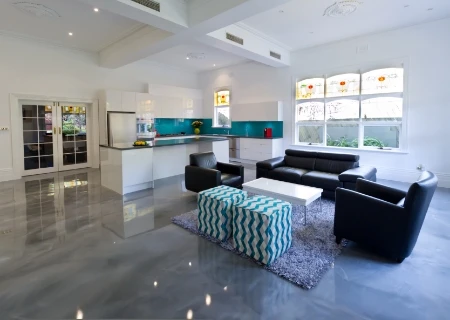

Imagine walking into a space that looks slick, professional, and ultra-durable, a floor that gleams under your feet, resists stains and chemicals, and stands strong year after year.
That is the promise of epoxy flooring. But once the moment arrives to turn that dream into brick, siding, and concrete, there are many decisions to make. The most significant of those is: Do you do it yourself or hire it out?
In Australia today, an ever-increasing number of Aussies are looking on to Google for “epoxy flooring contractors” and “epoxy floor installers near me”, with more and more homeowners discovering the advantages offered through epoxy coatings for garages, sheds, basements, commercial spaces, as well as unconventional living areas.
But before you click that “add to cart” button on the DIY epoxy kit from Amazon or race to finish your own floor with epoxy, let’s unpack what actually wins: the DIY job versus professional flooring installation.
Why This Decision Matters
Epoxy flooring isn’t a surface it’s an investment that transforms your space and protects the substrate. Flexible A properly applied epoxy floor will be able to:
- Durable against heavy foot traffic, chemicals, tire wear and moisture.
- Increase the value of your home or business.
- Provide a long life with minimal maintenance.
But all of those benefits hinge almost entirely on the quality of the floor installation.
“But that’s where the debate begins: Do you do it yourself type kits promise savings and ‘easy’ weekend project, or hand it over to a professional installer for longevity, durability, clean finishes and warranties.
Here, we break down both sides so you can figure out what makes sense for your space and budget.
DIY Epoxy Flooring: What You’re Really Signing Up For
DIY epoxy kits are booming, especially with tutorials that make it look easy.
Here’s what the D.I.Y. path gives you:
Lower Upfront Costs
The DIY kits are a fraction of the cost of professional installation. You could pay several hundred dollars for materials and that’s just part of the true cost.
Flexible Scheduling
No more booking installers or waiting for availability. You decide when to begin, usually sometime during a weekend.
Sense of Accomplishment
For do-it-yourselfers, seeing the job through to completion can be satisfying particularly if the area in question is small and nonessential.
The Hidden Challenges of DIY Epoxy Flooring
Surface Prep Is Harder Than It Looks
Before epoxy will adhere to concrete, the substrate must be prepared mechanically and not just swept or lightly sanded. Skipping or insufficient prep results in poor adhesion, bubblegum like bubbles and later peeling.
DIY Materials Are Often Lower Quality
From home centers, you’re buying an underdosed watered-down formula with too few solids and thin coatings that scratch easily and can’t handle heavy use.
Time and Skill Required
Once you’ve mixed it together, epoxy has a very short working time, so that means working quickly and accurately. And screw up your mixing ratios or your environment (heat/humidity), and you end up with a crappy finish.
No Warranty or Insurance
If something messes up bubbles, cracks, or peeling, you’re out of luck. If it is professionally installed, there is usually a warranty and professional assistance too.
Professional Epoxy Flooring Installation: Why Pros Deliver Better Results
Anyway, let’s see what you get when you hire professional epoxy floor installers:
Industrial-Grade Materials & Techniques
Installed by professional applicators, high-solids resins and quality pigments work together to create a product that will look great and perform for decades with superior chemical and UV resistance.
Thorough Surface Preparation
Pros don’t just sand lightly; they use diamond grinders and shot blasting to mechanically profile the floor, removing contaminants and promoting deep epoxy bonding.
Fast, Efficient, and Clean
A pro team can generally knock out most garage or residential installs in a day or two – providing less downtime, quicker curing and better finishing.
Guaranteed Results
By hiring professional installers, you’re buying not only labour, but peace of mind. Warranties and service options ensure you’re not having to be a mechanic down the road.
Quick Side-by-Side: DIY vs Professional Epoxy Flooring
| Feature | DIY Epoxy Kits | Professional Installation |
| Upfront Cost | Lower | Higher |
| Durability | 1–3 years typical | 8–20+ years withthe correct system |
| Surface Preparation Quality | Minimal | Industrial-grade mechanical prep |
| Finish Quality | Uneven, prone to bubbles/peeling | Smooth, glossy, highly consistent |
| Warranty/Support | None | Often included |
| Time Investment | Multiple weekends | 1–2 days |
| Complexity & Risk | High | Low |
How to Decide What’s Right for You
Comparing DIY epoxy flooring to hiring professional epoxy flooring contractors is about more than the price. Rather, it’s about how the space will be used, for how long you want a floor to last and how much risk you’re willing to assume.
Analyse What Is Needed and How the Space Is Used
Low-traffic applications, such as small storage rooms, might get by with a DIY epoxy coating, but garages, workshops and commercial spaces can take daily abuse from vehicles going in and out; tools being dropped or moved around on the floor; and typical spills. These are high-use areas that require more durable coatings and proper bonding treatments that professional epoxy floor installers near you can provide.
Consider the Finish You Want
Epoxy flooring shows every mistake. Many do-it-yourself kits have uneven coverage, roller marks, or bubbles. Professionals care about consistency, smoothness and a floor that maintains its visual appeal for the long haul, especially if the floor is visible or adds value to your real estate.
Be Honest About Prep and Time
Surface prep is the soul of epoxy floors, and it’s also the most difficult. Without the appropriate type of machine used for grinding, you won't be able to properly pre-bond the epoxy. DIY projects typically run long, over several weekends; the pros knock them out in a day or two.
Weigh Risk vs Peace of Mind
DIY epoxy is all on you, so the risk is yours to take. Problems such as peeling or premature failure can arise from temperature, mixing errors or bad prep. Professional installers also diminish that risk and can provide warranties on their work.
Look Beyond the Upfront Cost
DIY tools can do the job for less, but floors that fail prematurely are costly to repair. Commercial epoxy floors tend to last longer, hold up better, and can offer better value for a while.
Conclusion
As it relates to epoxy floors, choosing whether to do a DIY or professional job is about how much you truly value the finished project. DIY kits can be tempting for budget-focused projects, but they risk and limitations come to light quickly in the real world.
Quality epoxy flooring contractors can turn out a finish that looks nicer and lasts longer, and which won’t have you worrying about any of the negative issues cited in this article. If your home is something you take pride in, whether it be the garage, workshop or a storefront space, typically paying for a professional install is worthwhile.
Ready to transform your floors? Reach out to trusted epoxy floor installers near me and get a quote. Quality floors start with quality professionals. Don’t settle for anything less. |
FAQs
- Why do they say DIY costs more in the long run?
Doing it yourself can seem cheaper up front, but mistakes (and waste) of materials, lack of or inadequate preparation and shorter overall life often make for an early cost to do over again that exceeds a pro job in most cases.
- Can I do the prep myself and hire a pro for the pour?
You can, but pro installers often like to do their own prep so they can ensure adhesion and because they don’t want to be responsible for issues incurred from improper surface work. Communication with your contractor is essential.
- What is the lifespan of professional epoxy flooring?
Commercial-grade epoxy floors can last up to 10–20 years if properly maintained.
- Is it safe to use a DIY epoxy kit inside?
Epoxy fumes are generated during the curing process. Unventilated and without protective gear, it can be uncomfortable or hazardous. Ventilation, safety gear, all managed by pros.
- When Can I Walk On The Floor After Installation?
Professional installs can frequently dry fast; certain finishes will be walk-ready after 24 hours. Home improvement kits also can take longer to cure.
- Do professionals provide the customer with custom colours or finishes?
Yes! Reputable installers can also offer a variety of color options, or flake sizes, and even protective topcoats to help match any design aesthetic.























Sign in to leave a comment.