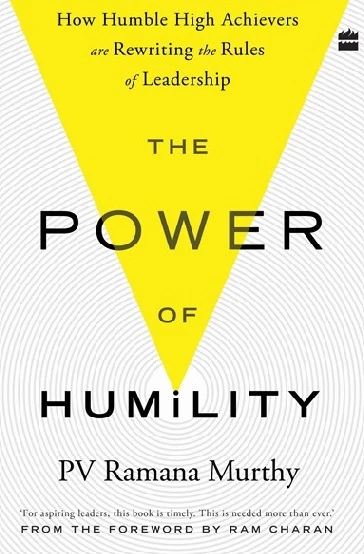

Do leaders who are modest produce better workers? After years of investigation, a new book provides a solution. Is there a connection between modesty and success? Are leaders naturally humble or is it a learned quality? Can leaders who are modest motivate their teams to work harder? Is leaders' humility a reflection of their frailty or their strength?
A biblical excerpt from PV Ramana Murthy's book "The Power of Humility: How Humble High Achievers Are Rewriting the Laws of Leadership," available from Harper Collins. Online book buys are also an option.
Plot
We all have some knowledge of thankfulness. Both philosophers and our contemporary lifestyle gurus have written about it. We have even read that it can calm us down and move mountains. There is no escaping the emotional roller coaster we experience when reading about or seeing the "success" and "happiness" of others in the world we live in, however, as it is dominated by social media platforms that shape our responses. These negative emotions include resentment, bitterness, hatred, and jealousy-driven competition. Despite our best efforts, we too contribute to the dog-eat-dog mentality, and one-upmanship, and live with exaggerated views of our superior value. It is challenging to slow down and show people thankfulness since this "softer" aspect of being appreciative gets lost in the hustle and bustle of our busy lives and remains a difficult philosophical reaction to put into reality. Of course, there are some exceptions, but they are uncommon.
After all, being grateful is more than just saying "thank you" a few times during the day out of politeness. It goes far deeper than that; it is an expression of gratitude for someone or something that makes both the giver and the recipient feel better for the rest of their lives.
"Gratitude is an emotion that roots us and is a terrific method to balance out the negative outlook that uncertainty engenders," writes Dr. Guy Winch in his book Emotional First Aid. Dopamine and serotonin are two chemicals that help us feel lighter and happier when we show our thanks.
Hence, feeling thankful is an emotional state of mind that serves as a reminder to people of how far they have gone and how far they still have to go. It is influenced by the affective-cognitive drivers of humble leaders. It also serves as a reminder of the efforts and assistance of others who have helped them succeed so far and who may be able to advance them both personally and professionally.
Gratitude, in essence, is a social feeling that expresses our acknowledgment of what others have done for us. This characteristic keeps modest leaders rooted and grounded. It also operates differently: leaders who have humility at their heart see the value of others' contributions, no matter how tiny, and encourage others to show their appreciation. Whether it takes the shape of a grin, a pat on the shoulder, or words of gratitude, the recipient may sense the leader's sincere good intentions. As a result, showing gratitude transforms into a method of communication that can influence even the most stubborn individuals and create positive momentum.
In contrast, persons who lack humility are caught in a vicious cycle of negativity, fueled by sentiments of conceit, jealousy, cynicism, and narcissism. Everyone can see the outcome: untruthful behavior that bursts out of a superficial bubble.
It's not that modest leaders never feel these unpleasant feelings. They do, but because of their attention to others, far less so. They prioritize others before themselves, as we covered in the earlier chapters. Because of their intrinsic humility, they can see things from a perspective other than their own, which makes it easier for them to be grateful for whatever contribution others make. Gratitude serves to bring people together, which in turn benefits everyone's emotional health. In the introduction of The Psychology of Gratitude, author and philosopher Robert C. Solomon stated that "being able to express appreciation is not simply a virtue but part and parcel of the happy existence. It is a means to better one's life as well as a display of humility and debt acknowledgment.
More thankful individuals were generally "happier, more pleased with their life, less materialistic, and less prone to suffer from burnout," according to Summer Allen's white paper for the John Templeton Foundation. The author of "The Science of Gratitude" states in another place that it's "possible that more grateful parents are more likely to observe gratitude in their children because they are more attuned to it - this study may also suggest that parents can succeed in attempts to socialize their children to be more grateful."
President and managing director of Bosch India, Soumitra Bhattacharya, states it concisely and provides his example of how parents instill values and good emotions in their children, such as appreciation. As I reflect, I have to consider my journey. And during my journey, I was really lucky to have certain very fundamental traits that my parents unintentionally instilled in me, stated Bhattacharya. "I discovered such ideals via thinking, particularly because they were not imparted to me directly."
The key term here is "ingrained," since modest leaders naturally show their thanks both in their words and in their deeds. They feel satisfied because of their feeling of gratitude, their awareness that circumstances could have been worse, and their innate awareness of the fleeting nature of power and authority. A happy individual also doesn't have many complaints.
Christopher Littlefield, a TEDx speaker, and international speaker writes in his article "Use Gratitude to Counter Stress and Uncertainty" for Harvard Business Review that "nearly a decade of research by Dr. Robert Emmons, the world's leading scientific expert on gratitude, and others has found that people who have regular gratitude practices are healthier, happier, and have better relationships." Further study indicates that persistence in difficult activities is facilitated by feeling grateful.




















Sign in to leave a comment.