
Customer Relationship Management (CRM) is at a tipping point. As we move into 2025 and beyond, Salesforce Managed Services are reshaping how businesses in Australia and around the world manage relationships, drive growth, and stay competitive. If you’re considering how to future-proof your CRM strategy—especially with a Salesforce Managed Services Partner—this guide will spotlight the trends you can’t ignore.
Why CRM and Salesforce Managed Services Matter
Let's simplify: CRM is the foundation of deep and lasting customer relationships, not just software. But as Salesforce grows more powerful (with AI, automation, and global compliance built in), keeping your system in tune is harder than ever. That’s where partnering with a Salesforce Managed Services Partner becomes the secret weapon for agility.
Real-life Scenario
Imagine an Australian retailer who went live with Salesforce in 2023. By 2024, new clouds, AI features, and integration needs left their internal team overwhelmed. Bringing a dedicated managed services partner on board meant they could adopt new tech, automate campaigns, and build personalized experiences—without hiring a whole new IT team.
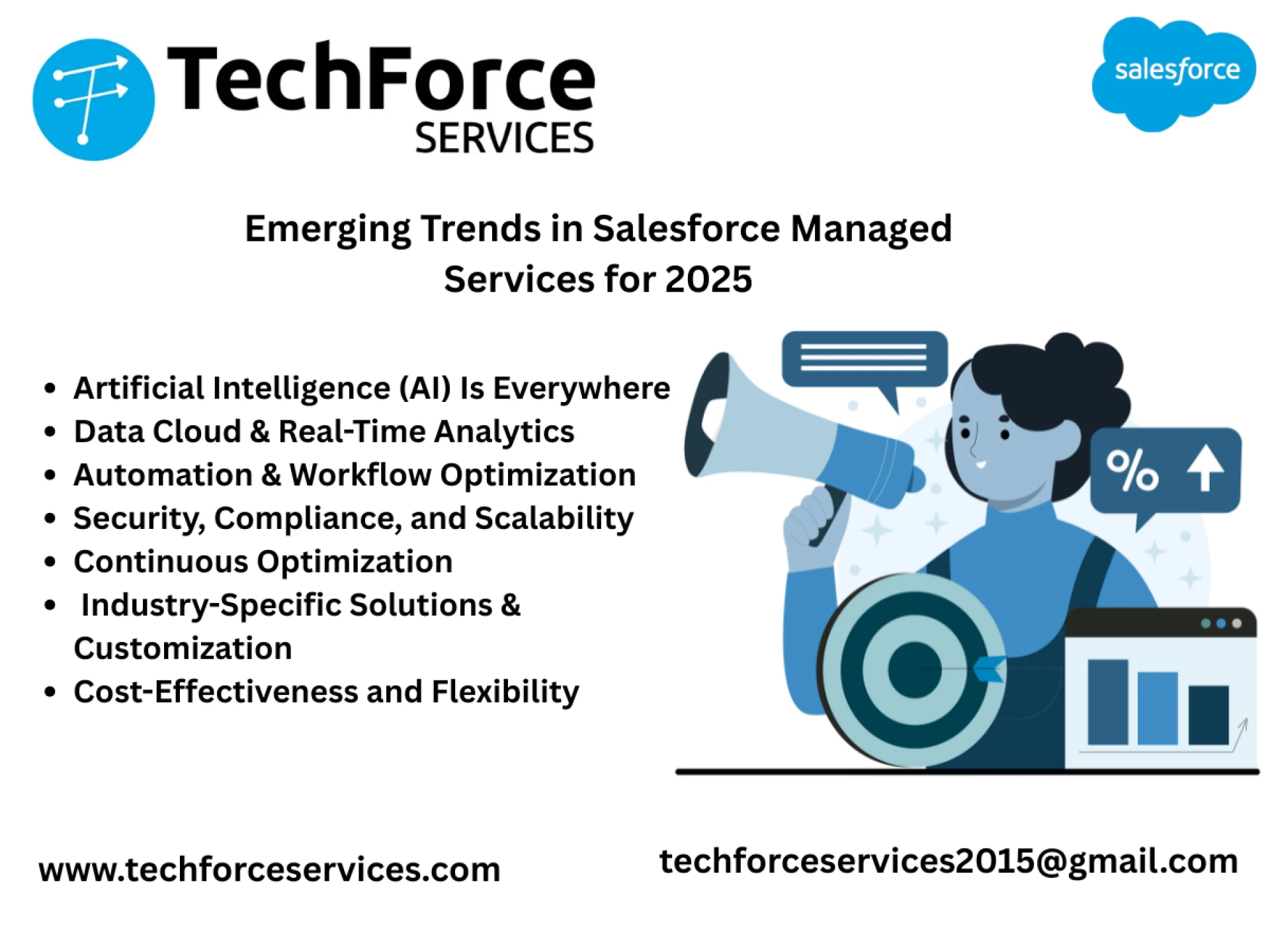
Emerging Trends in Salesforce Managed Services for 2025
1. Artificial Intelligence (AI) Is Everywhere
The most seismic shift? AI’s move from buzzword to business driver. Salesforce’s new Agentforce and Einstein GPT tools now automate tasks, predict customer needs, and recommend actions in real time. Managed service partners help organizations:
- Set up AI-driven lead scoring and forecasting,
- Use chatbots and Copilot for faster, smarter customer support.
- Ensure AI is compliant and ethical.
A managed services partner’s expertise takes the guesswork out of adopting and governing these tools for your unique environment.
2. Data Cloud & Real-Time Analytics
With so much data flowing between systems, businesses need to make sense of information as it happens. Managed Services Partners integrate Salesforce Data Cloud and Data Analytics—for real-time, 360° customer views. This enables hyper-personalization and smarter campaigns, while partners manage security, integration, and deduplication behind the scenes.
Real-life: Think about a healthcare company syncing patient data, call center interactions, and marketing emails for unified insights—all without daily manual exports.
3. Automation & Workflow Optimization
Salesforce’s ever-expanding automation options (like Flow and Hyperforce Automation) mean you can streamline case management, sales approvals, or service ticket routing. But without strategy, automation gets messy. Managed service experts:
- Audit automated workflows,
- Implement proactive monitoring,
- Evolve automations as your business changes.
4. Security, Compliance, and Scalability
Regulatory landscapes (think Australia’s data privacy laws, GDPR, CCPA, and PCI DSS) are tightening. Salesforce Managed Services Partners prioritize:
- Security audits and ongoing monitoring,
- Role-based data access,
- Compliance with local and international regulations,
- Scalable cloud architecture for global expansion.
5. Continuous Optimization (Beyond "Set and Forget")
Many companies treat CRM as a project, not a journey. But Salesforce updates three times a year, with new features and UI changes. Managed services deliver:
- Ongoing training and support,
- Adoption strategies to keep teams engaged,
- Health checks that solve issues before they cause pain.
A true partner isn’t just fixing what breaks—they’re driving continuous value and innovation for your business.
6. Industry-Specific Solutions & Customization
No two businesses are the same. Partners now offer tailored accelerators—whether for finance, the public sector, NFPs, or healthcare—built on deep regulatory and process knowledge. This saves setup time, ensures compliance, and opens access to best practices used by industry leaders.
7. Cost-Effectiveness and Flexibility
Hiring, onboarding, and retaining in-house Salesforce talent is expensive—especially given skill shortages in Australia. Managed services allow you to tap a pool of cross-trained experts on demand, scaling resources up or down as needed without fixed overhead costs.
Choosing the Right Salesforce Managed Services Partner
Not all partners are created equal. Look for those who:
- Offer a strategic, not just technical, approach,
- Provide support for ongoing innovation (not just admin fixes),
- Have deep experience in your industry (think finance, retail, health),
- Are proactive, not reactive—bringing new ideas and insights as your business grows.
Actionable Tips
- Evaluate your roadmap: What’s your biggest CRM pain point? Start there.
- Request a managed services assessment: Most partners offer these for free—they’ll help you spot hidden risks or opportunities.
- Ask for industry references: Don’t be shy about asking for examples with businesses like yours.
- Plan for AI now: Even if you’re not ready for full automation, get your data and processes in order so you can move fast when you are.
In a Nutshell
CRM will be intelligent, automated, and constantly changing in the future. Partnering with a Salesforce Managed Services Partner means you can confidently ride the next wave—whether it’s AI, new regulations, or global expansion—without day-to-day firefighting.
If you want your Salesforce investment to deliver value in 2025 and beyond, managed services aren’t just a nice-to-have—they’re essential for staying ahead of the curve and letting your team focus on what really matters: your customers.
Ready to get proactive? Now’s the time to start the conversation with a trusted Salesforce Managed Services Partner.






















Sign in to leave a comment.