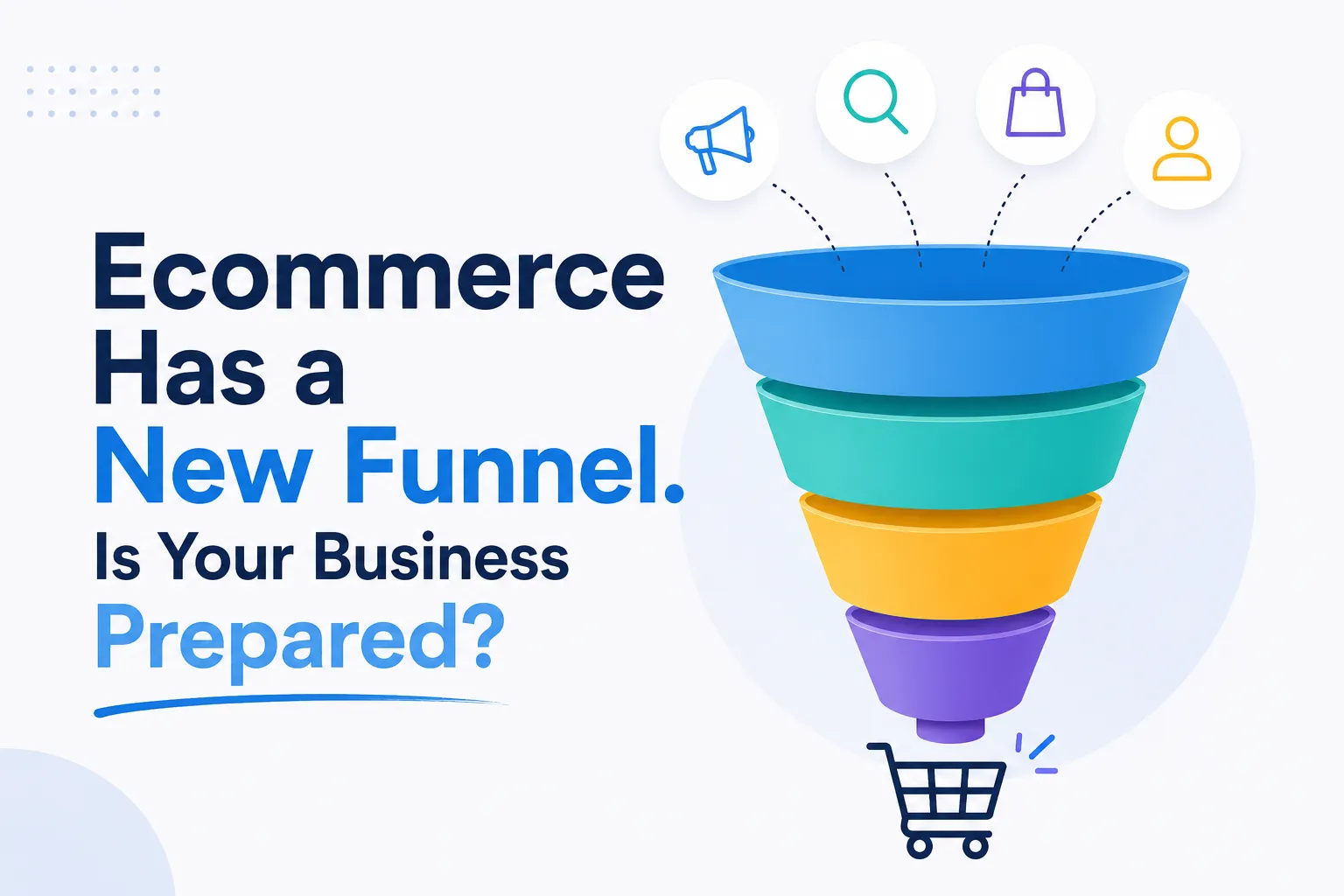

Agentic commerce has moved from an emerging concept to an active commercial reality. AI agents now browse, compare, and shortlist products on shoppers' behalf, often before a human ever visits a product page. Brands that show up in AI-generated recommendations win the sale. Brands that don't have effectively lost it before the funnel even started. Here's what this shift means for your data, content, marketing, and operations, and five concrete steps to prepare.
The Numbers That Make This Urgent
This isn't a distant projection. It's happening now:
- 50% of consumers already use AI-powered search in their shopping journey
- $750 billion in US ecommerce spend is projected through AI search by 2028
- $5 trillion in global retail revenue potential from agentic shopping by 2030
- 44% of AI search users rely on AI as their primary recommendation source
McKinsey calls AI agents "the new front door to the internet." When an AI-generated overview appears in search results, click-through rates drop from 1.41% to 0.64%. Your SEO rankings may hold steady — but the organic traffic built on those rankings may not.
Traditional Funnel vs. Agentic Funnel
The traditional ecommerce funnel is linear and human-navigated: shoppers search, browse product pages, compare options, and decide. Every step needs active human input.
The agentic funnel hands that navigation to an AI intermediary. A shopper asks a question, and the AI queries catalogs, reads reviews, cross-references prices, and returns a ranked recommendation, often without the shopper visiting a product page at all. McKinsey describes this as "shopping powered by autonomous AI agents," where the metric that matters isn't click-through rate but whether your product makes it into the AI's shortlist. This structural shift is covered in more depth in our guide to agentic commerce and the ecommerce funnel.
Four Things Agentic Commerce Changes for Your Business
This shift creates four distinct operational demands, each touching a different part of the organization.
1. Product Data Becomes a Direct Revenue Driver
AI agents recommend products based on structured catalog data. Missing attributes, materials, dimensions, use cases, compatibility, and fit mean the AI can't evaluate your product against a shopper's query, so it won't recommend it, no matter how good the product actually is.
To fix this, brands should:
- Complete every attribute field with specific, accurate information instead of generic copy
- Apply schema markup so AI systems can parse product page content
- Rewrite descriptions in natural language that answer real shopper questions ("Is this machine washable?" "Does it fit wide feet?")
A solid product information management system turns catalog enrichment into an ongoing operational capability rather than a one-time cleanup project.
2. GEO Becomes a Core Capability Alongside SEO
Traditional SEO still matters, but it's no longer enough on its own. Generative Engine Optimization (GEO), also called Answer Engine Optimization (AEO), structures content so AI systems like Google AI Overviews, ChatGPT, and Perplexity surface and recommend your brand directly.
Kendra Scott is a strong proof point: the brand built 8,000 AI-optimized content pages around gift scenarios and conversational queries. Those pages now drive roughly 5% of total site traffic, and 27% still rank on Google's first page — one content investment paying off across both channels.
Building GEO capability means:
- Creating long-tail content that mirrors how shoppers actually talk to AI assistants
- Building brand presence on UGC platforms, wikis, and forums that AI systems cite most often
- Publishing FAQ pages and comparison tables that generative models can parse cleanly
- Tracking AI impressions and citation frequency as primary KPIs, alongside organic rankings
Our AI search optimization and LLM discovery guide walks through the full framework for making content citable by AI systems.
3. Marketing Must Reach AI Touchpoints, Not Just Human Ones
Salesforce data shows 53% of shoppers now discover products through social platforms, and Gen Z is ten times more likely than older shoppers to want AI-driven recommendations. That makes the AI agent ecosystem. Bots pulling from TikTok, assistants drawing on influencer reviews an active discovery channel whether brands plan for it or not.
First-party data becomes critical here. When an AI agent completes a purchase without requiring a login, brands lose visibility into who the customer actually is. Loyalty programs, CRM integrations, and social login strategies reconnect these bot-mediated purchases to real customer profiles. Adobe Real-Time CDP services provide the unified data layer that makes this identity resolution possible.
4. Operations Must Serve AI Agents, Not Just Human Shoppers
The agentic funnel needs real-time, unified data across every system. Siloed inventory, CRM, and catalog systems present a fragmented picture to AI agents, and those agents will simply recommend competitors instead.
McKinsey calls for "agent-ready architecture": modular APIs, headless commerce, and centralized data platforms serving both human visitors and AI agents at once. Headless commerce provides exactly this flexibility, decoupling the frontend from backend systems so agents can pull real-time product and pricing data through open APIs. Our autonomous retail resource explores what agent-ready operations look like in practice.
Ask yourself:
- Can your systems process an order that originates inside a chat interface?
- Do inventory and reviews sync in real time across every channel an AI agent might query?
- Can an AI agent trigger fulfillment without manual intervention?
Five Steps to Prepare for Agentic Commerce
Step 1: Audit and Enrich the Product Catalog.
Complete every attribute field, apply schema markup, and rewrite descriptions to answer conversational queries directly. Incomplete catalogs stay invisible to AI systems regardless of product quality.
Step 2: Unify Data Infrastructure.
Integrate CRM, inventory, and order management so AI-facing systems reflect real-time truth. Fragmented data produces fragmented recommendations and sends customers to competitors.
Step 3: Build a GEO Content Strategy Alongside SEO.
Identify the conversational queries customers use with AI assistants, and answer them directly. Track AI mentions and citations alongside traditional rankings.
Step 4: Experiment With AI-Native Commerce Experiences.
Integrate your catalog with shopping chatbots, enable in-chat checkout, and test voice search. The goal: make every step of the journey navigable by an agent, not just a browser.
Step 5: Monitor Both Funnels and Adapt Continuously.
Track AI-driven traffic alongside traditional analytics, engage with emerging protocols like Model Context Protocol (MCP), and run a regular MarTech stack audit to keep both funnels optimized.
Both Funnels Matter: Winning Brands Optimize for Both
The agentic funnel doesn't replace the traditional one. Many shoppers still browse websites, and strong SEO and user experience continue to matter. Kendra Scott proves the dual return directly: 27% of their AI-optimized pages still rank highly on Google, too, one investment serving two discovery paths.
The brands that build lasting advantage over the next decade will optimize for both the human journey and the agentic one, in parallel. AI agents are already gatekeepers for a significant, growing share of the shopping journey. The foundational work, structured product data, unified infrastructure, and content built for both AI systems and human shoppers, stays valuable no matter which AI platforms end up dominant.
Build the foundation now. The funnel is changing around every brand that waits.



























Sign in to leave a comment.