

Shopify Plus B2B vs Magento is no longer a default win for either platform. Shopify Plus now ships native company accounts, unlimited pricing catalogs, net payment terms, and quantity rules that cover most mid-market wholesale requirements without custom development. Magento still leads where B2B runs genuinely complex, native RFQ workflows with versioning, multi-level approval hierarchies, and account-specific pricing management across more than 100 distinct price lists. Most wholesale brands get this decision wrong because they rely on outdated assumptions about platform capability rather than an honest assessment of their actual operational complexity. This guide corrects that by comparing both platforms on what actually matters in a real wholesale environment.
Why the Platform Comparison Looks Different in 2026
Magento was the automatic answer for serious wholesale operations for over a decade. Shopify simply could not match its B2B depth. That changed when Shopify Plus launched native B2B features in June 2022 and shifted further when Shopify extended core B2B functionality to its standard plans in April 2026 at no additional cost.
Both platforms have matured since, but in opposite directions. Shopify Plus moved toward faster deployment, lower operational overhead, and blended B2B and D2C functionality. Magento moved toward deeper enterprise configurability for complex multi-tier B2B operations. Our B2B wholesale commerce solutions team works across both platforms, and this comparison reflects what holds up in actual implementations rather than in marketing feature lists.
Shopify Plus B2B vs Magento: What Each Platform Delivers on Core B2B Requirements
Here is how each platform performs on the requirements that matter most to wholesale and distribution operations in practice.
Company accounts: Native on both Shopify Plus and Magento. Standard Shopify plans also include this natively since April 2026.
Custom price lists: Standard Shopify plans support up to three pricing catalogs. Shopify Plus supports unlimited catalogs with direct company and location assignment. Magento delivers per-category and per-product pricing at granular levels suited to operations managing many distinct negotiated arrangements.
Quoting and RFQ: Shopify Plus handles basic quoting through third-party apps. Magento ships native RFQ with versioning and multi-step approval workflows, a meaningful gap for brands where negotiated quoting is a routine part of the buying process.
Multi-level approvals: Limited on all Shopify plans. Magento delivers native deep hierarchy support for layered purchasing structures with department, manager, and finance approval at each stage.
Net payment terms: Native across all Shopify plans and Magento.
Deposits and partial payments: Not available on standard Shopify plans. Native on Shopify Plus. Configurable on Magento.
Blended B2B and D2C storefront: All Shopify plans handle this natively with login-based experience adaptation. Shopify Plus adds a dedicated B2B domain option. Magento achieves this but requires more configuration and ongoing maintenance.
Best fit by complexity: Standard Shopify plans suit simple wholesale with three or fewer pricing tiers. Shopify Plus suits operations under 100 price lists with moderate workflow complexity. Magento suits operations managing 100 or more price lists, complex approval chains, and deep ERP dependencies.
Where Shopify Plus Wins for Wholesale Operations
Shopify Plus has clear, practical advantages for wholesale brands that prioritize speed, operational simplicity, and lower total cost of ownership over deep configurability.
Single Storefront for B2B and D2C Together
Running wholesale and consumer sales from the same site, with the experience adapting based on customer login status, is one of Shopify Plus's most significant practical advantages over Magento. Brands consolidating B2B and direct-to-consumer onto one platform find Shopify Plus's architecture naturally suited to that goal. Magento achieves the same outcome but requires more configuration effort to establish and more maintenance to sustain over time.
Faster Launch With Less Custom Development Required
Native B2B tools in Shopify Plus mean teams spend less time building functionality from scratch and more time configuring tools that already work. Company accounts, pricing catalogs, net payment terms, and quantity rules are all platform-native rather than requiring custom development to activate. Our Shopify Plus development team implements these capabilities directly without needing to fill platform gaps with heavy custom logic.
Lower Total Cost of Ownership for Mid-Market Wholesale
For operations under approximately $50 million in B2B revenue with standard pricing and approval workflows, Shopify Plus's flat platform fee and reduced maintenance burden typically costs less over time than self-hosted Magento. Self-hosted Magento carries separate costs for hosting, security patching, infrastructure management, and PCI compliance, all of which Shopify Plus absorbs into its platform fee as standard.
Managed Infrastructure Eliminates a Significant Operational Burden
Shopify Plus handles hosting, security, and PCI compliance as part of the platform. Magento operators own those responsibilities entirely. That overhead consumes engineering time and budget that could otherwise go toward commercial features and operational improvements.
What April 2026 Changed About the Shopify B2B Landscape
The April 2026 Shopify update extended company profiles, up to three pricing catalogs, volume discounts, and net payment terms to Basic, Grow, and Advanced plans at no extra cost. The core B2B access barrier that previously made Shopify Plus the only option for native wholesale functionality within Shopify disappeared with that update.
What remains exclusive to Shopify Plus after April 2026:
- Unlimited pricing catalogs with direct assignment to companies and locations
- A dedicated B2B storefront on its own separate domain
- Deposits and partial payment functionality
- Custom checkout logic through Shopify Functions
- EDI integrations for supply chain connectivity
The practical question for most brands today is no longer whether to pay for Shopify Plus to access native B2B. It is whether pricing complexity, payment requirements, and storefront separation needs exceed what lower-tier plans now include natively. For many simpler wholesale operations, the answer is that they do not.
Where Magento Still Leads for Complex B2B Operations
Magento retains real advantages where wholesale operations have genuine complexity that Shopify Plus's native tools and available applications cannot fully replicate without significant app investment and workaround architecture.
Native RFQ and Quote Management With Full Approval Workflows
Magento's built-in RFQ system supports quote versioning, multi-round negotiation, and multi-step approval workflows natively within the platform. Shopify Plus addresses quoting primarily through third-party applications of varying depth and reliability. For brands where negotiated quoting is a standard part of regular buying processes rather than an occasional exception, Magento's native quoting depth is difficult to replicate on Shopify Plus at the same level of operational consistency.
Multi-Level Purchasing Approval Hierarchies
Organizations with layered purchasing approval requirements, department buyers, managers, and finance teams each playing defined roles at different approval stages benefit from Magento's native hierarchy support in ways that Shopify Plus does not currently match without building app-based workarounds. If multi-level approvals are a daily operational workflow requirement that buyers depend on, that gap represents a genuine practical constraint in the platform decision.
Pricing Management at Scale Above 100 Price Lists
Once a distributor manages more than approximately 100 distinct negotiated price lists, Magento's per-category and per-product pricing engine handles the operational scale more sustainably. Managing several hundred distinct pricing arrangements inside Shopify Plus's catalog management interface creates administrative overhead that brands at that scale consistently identify as a meaningful operational friction point.
Deep ERP Integration and Complex Business Logic
Magento's open architecture makes it significantly easier to build highly customized business logic tied directly into ERP systems. Shopify Plus supports ERP integration through applications and APIs, but organizations whose entire pricing, inventory, and order logic is tightly integrated with a custom ERP system find Magento's architectural flexibility more accommodating without requiring costly workarounds.
Cost Comparison: What Each Platform Actually Costs for B2B
Implementation Cost
A standard B2B setup on Shopify Plus typically costs less and launches faster than an equivalent Magento build because most B2B functionality ships natively. Custom development adds complexity on top of a working baseline rather than building the baseline from scratch. Magento requires development investment to construct B2B workflows up from a more flexible but less preconfigured starting point.
Ongoing Operating Cost
Shopify Plus's flat monthly fee absorbs hosting, security, and infrastructure maintenance into one predictable number. Self-hosted Magento budgets for those costs separately on top of Adobe Commerce licensing. For mid-market wholesale brands, that ongoing cost difference is often one of the most persuasive arguments for Shopify Plus beyond individual feature comparisons.
The April 2026 update narrows the cost gap for simpler wholesale setups specifically. A merchant managing three or fewer pricing tiers no longer needs Shopify Plus to access native B2B. That advantage disappears once pricing complexity exceeds what standard plans support. The full breakdown of what a Magento-to-Shopify-Plus migration costs across different store types is covered in the migration cost guide.
Decision Framework: Which Platform Fits Your B2B Operation
The operational thresholds below reflect practical experience from real implementations across both platforms. Treat them as informed starting points rather than fixed industry rules.
Choose Shopify Plus When Your Operation Fits These Criteria
- Under approximately $50 million in B2B revenue with standard pricing, approval, and quoting workflows, native features likely cover requirements without significant customization
- You want to run B2B and D2C from a single storefront with login-based experience differentiation. Shopify Plus's architecture makes this more natural to implement and maintain
- You manage fewer than 100 distinct price lists. Shopify Plus's catalog management handles this scale without creating the administrative overhead that appears at higher price list volumes
- You want managed infrastructure without owning hosting, security, or PCI compliance as operational responsibilities
Choose Magento When Your Operation Fits These Criteria
- More than 100 distinct negotiated price lists with complex multi-tier pricing structures, Magento's pricing engine handles this scale more sustainably
- Multi-level purchasing approval chains are a daily workflow requirement. Magento's native hierarchy support is difficult to replicate at the same depth on Shopify Plus
- Deeply customized ERP dependencies where business logic is tightly integrated into a custom system. Magento's open architecture accommodates that complexity without requiring workaround architecture
- Complex quoting and RFQ workflows are core to the standard buying process, not occasional exceptions
Where B2B Buyer Expectations Are Heading
B2B buyers increasingly expect the same self-service purchasing experience they have as consumers browsing, building carts, and completing purchases without needing sales representative involvement for standard transactions. That behavioral shift drives a growing number of distributors to consolidate B2B and D2C operations onto a single platform rather than maintaining separate storefronts with separate catalogs and separate operational overhead.
Salsify's 2026 B2B ecommerce research confirms that a large majority of B2B decision-makers now expect digital self-service options comparable to consumer ecommerce. Both platforms are building toward that expectation, but Shopify Plus's blended-storefront architecture aligns more naturally with how that consolidation plays out for most mid-market wholesale brands.
Migrating a B2B Operation From Magento to Shopify Plus
For brands that determine Shopify Plus fits their wholesale requirements, the migration from Magento involves elements that transfer cleanly and elements that require deliberate rebuilding.
What Transfers Without Major Rebuilding
Standard company account structures and straightforward pricing tiers map well onto Shopify Plus's native B2B features. Product catalogs, customer records, and historical order data move through a structured data migration process with validation at each transfer stage.
What Requires Purpose-Built Rebuilding
Deep RFQ workflows and multi-level approval chains typically need rebuilding using Shopify Plus's native tools and B2B-specific applications rather than migrating one-to-one from Magento. Scoping that rebuild into the migration plan from project start, rather than discovering it mid-project, is what keeps migrations on budget.
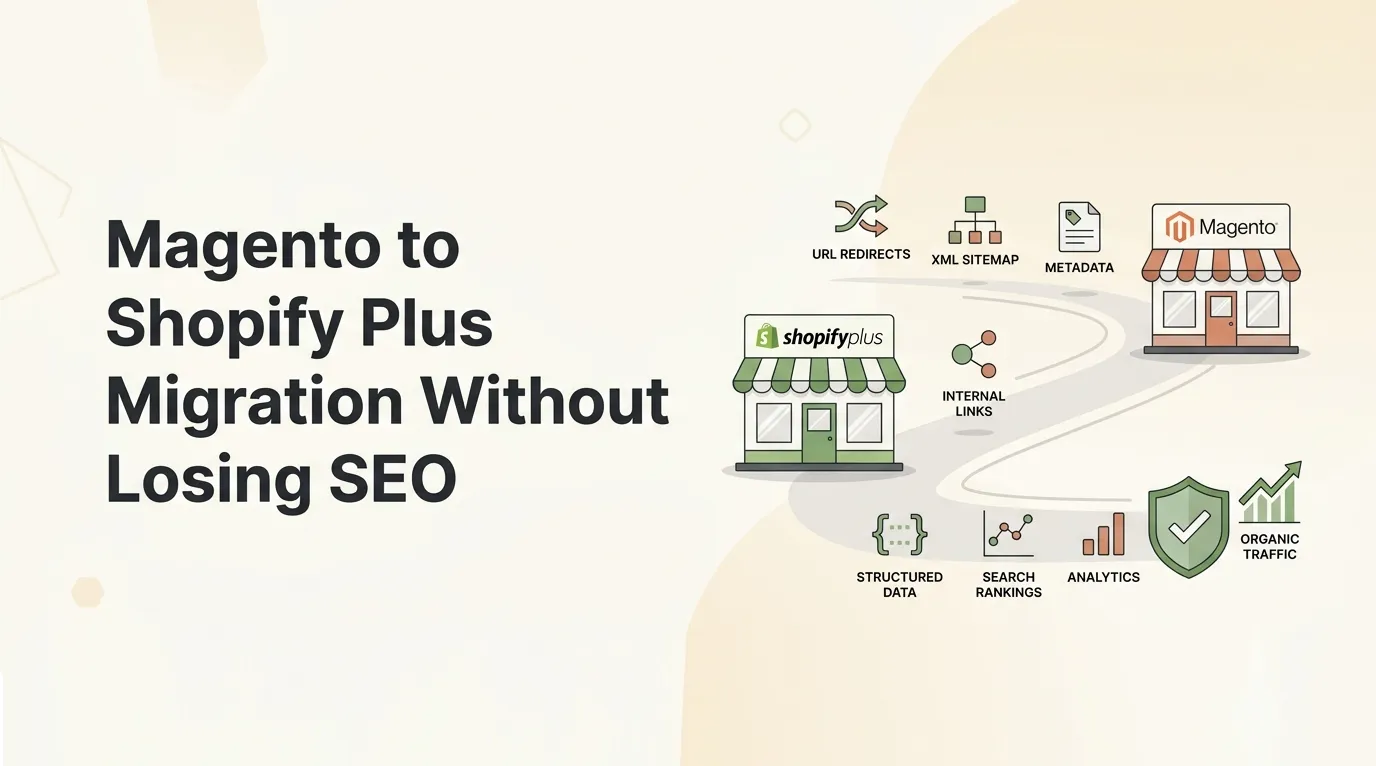
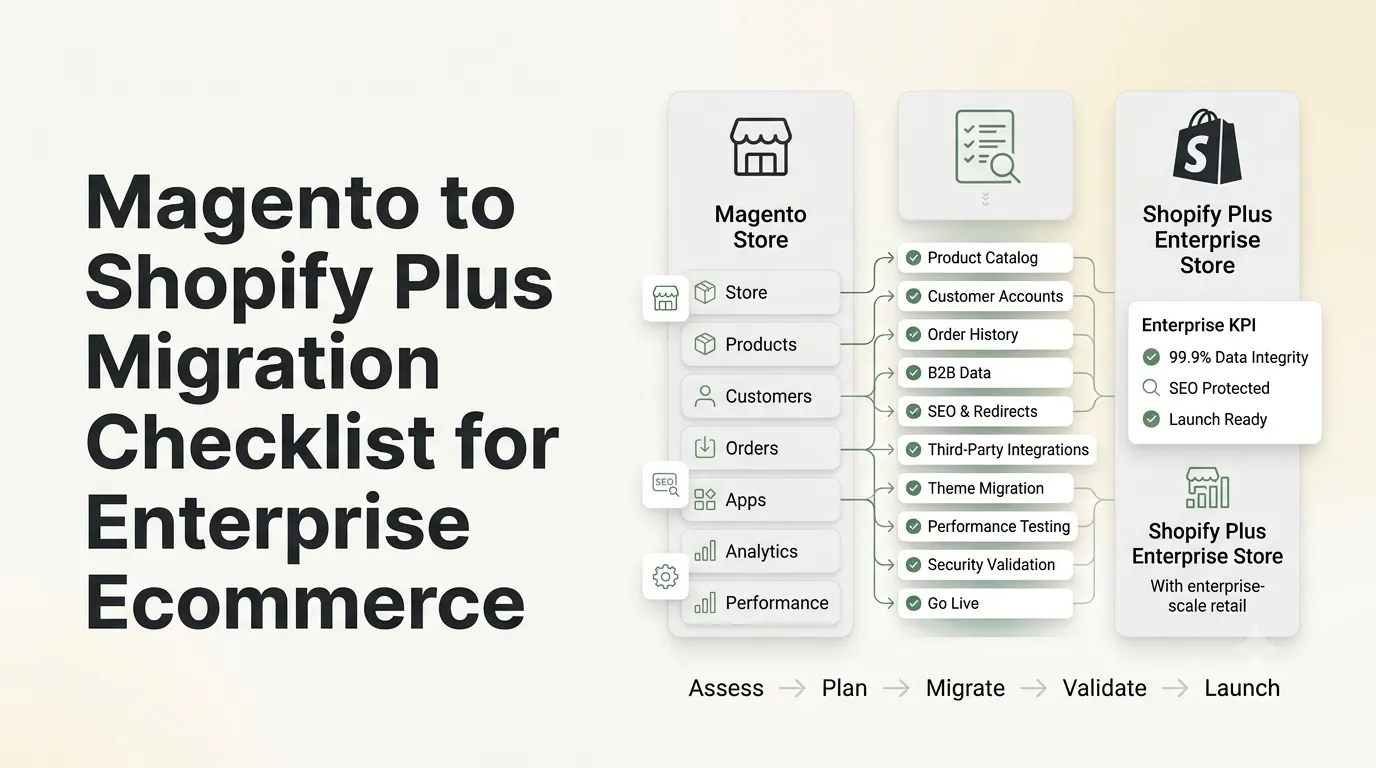
Our Magento to Shopify Plus migration services team scopes B2B rebuild requirements as part of the initial migration plan. For a realistic view of how long migration takes for a B2B-heavy operation, the migration timeline guide covers the full sequence. The migration checklist covers every phase in operational detail. If your B2B catalog carries significant organic traffic, the SEO protection guide is worth reviewing before technical work begins.
For the complete feature-by-feature comparison and decision framework, the Shopify Plus vs Magento B2B guide covers each point in greater depth.
Shopify Plus covers most mid-market wholesale requirements without the infrastructure overhead Magento demands. Magento still leads where B2B complexity is genuine, native RFQ workflows, multi-level approval hierarchies, and pricing management above 100 price lists. The right platform decision comes from an honest operational assessment, not from assumptions about industry defaults or which migration direction appears simpler. Choosing the wrong platform based on either creates operational problems that compound over time.



















Sign in to leave a comment.