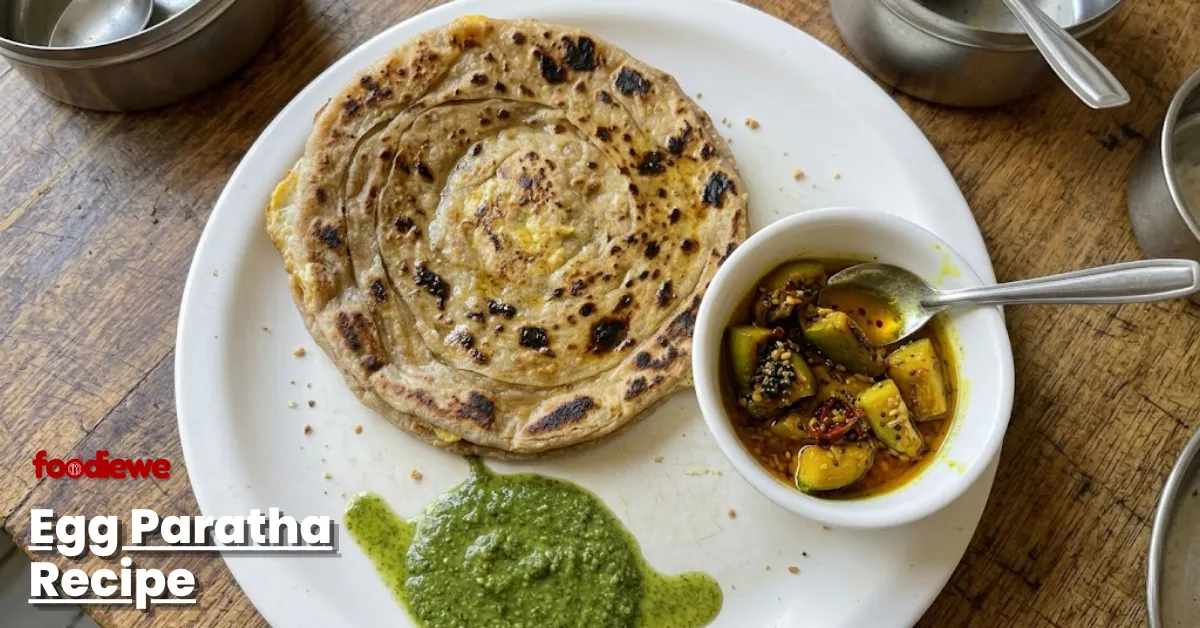

That moment when a dhaba cook cracks an egg onto a half-cooked paratha, spreads it fast, folds it over, and slaps it in ghee — that's not magic. It's just technique most home cooks skip.
Egg paratha sounds simple and keeps humbling you until you nail the actual sequence. Here's everything you need — what it is, how to make it work, and what quietly ruins it.
Quick Answer: To make egg paratha, cook one side of a rolled dough disc on a hot tawa for 60–90 seconds, spread one beaten spiced egg on the surface, fold while still wet, and cook in ghee until golden. One large egg paratha provides roughly 14–16g of protein.
What Is Egg Paratha and Why It Became a Street Food Icon
Egg paratha is a whole wheat flatbread where a spiced beaten egg is spread onto a partially cooked dough disc on a live tawa, then folded and cooked in ghee until golden and slightly crisp. It's not an omelette wrapped in roti — that's a different, lesser thing.
The anda paratha recipe took off along North India's highway dhabas in the 1980s–90s, especially in Punjab and Haryana, where truck drivers needed something fast and filling. The fold-on-tawa method is the one most people mean when they say dhaba style egg paratha.
According to USDA food composition data, one paratha made with one large egg and a teaspoon of ghee runs approximately 280–320 calories. Solid breakfast, honest macros.
How to Make Egg Paratha Without Ruining It
Getting egg paratha right means getting the sequence right — the tawa must be hot before the egg ever touches it.
- Roll and pre-cook one side — Roll dough to 6–7 inches, place on a medium-high tawa, cook 60–90 seconds until small bubbles appear. Raw dough + egg = everything sticks.
- Flip, then egg immediately — Flip the paratha and at once pour your beaten egg (seasoned with salt, red chilli, coriander) onto the cooked side. Spread fast with the back of a spoon. Hesitation means uneven setting.
- Fold before the egg fully sets — Fold the paratha in half while the egg is still slightly wet. Press gently. This traps the egg inside to finish cooking from the dough's heat — the way street style egg paratha is always done.
- Ghee, medium heat, patience — Add half a teaspoon of ghee, flip, cook both sides 60–90 seconds each. Medium heat only — high burns the outside before the inside is done.
Pro Tip: Beat and season your egg before you start cooking. You have roughly 8–10 seconds to spread it once the paratha flips — there's no time to season mid-tawa.
The Mistakes That Actually Ruin Egg Paratha
Most failures come down to three things.
Tawa not hot enough. A lukewarm tawa makes the egg spread sluggishly and stick. It should be hot enough that a water drop evaporates in under 2 seconds. This single error ruins more parathas than bad dough ever will.
Too much egg. One large egg per paratha. More than that and the fold becomes a mess — the egg oozes out, the inside stays wet. I've done this more than once. It's not good.
Folding too late. Once the egg is fully set, it won't bond to the dough. You get a flap that falls out at the first bite. Fold while it's still tacky — always.
One honest caveat: egg paratha dhaba style genuinely works best on a heavy iron tawa. Non-stick doesn't hold heat the same way. Not impossible, just harder.
For exact dough ratios and the tawa heat test explained properly, the Egg paratha recipe on Foodiewe.com is worth saving.
Tips That Actually Help in an Indian Kitchen
Small sourcing decisions make a real difference here.
- Chakki atta over maida — Fresh whole wheat chakki atta (₹35–45/kg at most kirana stores) gives pliable dough that folds without cracking. Maida is softer but the egg doesn't cling as well.
- Iron tawa, always — A seasoned iron tawa (₹300–600 at utensil markets) holds heat far better than non-stick and gives you that slight dhaba-style char.
- Pair with achaar, not ketchup — Mango or chilli achaar is the classic accompaniment. Green chutney works. Ketchup is a personal choice I won't judge, but it's not the move.
- The egg stuffed paratha version — In some homes, the egg is mixed into the stuffing before rolling. It's good, but the on-tawa fold method gives you a crispier result every time.
FAQ
What is egg paratha and how do you make it?
Egg paratha is a whole wheat flatbread where a spiced beaten egg is spread on a partially cooked dough disc, folded, and cooked in ghee on a hot tawa. Roll the dough, cook one side, flip, spread egg immediately, fold while wet, add ghee, cook golden. One egg per paratha is the right ratio — no more.
Can I make egg paratha without ghee, or is there a regional variation?
Yes — mustard oil is used in Bihar and Bengal instead of ghee, giving a sharper flavour. In some South Indian versions, coconut oil works well. Ghee gives the richest result, but any high smoke-point fat does the job. The dhaba version almost always finishes in ghee.
How many calories does one egg paratha have?
One standard egg paratha — 60g whole wheat dough, one large egg, one teaspoon ghee — contains roughly 280–320 calories and 14–16g of protein. The egg contributes about 6g of protein, the whole wheat adds another 7–8g. It's a filling, nutritionally complete breakfast for the calorie count.
Conclusion
Egg paratha doesn't need to be complicated. Hot tawa, fast hands when the egg goes on, fold it while it's still wet. Make it three times and it stops being a recipe — it becomes instinct. That's exactly how it works at every good dhaba, and it can work the same way in your kitchen.






















Sign in to leave a comment.