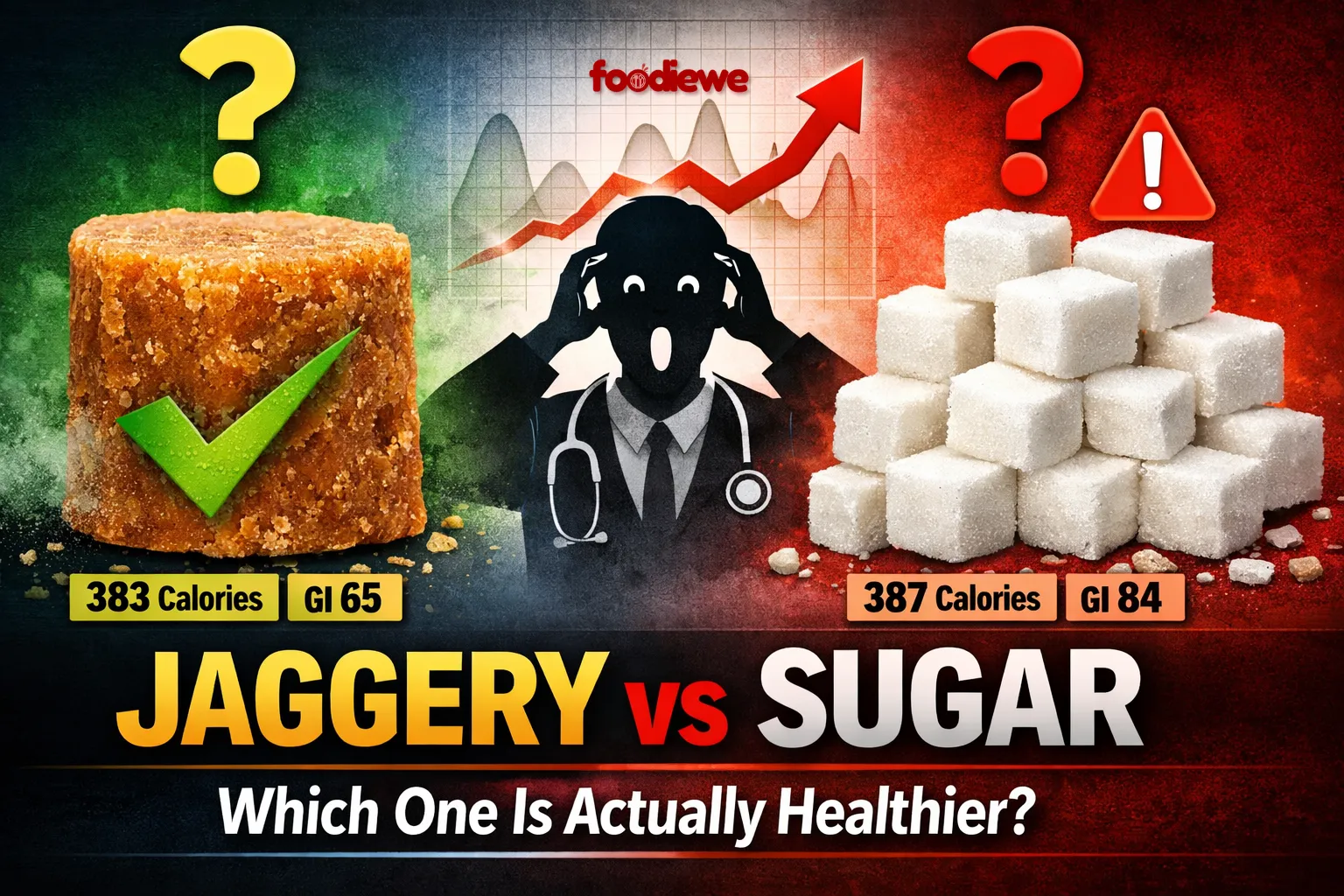

Both jaggery and sugar will raise your blood sugar. That's the honest starting point nobody wants to lead with. But if you're choosing between the two — for your chai, your kheer, your laddoos — the jaggery vs sugar comparison does have a real answer, and it's more nuanced than "jaggery is healthy, sugar is evil." Here's what the glycemic data shows, what traditional Indian kitchen wisdom gets right, and where the line actually is.
Quick Answer: Jaggery raises blood sugar less than refined white sugar, with a glycemic index of approximately 84–86 compared to sugar's GI of 100 — but the difference only matters when portions are small (under 10g). Both are predominantly sucrose, and large amounts of either will spike blood glucose significantly.
What Makes Jaggery and Sugar Metabolically Different
Jaggery is an unrefined sweetener made by boiling fresh sugarcane juice or palm sap into concentrated solid blocks — retaining its natural molasses, trace minerals, and residual moisture — while refined white sugar is pure crystallised sucrose with everything else chemically stripped away. That's the foundational difference, and it matters metabolically for two reasons. First, jaggery's residual fibre and mineral content — including approximately 11mg calcium and 4mg iron per 100g, per Indian food composition data — may mildly slow glucose absorption. Second, its stronger, more complex flavour means you tend to use less of it. Brown sugar vs jaggery isn't the same comparison: brown sugar is just refined sugar with molasses reintroduced, not a naturally unrefined product. Traditional block jaggery from Maharashtra or Gujarat costs ₹80–120 per kg at local kiranas and has been a kitchen staple across the subcontinent for over 3,000 years.
How to Use Jaggery as a Lower-GI Sugar Substitute Without Undoing the Benefit
Switching from sugar to jaggery in a way that actually affects your glycemic response requires more than just swapping one for the other — portion control is what makes or breaks it.
- Start with block jaggery, not powder. Powdered jaggery often contains anti-caking additives and may be partially refined. Block form from your local kirana is less processed and easier to break into measured pieces. Skip this step and you might not be getting the mineral content you think you are.
- Weigh your portions — at least once. A 5g piece of jaggery is roughly the size of a large marble. Eyeballing "a small piece" typically results in 10–15g, which doubles or triples your glycemic load. Do it once with a kitchen scale so your eyes are calibrated.
- Use it in warm liquids first. Jaggery in tea benefits go beyond flavour — jaggery dissolves more slowly than refined sugar in hot liquid, and the act of sipping chai over time distributes the glucose hit across 10–15 minutes rather than all at once. Don't dump it into cold drinks where it just sinks and doesn't integrate.
- Pair jaggery with fat or fibre. Using jaggery in a laddoo made with sesame or coconut, or in a dal with fibre-rich ingredients, slows the glucose absorption further. Using it alone in plain hot water as a "health drink" removes every buffer. And that's a surprisingly common mistake.
Pro Tip: For chai, use exactly one 5g piece of Kolhapuri jaggery per cup and let it steep for 90 seconds before drinking. The flavour comes through fully at that size — you won't want more.
Where People Get the Jaggery-vs-Sugar Switch Wrong
The most common errors in the jaggery vs sugar which is better conversation aren't about the sweeteners themselves — they're about how people change their behaviour after the switch.
Mistake 1: Equating "lower GI" with "unlimited." A GI of 84–86 vs 100 is a real difference, but it's not a dramatic one. Using three times as much jaggery because it feels healthier produces a worse glycemic outcome than modest sugar use. The math doesn't care about your intentions.
Mistake 2: Ignoring jaggery vs sugar calories. Per 100g, jaggery sits at approximately 383 kcal and sugar at 387 kcal — essentially identical. People switch to jaggery for weight or sugar management and consume more of it, assuming the caloric gap is significant. It's not.
Mistake 3: Buying low-quality jaggery and expecting clinical benefits. A lot of commercially packaged "jaggery" is adulterated with sodium bicarbonate or artificial colour. The mineral content and GI advantage cited in research applies to traditional block jaggery — not every product labelled jaggery delivers that. And that's an inconvenient truth the wellness industry tends to gloss over.
For a thorough side-by-side of nutritional profiles, real-kitchen usage tips, and the research behind both sweeteners, the jaggery vs sugar which is better guide on Foodiewe.com is one to save.
Practical Tips for the Indian Kitchen — Making the Switch Actually Work
The most effective strategy for reducing blood sugar impact in Indian cooking isn't about finding a magic sweetener — it's about using less of whichever one you choose, more intelligently.
- Buy Kolhapuri or Belgaum block jaggery (₹80–120/kg at kiranas) for general cooking — it's denser, less adulterated, and breaks cleanly into measured pieces.
- Palm jaggery (karupatti) from Tamil Nadu, available online or at South Indian grocery stores for ₹150–200/kg, has a distinctly smoky flavour that's stronger per gram — so you naturally use less of it. Worth trying for filter coffee.
- Is jaggery better than sugar for diabetics? Only marginally, and only in small amounts — so focus on reducing total sweetener use rather than switching types. That's where the real blood sugar benefit comes from.
- In winter, jaggery is easier to work with — it softens slightly in warmth and becomes brittle in cold, which actually makes precise breaking easier in December and January.
- Pair jaggery-sweetened dishes with curd or a fibre-rich dal — the combination significantly buffers the glycemic spike compared to eating jaggery-based sweets on an empty stomach.

























Sign in to leave a comment.