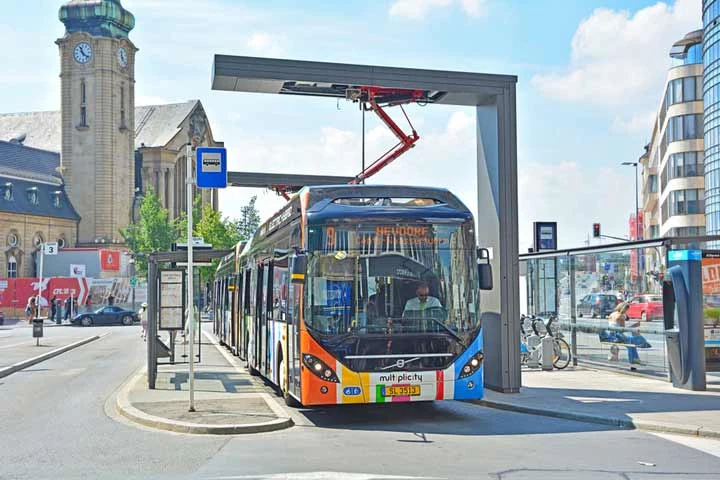

Vehicles running on fuels like petrol and diesel lead to largescale environmental degradation. Increasing air pollution around the world accelerates global warming causing irregular climatic changes which further gravely attacks the environment pertaining to a sudden increase or decrease in temperature, heavy rainfall, heat waves, smog, and so on. Thus, to curb the amount of air pollution released in the environment, more and more people nowadays are inclining towards electric vehicles. Apart from electric cars and motorbikes, electric buses are also bursting onto the scene due to their quiet operation, affordability, sustainability and accommodating benefits. Due to their increasing application as company buses, school buses, and public buses, transport corporation have provided an adequate place for an electric bus charging infrastructure at regular intervals for seamless journey for customers. According to a report published by Research Dive, the global electric bus charging infrastructure is expected to generate a revenue of $5,922.2 million by 2028, growing at a CAGR of 17.7% from 2021-2028. However, the COVID-19 outbreak has slightly curbed the growth of the market due to the restrictions imposed by the government on the import and export duties.
Request Exclusive Sample Report here @ https://www.researchdive.com/download-sample/8421
What Are the Different Electric Bus Charging Methods?
An electric bus is an electric vehicle (EV) which runs on electricity and not on any kind of fuels like petrol or diesel, and hence they require charging stipulated intervals. There are two types of charging namely, plug-in charging and on-route charging.
Plug-in charging can be used as an overnight charging but the charging is initiated only after all the program safety conditions are abided by. The bus analyzes various factors like temperature and state of charge (SOC) in order to decipher the utmost charge rate required to be transferred from the charger.
On-route charging enables the bus to remain in constant service for 24 hours daily. The electric bus is charged with the help of a pantograph by connecting it to the roof rails and controller of the bus, after placing the bus under the pantograph. A number of charging framework are analyzed to ensure a convenient and efficient charge for the bus.
Connect with our expert analyst to get more details@ https://www.researchdive.com/connect-to-analyst/8421
How is Electric Bus Different from Traditional Bus in Terms of Emission?
All the electric buses have a much lower emission compared to the traditional buses running on natural gas, diesel, and petrol. Electric buses are ideal options for school buses and long-distance journeys among people due to the decreased amount of carbon footprint released due to the lower power consumption, in spite of long journeys and frequent travels among people. Some school buses can travel up to 120 miles on a single charge with the minimum emission of carbon footprints which would not be the case of traditional buses. Moreover, electric buses these days travel at a much higher speed with minimum power consumption and slightest carbon emission. Therefore, a swift and efficient journey is vital for the passengers travelling on prolonged journeys. According to a study conducted by the Union of Concerned Scientists, a diesel bus is accounted to affect approximately 1.5 to 8 times the global warming emissions compared to that of an electric bus.
What is the Future of Electric Bus Charging System?
Due to the increasing adoption of electric buses around the world, there has been a significant demand for a reliable and efficient bus charging station for a swift and immaculate experience for the passengers. Therefore, the demand for bus charging station is expected to witness a remarkable growth in the coming years. However, proper maintenance and supervision of high-tension electricity connection, ancillary infrastructure, charging points, charging schedule, space availability, control systems, and so on are vital for the smooth operation of the electric bus charging system.
Request for this Report Customization & Get a 10% Discount on this Report@ https://www.researchdive.com/request-for-customization/8421
Related Reports:
Automotive Semiconductor Market
About Us:
Research Dive is a market research firm based in Pune, India. Maintaining the integrity and authenticity of the services, the firm provides services that are solely based on its exclusive data model, compelled by the 360-degree research methodology, which guarantees comprehensive and accurate analysis. With unprecedented access to several paid data resources, a team of expert researchers, and a strict work ethic, the firm offers insights that are extremely precise and reliable. Scrutinizing relevant news releases, government publications, and decades of trade data, and technical white papers, Research dive delivers the required services to its clients well within the required timeframe. Its expertise is focused on examining niche markets, targeting their major driving factors, and spotting threatening hindrances. Complementarily, it also has a seamless collaboration with the major Market aficionado that further offers its research an edge.
Contact Us:
Mr. Abhishek Paliwal
Research Dive
30 Wall St. 8th Floor, New York
NY 10005 (P)
+ 91 (788) 802-9103 (India)
+1 (917) 444-1262 (US) Toll
Free: +1 -888-961-4454
Email: [email protected]
LinkedIn: https://www.linkedin.com/company/research-dive
Twitter: https://twitter.com/ResearchDive
Facebook: https://www.facebook.com/Research-Dive
0



























Sign in to leave a comment.