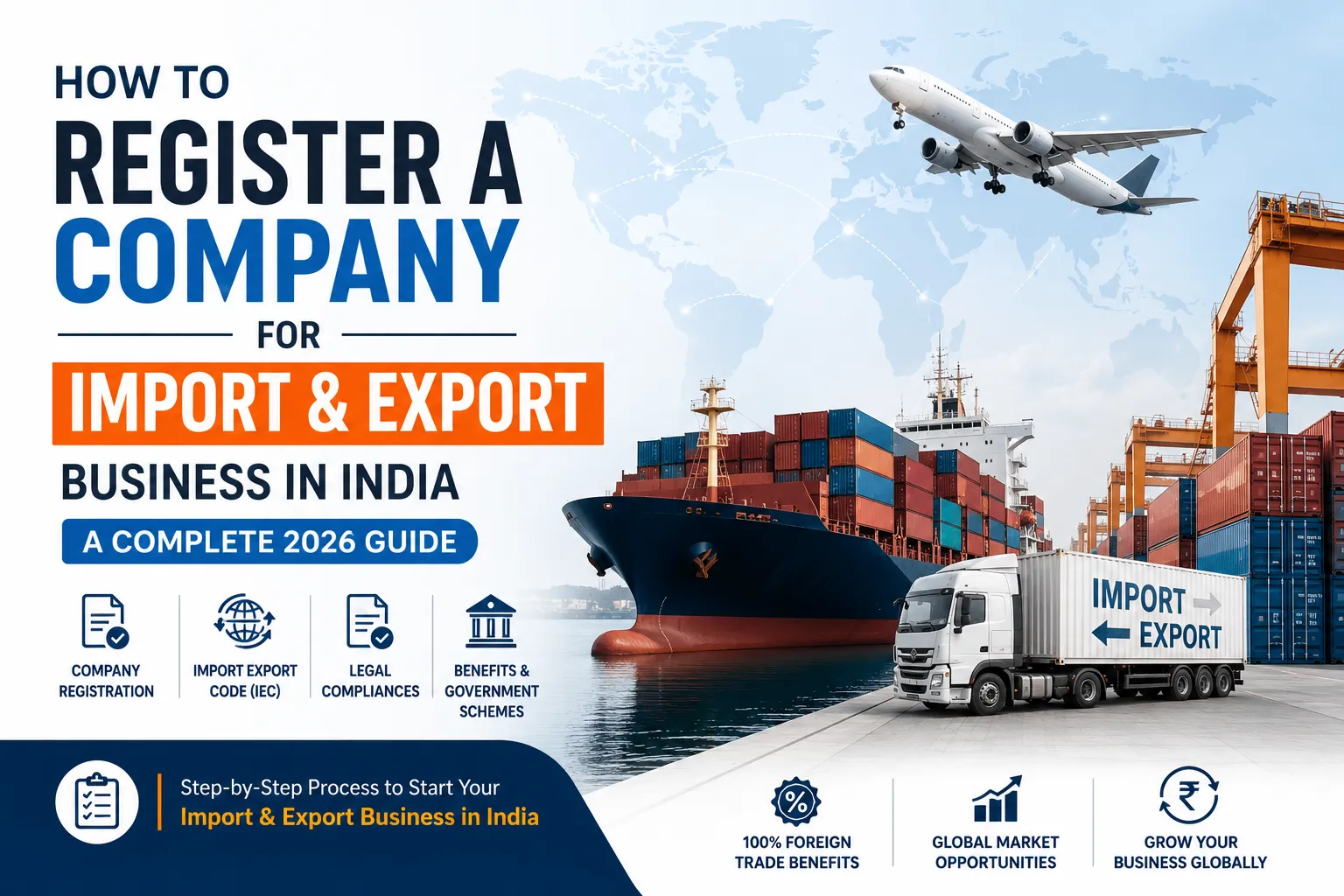

The global trade landscape in 2026 is more accessible than ever, but for Indian entrepreneurs, the journey begins with a solid legal foundation. Whether you are planning to ship traditional textiles or modern SaaS solutions, knowing how to register a company for import & export business is the first step toward international success.
This guide outlines the updated 2026 regulatory framework, including the new FEMA (Export and Import of Goods and Services) Regulations and the streamlined digital application processes.
Choosing the Right Business Structure
Before you can engage in global trade, you must establish a legal entity. In India, the choice of structure impacts your credibility with foreign buyers and your ability to scale.
- Sole Proprietorship: Ideal for micro-exporters or freelancers. It is the fastest to set up but offers no limited liability.
- Limited Liability Partnership (LLP): A popular choice for startups with co-founders. It combines the flexibility of a partnership with limited liability protection.
- Private Limited Company: The "Gold Standard" for company registration in India. Most international buyers prefer dealing with Private Limited entities due to the rigorous compliance and transparency they offer.
Step-by-Step Registration Process (2026 Update)
Step 1: Obtain a PAN and GST Registration
Every import & export business in India must first have a Permanent Account Number (PAN) in the name of the entity. Following this, GST registration is mandatory. Even though exports are "zero-rated" (tax-free) under GST, you need the registration to claim refunds on the taxes you paid for raw materials or services (Input Tax Credit).
Step 2: Open a Dedicated Current Account
You must open a current bank account with a bank authorized to deal in Foreign Exchange.
Note: Ensure your bank can provide an AD Code (Authorised Dealer Code) and is capable of issuing e-BRCs (Electronic Bank Realization Certificates).
Step 3: Apply for the Import Export Code (IEC)
The IEC is your primary identity for global trade. Issued by the Directorate General of Foreign Trade (DGFT), this 10-digit code is now fully integrated with your PAN.
The 2026 IEC Application Process:
- Visit the DGFT Portal.
- Register using your PAN, mobile, and email.
- Fill out Form ANF 2A.
- Upload required documents (Cancelled cheque and address proof).
- Pay the government fee of ₹500.
- Verification: Use Aadhaar-based OTP (for proprietors) or a Class 3 Digital Signature Certificate (DSC) for companies and LLPs.
Step 4: Register with Export Promotion Councils (RCMC)
To avail of government incentives like the RoDTEP scheme (Remission of Duties and Taxes on Exported Products), you must obtain a Registration-cum-Membership Certificate (RCMC) from the relevant Export Promotion Council (e.g., FIEO for multi-products, APEDA for agricultural products).
Mandatory Compliances in 2026
Registration is only the beginning. To keep your company for import & export business active, you must adhere to the following:
Annual IEC Update
Even if there are no changes to your business details, the DGFT requires all IEC holders to confirm their details online annually between April and June. Failure to do so will result in the deactivation of your trade license.
ICEGATE Registration
Once you have your IEC, you must register on the ICEGATE (Indian Customs Electronic Gateway) portal. This allows you to file Shipping Bills (for exports) and Bills of Entry (for imports) digitally.
AD Code Registration at Ports
You must register your bank’s AD Code at every customs port (sea or air) from which you intend to ship goods. This ensures that your export proceeds are correctly tracked and linked to your bank account for GST refunds.
Key Highlights of FEMA 2026 Regulations
The Reserve Bank of India (RBI) recently simplified trade with the FEMA (Export and Import of Goods and Services) Regulations, 2026. Notable changes include:
- Extended Timelines: Exporters now have up to 15 months to realize and repatriate proceeds (18 months if settled in INR).
- Simplified Compliance: Small-value transactions (up to ₹10 Lakh per invoice) can be closed by banks based on a simple declaration from the exporter.
- Third-Party Payments: New rules offer more flexibility for receiving payments via third-party service providers, facilitating smoother B2B transactions.
Documentation Checklist
To register a company for import & export business, keep these high-quality scans ready:
| Document Category | For Proprietorship | For Companies/LLP |
| Identity Proof | PAN & Aadhaar of Owner | PAN of Company & Director ID |
| Business Proof | GST Certificate | Certificate of Incorporation |
| Address Proof | Utility Bill / Rent Agreement | Registered Office Proof + NOC |
| Bank Proof | Cancelled Cheque (Personal Name) | Cancelled Cheque (Company Name) |
Conclusion
Starting an import & export business in India in 2026 is significantly faster due to the "Digital India" initiatives. By choosing the right structure, securing your IEC, and staying compliant with the new FEMA guidelines, you position your brand for the global stage. If you are just starting, focus on obtaining your IEC and GST first, these are the "keys" that unlock the doors to international trade.

























Sign in to leave a comment.