

Introduction
In today’s digital business environment, email communication is more than just sending messages. It is the foundation of client interaction, internal collaboration, document sharing, and operational decision-making. Businesses exchange highly sensitive information through emails every day, including financial records, contracts, customer details, and strategic discussions. As organizations become more digitally connected, email security has become a major concern for enterprises worldwide.
At the same time, cyber threats are evolving rapidly. Modern phishing attacks, ransomware campaigns, and Business Email Compromise scams are targeting businesses of all sizes. Attackers are no longer relying on simple spam emails. Instead, they use advanced social engineering and AI-driven techniques to manipulate employees and steal confidential information. This has forced businesses to rethink how they secure their communication systems.
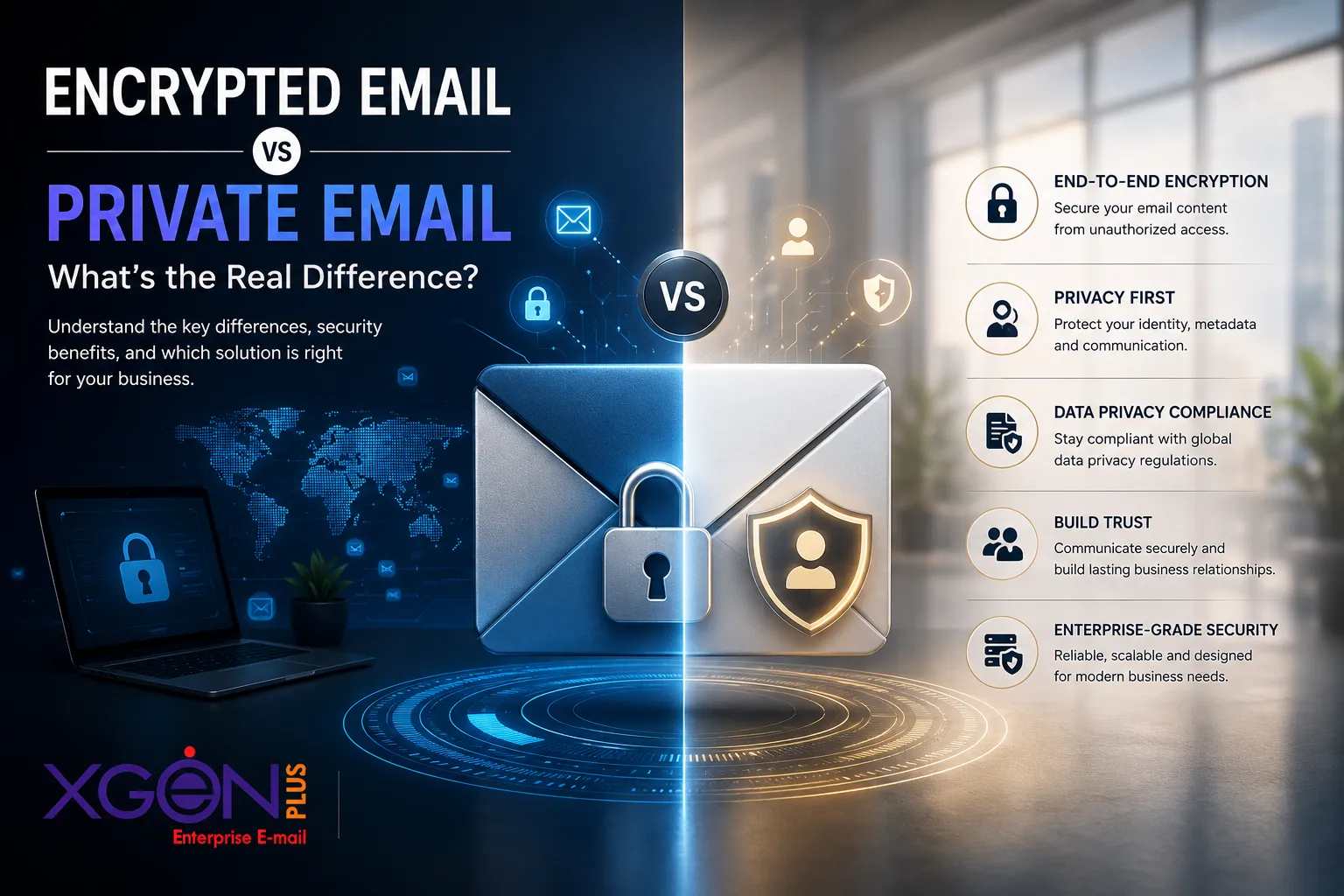
This is where the discussion around Encrypted Email and Private Email becomes important. Many organizations assume both terms mean the same thing, but they serve different purposes. While encrypted email focuses on securing message content, private email goes beyond encryption and emphasizes complete communication privacy and data protection.
Understanding the real difference between these two solutions is critical for businesses looking to improve enterprise-grade email security, comply with data privacy regulations, and adopt reliable business email solutions for the future.
What Is Encrypted Email?
Encrypted Email is designed to secure email messages by converting readable information into an encrypted code that unauthorized users cannot access. The main goal of encrypted email is to protect sensitive business communication from cybercriminals, hackers, and unauthorized interception during transmission. This approach is widely used by enterprises handling confidential information such as financial data, legal documents, and customer records.
Modern businesses are increasingly adopting encrypted email systems to strengthen cybersecurity and reduce risks associated with phishing attacks and data breaches. Encryption ensures that even if attackers intercept an email during transmission, the message content remains unreadable without the correct decryption key. This provides an additional layer of protection for organizations operating in highly regulated industries.
Several technologies are commonly used for encrypted email communication, including PGP, TLS, and S/MIME. Among these, PGP remains one of the most trusted encryption standards for secure business communication. It uses advanced cryptographic methods to ensure the confidentiality, authenticity, and integrity of email messages.
For businesses focused on secure communication, encrypted email has become an essential part of modern business email solutions. It not only protects sensitive information but also improves customer trust and strengthens organizational cybersecurity posture.
How Encrypted Email Works
When a user sends an encrypted email, the message is transformed into unreadable encrypted data before it leaves the server. This encrypted data can only be decrypted and viewed by the intended recipient who has the correct decryption key. The process ensures secure transmission across networks and minimizes the risk of unauthorized access.
Encrypted email systems rely heavily on public-key cryptography. In technologies like PGP, the sender uses the recipient’s public key to encrypt the message, while the recipient uses a private key to decrypt it. This creates a secure communication channel between both parties without exposing sensitive data to attackers.
Businesses using encrypted email solutions gain stronger protection against cyber threats, especially when employees frequently exchange confidential business information. This level of protection is increasingly important for organizations dealing with regulatory compliance and customer privacy expectations.
Encrypted communication also helps businesses reduce risks associated with Business Email Compromise attacks, where attackers attempt to impersonate executives or employees to manipulate financial transactions or steal sensitive information.
- End-to-end encryption
- TLS (Transport Layer Security)
- PGP (Pretty Good Privacy)
- S/MIME encryption
What Is Private Email?
Private email is designed with a broader focus on user privacy, data ownership, and confidential communication. Unlike traditional email services that may collect user data for analytics or advertising purposes, private email platforms prioritize protecting both communication content and user identity. This makes private email highly valuable for enterprises concerned about privacy and compliance.
Modern private email providers are built around privacy-first infrastructure. They aim to reduce metadata exposure, prevent user tracking, and minimize data collection practices. In addition to encryption, private email systems focus on ensuring that businesses maintain greater control over their communication data and digital interactions.
As data privacy regulations continue becoming stricter globally, organizations are increasingly searching for secure and privacy-focused communication systems. Businesses handling sensitive legal, healthcare, or financial information require email platforms that protect not only message content but also user activity and communication patterns.
Private email services are becoming a preferred choice for enterprises seeking advanced enterprise-grade email security and long-term communication privacy. They provide stronger protection against surveillance, unauthorized monitoring, and modern cybersecurity threats.
Core Benefits of Private Email
Private email services offer several advantages beyond standard encryption. These platforms are designed to reduce tracking, improve confidentiality, and give users greater control over their digital communication environment. For businesses, this creates a more secure and privacy-focused ecosystem.
Many private email providers use zero-access architecture, meaning even the service provider cannot read user emails. This significantly improves trust and reduces risks associated with third-party data exposure. Businesses looking for secure business email solutions increasingly consider privacy-focused infrastructure a competitive advantage.
Private email also helps organizations align with modern compliance frameworks and evolving privacy expectations from customers and stakeholders. As cyber threats become more sophisticated, businesses need communication systems that prioritize both security and privacy.
Organizations adopting private email platforms can strengthen customer confidence while protecting their internal operations from data leaks and surveillance risks.
- User anonymity
- Metadata protection
- Zero-access architecture
- Privacy-first infrastructure
- Reduced tracking
Encrypted Email vs Private Email: Key Differences
Although both encrypted email and private email aim to improve security, they focus on different aspects of communication protection. Encrypted email primarily secures message content during transmission, while private email focuses on broader privacy protection, including metadata, user identity, and communication behavior.
Many businesses mistakenly believe that encryption alone provides complete privacy. However, even encrypted systems may still expose metadata such as sender information, timestamps, IP addresses, and communication patterns. This information can still reveal valuable business intelligence to attackers or third parties.
Private email platforms address these limitations by implementing additional privacy-focused protections. They minimize data collection, restrict tracking, and strengthen user confidentiality across the entire communication ecosystem. This makes private email particularly valuable for organizations operating in highly regulated industries.
For enterprises evaluating modern business email solutions, understanding this distinction is essential. Choosing the right platform depends on business goals, compliance requirements, and long-term cybersecurity strategy.
| Feature | Encrypted Email | Private Email |
| Focus | Securing message content | Protecting user privacy and communication |
| Encryption | Primary feature | Included but broader privacy focus |
| Metadata Protection | Limited | Strong |
| Tracking Prevention | Not always included | Usually included |
| Data Collection | Possible | Minimal or zero |
| User Privacy | Moderate | High |
| Compliance Support | Strong | Strong |
| Business Use Cases | Secure communication | Secure + private communication |
Why Businesses Need More Than Basic Email Security
Traditional email security methods are no longer sufficient against modern cyber threats. Businesses today face highly advanced phishing attacks, AI-driven scams, ransomware campaigns, and sophisticated Business Email Compromise incidents that specifically target employees and executives.
Cybercriminals now use intelligent impersonation techniques to manipulate users into sharing sensitive information or transferring funds. A single compromised email account can lead to financial losses, operational disruption, reputational damage, and compliance violations. This is why businesses must move beyond outdated security practices.
Modern organizations require comprehensive enterprise-grade email security that combines encryption, privacy protection, threat detection, and intelligent monitoring. Businesses also need communication platforms capable of supporting regulatory compliance and secure collaboration across teams.
Adopting advanced business email solutions helps enterprises reduce cybersecurity risks while improving customer trust and operational resilience. Secure communication is no longer optional; it is a critical business requirement in the digital era.
- AI-driven threat detection
- Advanced phishing protection
- Secure authentication systems
- Data privacy compliance
- Business continuity protection
How XgenPlus Helps Businesses Secure Email Communication
XgenPlus provides modern business email solutions designed for enterprises that prioritize security, privacy, and scalability. Built with advanced infrastructure and enterprise-focused capabilities, XgenPlus helps organizations secure their communication environment against evolving cyber threats.
The platform combines secure email architecture, intelligent protection systems, and privacy-focused communication tools to deliver reliable enterprise-grade email security. Businesses can improve operational efficiency while protecting sensitive communication from unauthorized access and modern cyberattacks.
XgenPlus also helps organizations strengthen compliance readiness by supporting secure communication standards and privacy-focused infrastructure. As cyber risks continue growing, businesses require secure digital communication systems that can scale with operational demands.
Whether organizations want to prevent phishing attacks, reduce Business Email Compromise risks, or improve secure communication workflows, XgenPlus delivers enterprise-ready email solutions designed for modern business environments.
- Advanced email protection
- Secure communication infrastructure
- Privacy-focused architecture
- Compliance-ready solutions
- Enterprise scalability
Conclusion
The difference between Encrypted Email and Private Email is more significant than many businesses realize. While encrypted email focuses on protecting message content during transmission, private email goes further by protecting user privacy, metadata, and overall communication confidentiality. Both play an important role in strengthening modern business communication.
As organizations face increasing cybersecurity threats, stricter data privacy regulations, and rising incidents of Business Email Compromise, a secure communication infrastructure has become essential for long-term business success. Businesses can no longer rely on traditional email systems that lack advanced privacy and security protections.
Modern enterprises need intelligent and scalable business email solutions capable of preventing cyber threats, protecting sensitive data, and supporting secure collaboration. Combining encryption, privacy-focused infrastructure, and advanced threat protection creates a stronger foundation for digital communication security.
For businesses looking to modernize email communication while improving privacy and cybersecurity, platforms like XgenPlus provide the secure and reliable infrastructure needed to support future-ready enterprise communication.
























Sign in to leave a comment.