
Introduction
AI is no longer a future investment; it’s a present-day differentiator. Enterprises today face rising operational complexity, communication overload, and pressure to deliver faster outcomes with leaner teams. Traditional automation tools are hitting their limits because they execute rules, not decisions.
This is where Enterprise AI automation fundamentally changes the equation. By deploying AI agents for business, organizations unlock systems that think, act, and optimize autonomously. This article explores real, proven AI agent use cases that generate measurable ROI across enterprise environments.
The Problem: AI Is Everywhere—But ROI Is Rare
Many enterprises have experimented with AI but struggle to convert pilots into profits. The issue isn’t ambition, it’s execution. AI projects often remain isolated, require excessive human intervention, or fail to integrate with core systems like email and workflows. As a result, value creation stalls before scale.
Autonomous AI systems solve this by shifting AI from advisory roles into action-oriented roles. When AI moves from insights to execution, ROI follows consistently and predictably.
What Are Enterprise AI Agents (Really)?
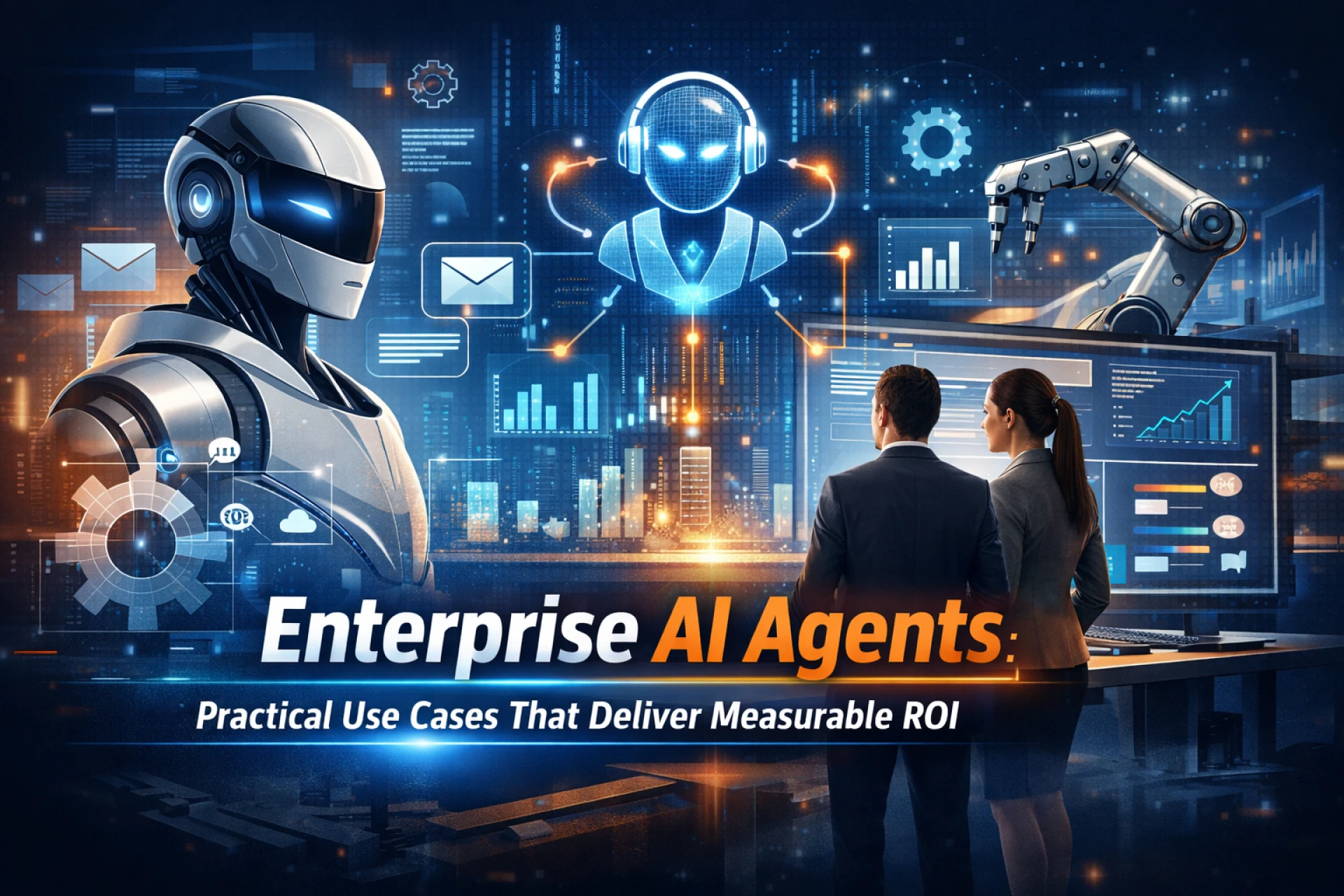
Enterprise AI agents are autonomous, goal-driven systems designed to operate within real business environments. Unlike chatbots or static automations, they continuously monitor data, evaluate scenarios, and take action across enterprise platforms.
These agents integrate deeply into AI-powered enterprise operations, adapting in real time as conditions change. They don’t just assist employees, they operate alongside them as digital counterparts. This autonomy is what makes enterprise AI agents scalable, reliable, and ROI-focused.
Why Enterprises Are Betting on AI Agents
Enterprises are adopting AI agents because they address the core limitations of traditional automation. They reduce dependency on manual oversight while increasing speed, accuracy, and consistency. By embedding intelligence into everyday operations, companies unlock exponential productivity without linear cost increases.
Enterprise workflow automation powered by AI agents enables organizations to scale decision-making, not just task execution. The result is a workforce augmented by systems that work 24/7 without burnout.
High-Impact AI Agent Use Cases (With Real ROI)
1. AI Agents for Workplace Communication
Workplace communication is one of the largest hidden drains on enterprise productivity. Emails, internal requests, and cross-team coordination consume hours of focused work every day. AI agents transform workplace communication by adding intelligence directly into the flow of messages.
Instead of employees managing inboxes, agents manage priorities and intent. This shift reduces noise, accelerates response times, and ensures critical communication never slips through the cracks.
Key capabilities include:
- Automated email prioritization and routing
- Context-aware email drafting and replies
- Compliance monitoring and risk alerts
- Smart escalation of urgent messages
2. Autonomous AI Agents for Enterprise Email Operations
Email remains mission-critical, but managing it at scale is increasingly complex. Autonomous agents elevate the enterprise email solution from infrastructure to intelligence. These agents analyze patterns, sentiment, and threats in real time, making judgment calls that previously required human review.
When paired with predictable Business Email Plans & Pricing, enterprises gain both operational control and financial clarity. Email becomes a strategic asset rather than an operational burden.
Use cases include:
- Intelligent spam and phishing detection
- Automated follow-ups and reminders
- Sentiment analysis for leadership insights
- Policy enforcement across departments
3. Enterprise Workflow Automation Across Departments
Most enterprise workflows fail at handoffs when tasks move between people, teams, or systems. AI agents eliminate these bottlenecks by owning workflows end to end. From initiation to completion, agents manage tasks without waiting for human prompts.
This is the true power of Enterprise workflow automation continuous execution without friction. Departments operate faster, with fewer errors and greater visibility.
Common implementations:
- Sales lead qualification and CRM updates
- HR screening, scheduling, and onboarding
- Finance invoice processing and approvals
- IT ticket triage and resolution
4. AI-Powered Enterprise Operations
Operations teams are expected to anticipate issues, not just respond to them. AI agents enable AI-powered enterprise operations by analyzing data streams continuously and acting before problems escalate.
These agents detect inefficiencies, predict failures, and trigger corrective actions automatically. The result is an organization that self-optimizes in real time. Operations shift from reactive firefighting to proactive performance management.
Operational advantages include:
- Predictive system monitoring
- Automated resource optimization
- Real-time anomaly detection
- Continuous performance improvements
5. Customer Support AI Agents That Scale
Customer expectations are rising while support costs are under pressure. AI agents allow enterprises to scale service without sacrificing quality. Modern agents understand intent, emotion, and context, not just keywords.
They resolve issues autonomously and escalate only when human judgment is required. This balance improves customer satisfaction while protecting margins.
Business impact includes:
- Faster resolution times
- Reduced support workloads
- Consistent customer experiences
- Higher agent productivity
The Hidden Advantage: AI Agents as Force Multipliers
The most powerful aspect of AI agents isn’t automation, it’s amplification. A single agent can support dozens of employees simultaneously, executing decisions at machine speed. This creates leverage that no hiring strategy can match.
AI agents for business don’t replace teams; they expand what teams are capable of achieving. Enterprises that recognize this gain a structural advantage that competitors struggle to replicate.
Why Email Is the Gateway to Enterprise AI Adoption
Email connects every system, department, and decision in an organization. That makes it the ideal entry point for AI adoption. Intelligent email agents immediately improve communication, coordination, and execution across workflows.
Once email becomes autonomous, downstream processes accelerate naturally. A secure, scalable enterprise email solution becomes the foundation for enterprise-wide AI transformation.
Choosing the Right AI Partner Matters
Enterprise AI success depends heavily on the underlying platform. Security, integration, scalability, and long-term innovation are non-negotiable. Organizations need partners who understand enterprise realities, not consumer AI shortcuts.
Platforms like XgenPlus provide enterprise-grade communication infrastructure designed to support advanced AI agents. With a strong ecosystem, partner programs, and scalable offerings, XgenPlus Products align technology with business outcomes.
Conclusion:
Enterprise AI agents represent a fundamental shift from tools that assist to systems that act. They power Autonomous AI systems, enable Enterprise AI automation, and deliver measurable ROI across communication and operations.
The enterprises winning tomorrow are those deploying AI agents today strategically, securely, and at scale. The question isn’t whether AI agents belong in your enterprise. It’s whether you’re ready to let them work.

Sign in to leave a comment.