
Introduction
For decades, web browsers have been simple tools designed to help users access information. They displayed websites, allowed navigation, and relied entirely on human interaction to function. Every action, from searching to filling forms, required manual effort. While this worked in the past, modern digital workflows demand greater speed, efficiency, and intelligence.
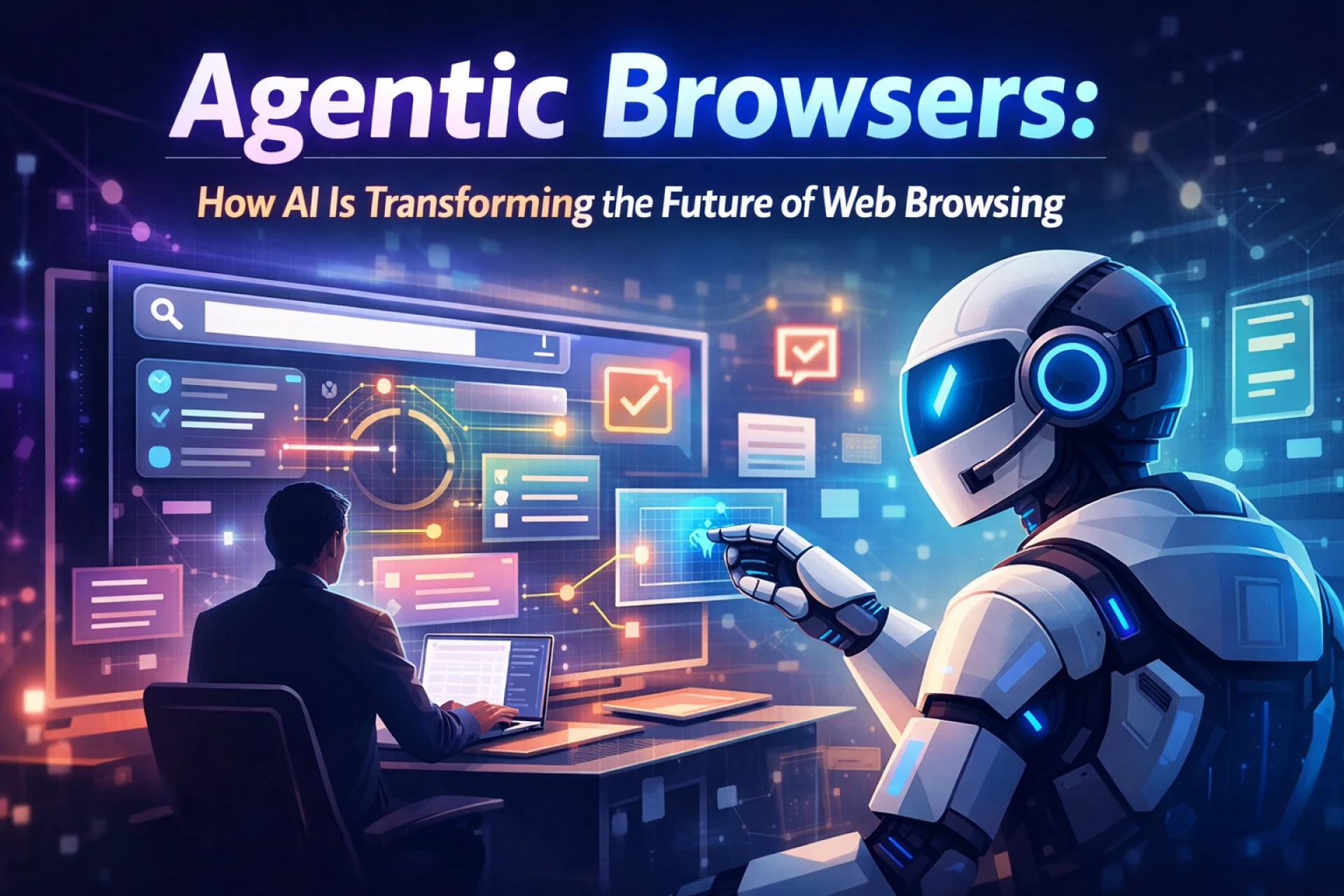
Today, artificial intelligence is redefining how users interact with the web. A new generation of AI browsers is emerging, capable of understanding intent and executing tasks autonomously. This shift introduces the concept of agentic browsing, where browsers no longer wait for instructions but actively assist in completing goals.
This evolution marks the beginning of intelligent web browsing, where the browser becomes a proactive participant rather than a passive tool. Instead of simply accessing information, users can now rely on systems that perform actions independently. This transformation is especially important for professionals and enterprises seeking scalable productivity.
Agentic browsers represent the next stage in digital interaction, combining browser automation, artificial intelligence, and autonomous execution to transform how work happens online.
What Are Agentic Browsers?
Agentic browsers are advanced AI-powered browsing systems designed to operate autonomously and execute tasks on behalf of the user. Unlike traditional browsers that require continuous input, these systems interpret user intent and perform actions independently. They leverage artificial intelligence to understand goals, navigate web environments, and complete workflows without manual intervention.
The core difference lies in autonomy. Traditional browsing requires users to manually search, click, and execute tasks step by step. In contrast, agentic browsing enables the browser to manage these tasks automatically. This significantly reduces cognitive load and improves efficiency.
These systems rely on a combination of artificial intelligence, natural language understanding, and workflow automation. This enables them to interpret complex instructions and execute them effectively. This represents a major advancement in autonomous browsing, transforming browsers into intelligent digital agents.
For professionals and enterprises, this means reduced manual effort, faster execution, and improved productivity. Instead of spending time navigating systems, users can focus on strategic tasks.
Agentic browsers are not just tools; they are becoming intelligent collaborators in digital workflows.
The Technology Behind Autonomous Browsing
Agentic browsers rely on several advanced technologies that enable intelligent decision-making and execution. These technologies work together to create systems capable of autonomous action and continuous improvement. This combination forms the foundation of modern AI Agent browsing.
Large Language Models (LLMs)
Large language models provide the reasoning capabilities required for intelligent browsing. These models understand user instructions, interpret context, and generate action plans. This allows agentic browsers to operate independently and execute complex workflows.
They enable natural interaction between users and systems, eliminating the need for technical commands. This makes agentic browsing accessible to professionals across industries.
Computer Vision for Web Interaction
Computer vision enables agentic browsers to understand web page layouts visually. This allows them to identify buttons, forms, and navigation elements automatically. This capability is essential for executing tasks across diverse web environments.
This technology makes browser automation more accurate and adaptable. It allows AI systems to interact with websites just like humans.
Natural Language Processing
Natural language processing enables browsers to interpret human instructions accurately. This allows users to communicate goals naturally, without needing structured commands.
This improves usability and supports seamless intelligent web browsing experiences.
Workflow Automation Engines
Automation engines enable the browser to execute workflows autonomously. These systems perform actions such as navigating pages, filling forms, and extracting information.
This capability forms the foundation of autonomous browsing, allowing systems to complete tasks independently.
How Agentic Browsers Work
Agentic browsers follow a structured process that allows them to execute tasks autonomously. This process ensures accuracy, efficiency, and intelligent decision-making. Each step contributes to the overall effectiveness of AI-powered browsing systems.
Understanding Intent
The system first analyzes the user’s instruction to understand the intended goal. This involves interpreting context, identifying relevant tasks, and determining execution requirements.
This enables intelligent execution without manual intervention.
Planning Actions
Once intent is understood, the system creates an execution plan. This plan outlines the steps required to achieve the desired outcome.
This structured approach ensures efficient browser automation.
Autonomous Execution
The browser executes tasks independently, navigating websites and completing workflows. This allows users to achieve goals without manual interaction.
This is the essence of agentic browsing.
Learning and Optimization
Agentic browsers continuously learn from interactions. This improves performance, efficiency, and accuracy over time.
This enables long-term optimization of workflows.
Real-World Applications of Agentic Browsing
Agentic browsing is already transforming professional workflows across industries. These systems improve efficiency by automating repetitive tasks and enabling faster execution. This allows organizations to scale operations without increasing manual effort.
Common applications include:
- Research automation
- Workflow execution
- Data extraction
- Process coordination
These capabilities improve productivity and reduce operational friction. This demonstrates the real-world value of AI browsers in enterprise environments.
As organizations adopt intelligent systems, agentic browsing will become essential infrastructure.
Why Agentic Browsers Matter for Enterprises
Enterprises operate in complex environments with multiple systems and workflows. Manual coordination slows execution and limits scalability. Agentic browsing introduces intelligent automation into enterprise workflows.
This improves operational efficiency and enables faster execution. By integrating with enterprise platforms, agentic browsers enable seamless workflow coordination.
Platforms like XgenPlus provide a communication infrastructure that supports intelligent enterprise workflows. A modern Enterprise email solution plays a critical role in enabling communication between systems and users.
This creates a unified digital ecosystem where intelligent systems operate efficiently.
Agentic browsing enables enterprises to scale productivity without increasing manual effort.
Security and Control in Autonomous Browsing
Security is essential for intelligent systems operating autonomously. Agentic browsers must operate within secure environments that protect data and ensure compliance.
Enterprise platforms provide a secure infrastructure that supports intelligent workflows. A secure business email solution ensures safe communication and coordination between systems.
Security frameworks ensure autonomous systems operate safely and reliably. This enables organizations to adopt intelligent technologies with confidence. Security is foundational to the future of autonomous systems.
The Future of Intelligent Web Browsing
The evolution of browsing is moving toward full autonomy. Traditional browsing required manual input, while modern systems enable intelligent assistance. Agentic browsers represent the next stage of autonomous execution.
This shift improves productivity and enables scalable digital workflows. Professionals can focus on strategic work instead of repetitive tasks.
Agentic browsing will redefine how digital work is performed. This transformation represents the future of AI-powered browsing. Organizations that adopt intelligent systems early will gain a competitive advantage.
Conclusion
Agentic browsers represent a fundamental shift in how users interact with digital systems. They transform browsers from passive tools into intelligent agents capable of autonomous execution. This evolution enables faster workflows, improved efficiency, and scalable productivity.
By combining artificial intelligence, automation, and intelligent decision-making, agentic browsers redefine digital interaction. They enable professionals and enterprises to operate more efficiently in increasingly complex environments.
Platforms like XgenPlus provide the communication infrastructure required to support intelligent enterprise workflows. As agentic browsing evolves, enterprise platforms must provide secure, scalable, and intelligent systems.
The future of browsing is not manual. It is autonomous, intelligent, and integrated.
Organizations that embrace this transformation will define the next generation of digital innovation.




























Sign in to leave a comment.