
A seismic-resistant structure. A concealed waterproofing layer. A high-performance window system. None of it visible in a show flat — until Godrej built a wall that made engineering something you could watch happen.
Here's a problem most technical brands eventually run into: the thing that actually makes your product better than the competition is the one thing nobody can see. A stronger structural frame. A more advanced manufacturing tolerance. A materials choice that costs more precisely because it performs better over decades, not days. On paper, it's your biggest advantage. In a showroom, it's invisible.
Godrej Properties ran into exactly this with Trilogy, its luxury development in Worli. The brand had genuine engineering advantages behind the home — but traditional tools, an AV room, a looping MP4 video, could only ever describe them. A buyer leaves that kind of pitch with an aesthetic impression, not a verified belief. And when the follow-up call comes, the sales team is arguing against a doubt they never actually got to resolve.
This is where experience center development stops being about atmosphere and starts being about proof. Turning a system nobody can see into a journey somebody can walk through and verify — that's the entire discipline.
What an Experience Center Is When the Product Is a System
Not every experience center exists to dazzle. Some exist to do something much harder: make an invisible system legible. Think of it less as a showroom and more as a translation layer — taking engineering, construction methods, or backend processes that normally live in a specification sheet, and giving them a physical, walkable form.
The test for whether it's working isn't "did visitors enjoy it." It's "can a visitor now explain, accurately, why this system is better" — and repeat that explanation to someone else later.
The Problem: Claims That Sound Like Marketing Until You Can Prove Them
This pattern is familiar to any brand whose real differentiation lives in engineering, materials, or process rather than appearance:
- "Premium quality" and "built to last" have been said by every competitor in your category, so the words alone carry no weight anymore
- Sales teams end up relying on individual skill and charisma to make technical claims land, which means results vary wildly rep to rep
- A buyer's aesthetic impression forms fast, but their trust in your engineering claims doesn't — and the gap between the two is where deals stall
- Collateral flattens complexity into bullet points nobody remembers past the meeting
The fix isn't a better brochure. It's a format where a technical claim becomes something a visitor can test, rather than something they're simply asked to believe.
Planning an Experience Center Around a System, Not a Product
Designing a customer experience center around an invisible system takes a different planning sequence than a typical product showcase. The build tends to move through six layers:
- Layout that guides without forcing. Visitors should feel free to explore, but the path should quietly steer them through the right sequence.
- Zones defined by function, not just topic — immersion, comparison, storytelling, and discussion each need their own space and pacing.
- Technology chosen by what needs proving, not what looks impressive on a spec sheet.
- A past-to-future narrative arc, so each interaction builds context before asking for belief.
- One coherent system across content, visuals, interaction, and flow — nothing should feel bolted on.
- Sensory design — sound, lighting, texture, and motion — tuned to reinforce comprehension, not just mood.
The result should feel less like walking through a display and more like watching a claim get demonstrated in real time.
The Visitor Journey: An S-Shaped Path Instead of a Straight Line
A straight line through a space tends to create decision paralysis — visitors either rush or freeze, unsure what deserves attention. An S-shaped path solves this differently: it removes the option to skip ahead, while still letting curiosity build naturally, module by module, rather than delivering everything as one long linear pitch.
Short-form content modules work particularly well here. Each one proves a single claim, cleanly, before moving to the next — rather than trying to build one long argument a visitor has to hold in their head all at once.
Five ways to turn a technical system into a genuinely engaging interactive installation:
- Convert one invisible spec into a visible before-and-after moment — don't just describe it, demonstrate it
- Use a kinetic or rotoscopic wall to animate what's normally static in a spec sheet
- Let the path shape pacing — a curved or S-shaped layout naturally slows visitors down at the right moments
- Give the sales team the same proof points the room gives visitors, so follow-up conversations stay consistent
- Close each module quickly — proving one claim in ninety seconds beats a five-minute deep dive most visitors won't finish
Experience Center Interactive Equipment for Making Systems Visible

The right experience center interactive equipment for this kind of story tends to include:
- Curved or straight rotoscopic walls that convert static specifications into kinetic, interactive storytelling
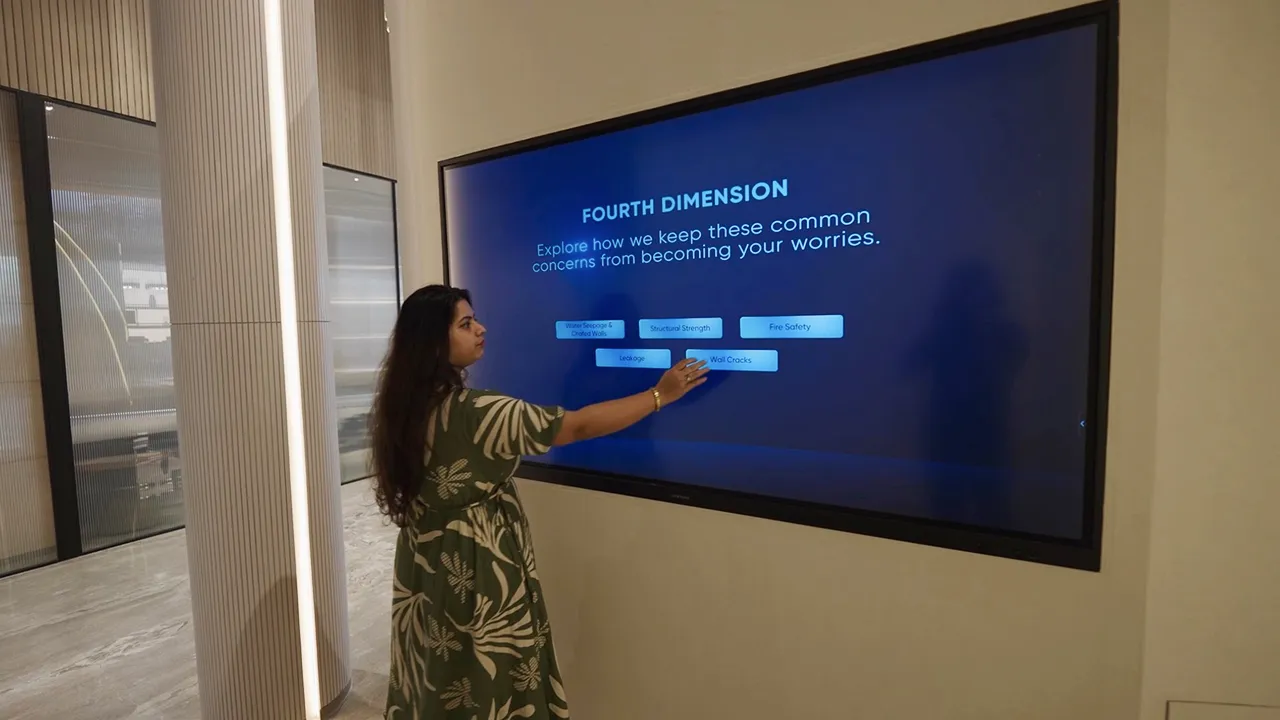
- Interactive touchscreen walls layering construction quality, materials, and engineering detail on demand
- Object recognition tables for physical products, letting visitors place an item and instantly see the engineering behind it
- Touch-driven comparison tools, contrasting standard-grade versus premium-grade systems side by side
- CRM-linked interaction tracking, so every module a visitor engages with becomes a data point for the sales team afterward
Where Systems-Into-Journeys Design Matters Most

This approach earns its keep anywhere the real product advantage is structural, not visual:
- Luxury and premium real estate, where construction quality and materials justify a price gap that isn't visible from a show flat
- Automotive and manufacturing, where safety engineering and build tolerances are the actual sale, not the paint job
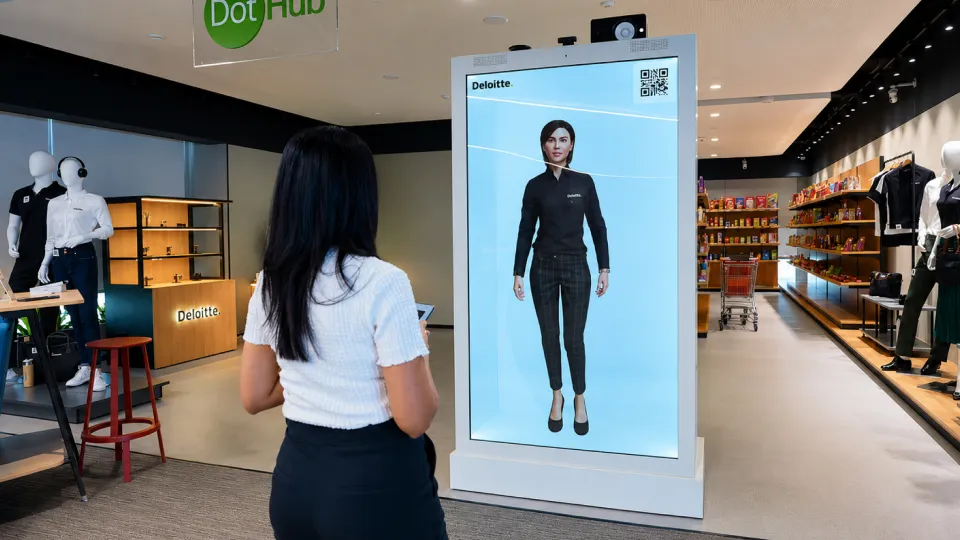
- Enterprise technology, where Deloitte used a similar system-to-journey approach at its Dot Hub AI Experience Center, turning a backend retail AI stack into something clients could physically explore rather than read about
- Infrastructure and industrial brands, translating engineering specifications into something a non-technical stakeholder can still evaluate confidently
Retail brands benefit from the same underlying logic in a lighter form — an object recognition table that instantly surfaces a product's materials and origin does for a shopper exactly what a rotoscopic wall does for a home buyer: it replaces a claim with a demonstration.
Case Study: Engineering You Can See

Godrej is one of India's most established real estate names, but even its premium developments had historically relied on standard AV rooms and looping MP4 videos to communicate value. For Trilogy in Worli, one of its most luxurious South Mumbai projects, Godrej chose to introduce experiential technology into its sales journey for the first time — not for novelty, but to prove what actually sets a Godrej home apart.
The build: the Fourth Dimension Experience Center, structured around two custom technologies working together.
- A Curved Rotoscopic Wall converts core product features into kinetic, interactive storytelling — engineering that was previously a static claim becomes something visitors watch unfold.
- An Interactive Touchscreen Wall layers in the detail — construction quality, materials, and engineering systems, available on demand for visitors who want to go deeper.
The path through the space follows an S-shaped route by design, eliminating the decision paralysis a straight, open layout tends to create. Short-form modules accumulate curiosity module by module rather than front-loading everything into one long narrative.
What it changed for the sales process: the experience center gave Godrej's sales team a consistent, verifiable set of talking points — every buyer now receives the same quality of technical evidence, regardless of which sales executive is in the room. Conversion reliability improves precisely because the proof mechanism no longer depends on individual sales skill alone.
Explore the full experiential sales journey built for Godrej Properties to see the complete build.
Implementation Timeline
System-to-journey builds tend to follow this rhythm:
- Weeks 1–4: Technical audit — identifying which invisible specifications actually differentiate the product and deserve a physical demonstration
- Weeks 4–10: Path and zone design, including S-shaped or curved layout planning specific to the space
- Weeks 10–20: Content production for rotoscopic and touchscreen walls, alongside hardware integration
- Weeks 20–24: Sales team walkthroughs, ensuring the room's proof points and the sales pitch stay aligned
- Ongoing: Content updates as specifications, materials, or product lines evolve
Space and Infrastructure Requirements
A few specifics matter more here than in a typical showcase:
- Curved wall surfaces need structural and mounting planning well before content production begins
- Touchscreen walls require reliable, low-latency backend architecture, since visitors expect an instant response when tapping between materials or systems
- S-shaped or curved paths need early architectural input, not a retrofit onto an existing straight-line layout
- Lighting needs to avoid glare across rotoscopic and touchscreen surfaces without flattening the kinetic effect
- Space for a discussion or closing zone, where sales conversations happen once the technical proof has already landed
Measurable Outcomes
Because this format is built to standardize and strengthen sales conversations, the metrics worth watching include:
- Consistency of technical claims communicated across different sales executives
- Buyer objection patterns, before versus after the installation
- Time spent per module, indicating which technical proof points genuinely hold attention
- Conversion rate on premium or higher-tier units specifically
- Sales team confidence and talking-point accuracy, measured through internal feedback
Frequently Asked Questions
Does this approach only work for real estate? No — any brand whose real advantage is structural, technical, or engineering-based can use the same logic, from automotive safety systems to industrial manufacturing tolerances.
How is this different from just filming a better product video? A video is still passive. A rotoscopic wall or touchscreen system lets a visitor control pacing and depth themselves, which builds a different kind of trust than watching something unfold on a screen.
Will this replace our sales team, or support them? It supports them directly — the room's proof points become the sales team's talking points, standardizing what every visitor hears regardless of who's presenting.
Can we start with one technology, like a touchscreen wall, and add more later? Yes. Modular builds are common specifically so a brand can expand the experience center as budget or need grows.
How do we decide which invisible specifications deserve a physical demonstration? Start with whatever buyers question most in follow-up calls — that's usually the clearest signal of where proof, not just description, is needed.
Ready to Make Your Engineering Visible?
If your real advantage is buried in a specification sheet nobody reads, it's not being felt by the people you're trying to convince. Ink In Caps has built exactly this kind of proof-driven experience center for brands whose quality deserves to be seen, not just claimed.
Reach out to our team to talk through how experience center development could turn your own invisible systems into a visitor journey worth trusting.





















Sign in to leave a comment.