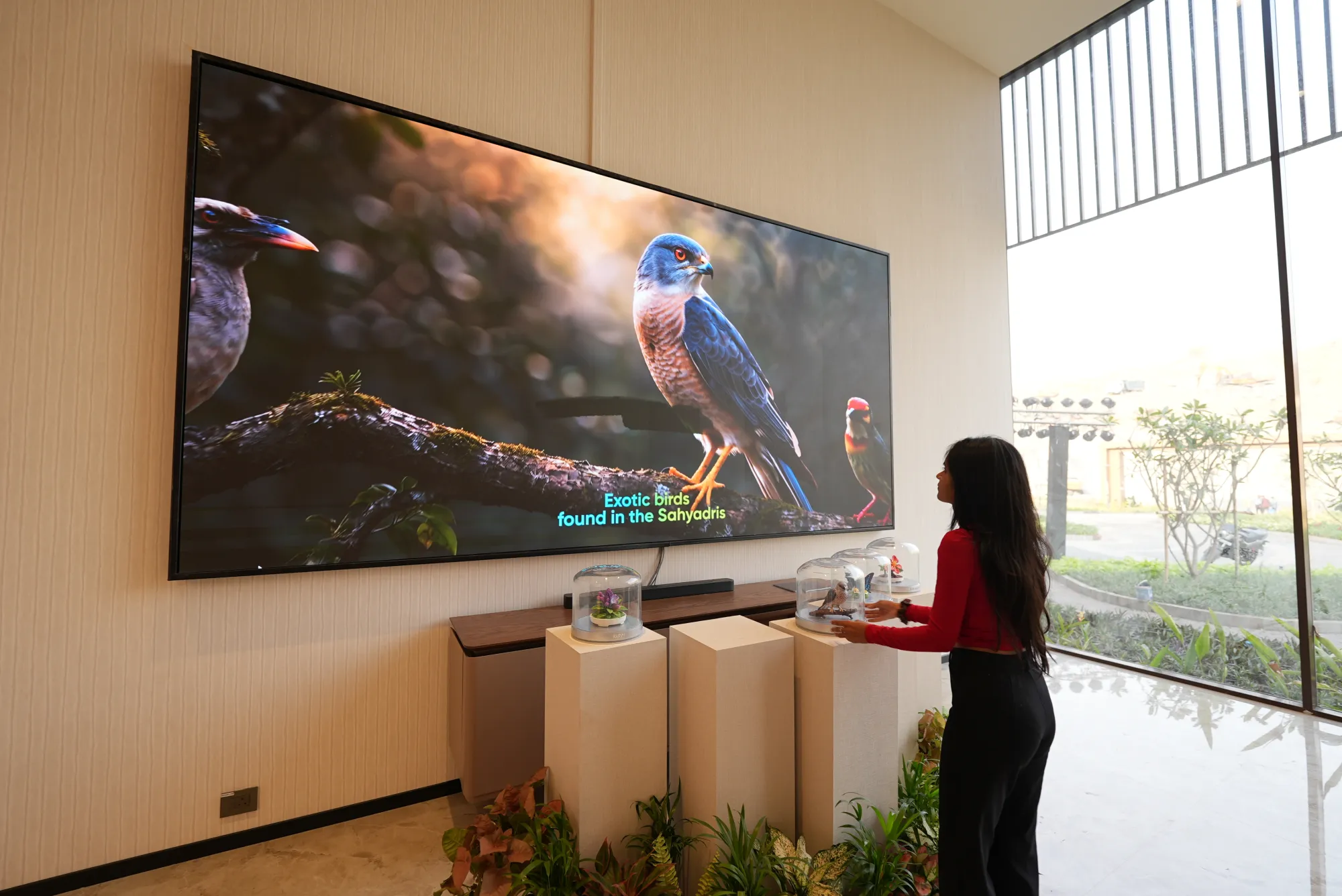

Somewhere in a marketing team's planning meeting right now, someone is asking a version of the same question: how do we make people actually stop, understand, and remember what we're showing them? The venue changes — a permanent experience centre, a three-day exhibition hall, a single-day product launch — but the underlying problem barely does. Attention is scarce, claims are easy to ignore, and a brand usually gets a handful of seconds to earn more than a glance.
Interactive technology for events has become the standard answer to that question across very different formats, and it's worth understanding how the same core toolkit — touch, gesture, projection, NFC, kinetic surfaces — gets reshaped depending on whether you're building a permanent flagship space or a booth that exists for 72 hours.
One Problem, Four Different Formats
It helps to be specific about what each format actually demands, because the planning, budget, and technology choices shift meaningfully between them.
- Events need to hold attention inside a crowded, competitive environment where dozens of other activations are fighting for the same eyeballs.
- Launches need to create a single, high-stakes moment that feels significant enough to justify the announcement.
- Exhibitions need to survive continuous, heavy public use across multiple days without a dip in reliability.
- Experience centres need to sustain engagement over months or years, not just a single event window.
The same interactive principle — let the visitor act instead of watch — applies to all four. What changes is scale, durability, and how much of the story a brand can afford to tell in the time it actually has.
A Case Study Built for Exhibition Scale: JioBrain at India Mobile Congress
India Mobile Congress is the country's premier technology showcase, held annually and inaugurated by the Prime Minister. For its 2024 edition, Reliance Jio approached IIC Lab with a genuinely difficult brief: make two abstract, technical initiatives — JioBrain, Jio's AI model, and its 5G Intelligent Village programme — feel tangible to a crowd that has no patience for abstraction.
The solution split into two distinct interactive systems.
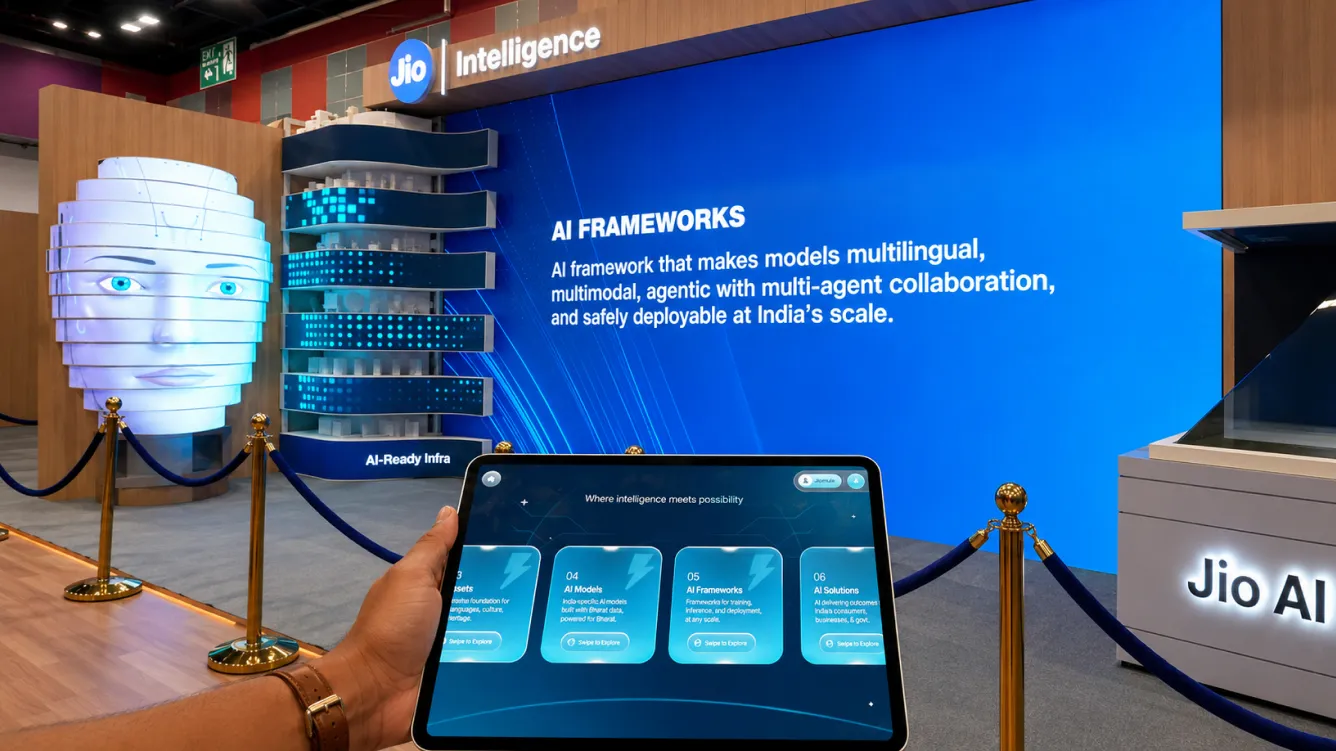
For JioBrain, IIC Lab built a multi-dimensional interaction system centred on a large LED display paired with three interactive kiosks. Each kiosk held custom-designed acrylic placards representing different industry applications of JioBrain's AI. A visitor picked up a placard, placed it on the kiosk, and NFC technology triggered a synchronised animation sequence — the kiosk lighting up while matching 2D and 3D content played on the main LED screen, walking through a real-world problem and how JioBrain solved it.
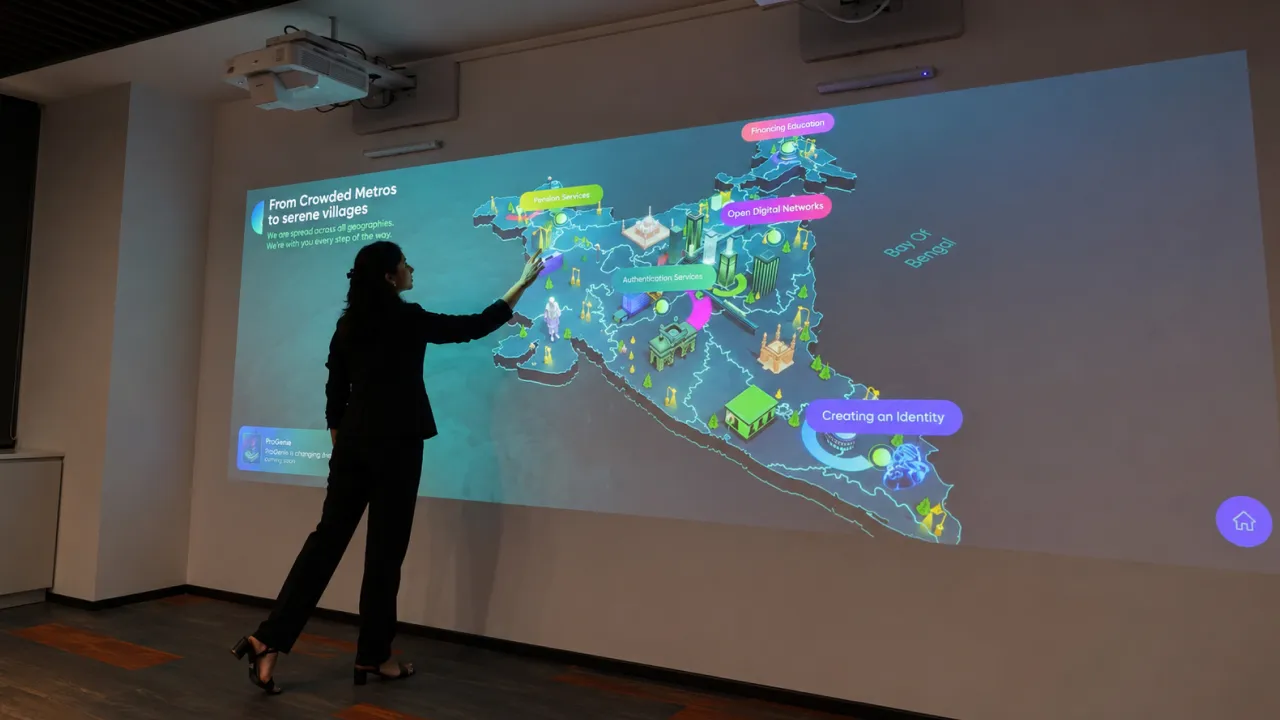
For the 5G Intelligent Village, the team built an interactive wall using projection mapping with touch sensitivity, structured as a 2.5D isometric village rather than a flat 2D presentation, deliberately built to create visual depth in a way standard slides can't. Visitors touched different parts of the village to trigger animations across four pillars — Smart Agriculture, Smart Healthcare, Smart Education, and Smart Panchayat — each one showing how 5G technology reaches rural India in a way that felt culturally grounded rather than abstract.
What Exhibition-Scale Reliability Actually Requires
This case study is a useful reminder that exhibition-scale interactive builds live or die on reliability, not just creativity. The NFC system had to handle continuous, high-volume interaction from large, non-stop crowds without failing. Digital animations had to align precisely with the physical engravings on each placard. And the team had to build a genuinely crash-resistant Unity application, because failure in a high-stakes, high-visibility environment isn't a minor bug — it's a visible, public failure.
That reliability was tested in the most stressful way possible: an LED panel failed minutes before Anant Ambani's scheduled visit to the booth, and the team had to resolve it in real time under enormous pressure. The projection wall's touch sensitivity also needed constant recalibration, since the fabricated surface shifted slightly under physical conditions in ways a lab test never fully predicts. These are the unglamorous realities behind a polished exhibition experience — and they're exactly why experienced technical execution matters as much as creative concept.
The Results
The installation drew over 170,000 visitors from across the globe, successfully presented to Reliance leadership including Anant Ambani despite the early technical scare, and established what the brand internally described as a benchmark for interactive technology at the event. More importantly, it did what abstract technology briefings almost never manage: it made AI and 5G infrastructure feel like something visitors personally understood, not just something they were told about.
How the Same Toolkit Adapts Across Formats
It's worth briefly seeing how the same underlying interactive principles show up differently depending on the format a brand is planning for:
- At events, Jio Star's WAVES 2025 activation used a curved anamorphic LED wall and a custom hologram to hold the attention of over 100,000 visitors and several government dignitaries across a multi-day summit.
- At launches, BMW's BEVScape platform was built for a single showroom before its potential earned it a national launch across 40+ dealerships at Auto Expo 2025.
- At experience centres, Godrej's Fourth Dimension zones at Trilogy and Varanya were built for sustained, permanent daily use across months of ongoing sales conversations rather than a single event window.
Each of these projects used a different combination of the same underlying tools — NFC, projection mapping, kinetic LED, gesture recognition, Unity-based interaction — reshaped entirely around how long the installation needed to last and how many people it needed to survive interacting with it. You can see the full range of these tools on IIC Lab's interactive wall technology page and browse deployments by industry on the use cases page.
Planning Across Formats: What Actually Changes
- Scope the lifespan first. A three-day exhibition build and a five-year experience centre need fundamentally different hardware durability, not just different content.
- Budget stress-testing time proportionally to expected footfall. JioBrain's NFC system needed to survive continuous use by a share of 170,000 visitors — that's a different engineering bar than a boutique retail kiosk.
- Plan fabrication lead time for anything custom. Kinetic LED walls, curved anamorphic surfaces, and isometric projection builds all require meaningful design and build time before install day.
- Build a real-time contingency plan for high-profile visits. If there's any chance of VIP attention, plan for the failure scenario, not just the success scenario.
- Decide early what data you actually need to capture — dwell time, interaction counts, or lead capture — because retrofitting analytics after launch is far harder than designing for it upfront.
Space and Infrastructure Needs by Format
Exhibitions need power redundancy and connectivity that can survive shared convention-hall conditions, plus a setup and calibration window that accounts for booth construction happening around your installation, not in isolation. Launches need a controlled reveal environment where lighting and sightlines are locked down in advance, since a launch moment rarely gets a second take. Experience centres need the earliest architectural involvement of all four formats, since structural load, wall mounting, and mechanical clearance for rotoscopic or kinetic systems have to be designed into the space itself, not added afterward.
What Brands Gain From Interactive Wall Projection Brand Activation, Across Every Format
The return looks different depending on the format, but it follows the same underlying pattern. Exhibitions gain reach and reliability at scale. Launches gain a moment significant enough to justify the announcement. Experience centres gain sustained engagement that compounds over months. And in every case, the brand gains something a static display structurally cannot deliver: a visitor who did something, not just someone who saw something.
Looking for Examples of Experiential Marketing That Helped B2B Brands?
JioBrain at India Mobile Congress is a strong example in its own right — the presence of Reliance leadership and a technical, industry-facing audience made this as much a B2B credibility exercise as a public showcase. The same NFC-and-kiosk structure has since informed how IIC Lab approaches other enterprise briefs where the audience includes technical decision-makers alongside the general public.
Tips for Brands to Create Memorable Interactive Installations
- Match the format to the lifespan. Don't over-engineer a three-day exhibition build to experience-centre durability standards, and don't under-engineer a permanent space to survive only a launch week.
- Design a real fallback for hardware failure, especially anywhere a VIP visit is even remotely possible.
- Use physical, tactile interaction wherever the audience skews non-technical. Placards and NFC pods outperform pure touchscreens for broad, mixed-age crowds.
- Recalibrate touch and gesture systems throughout a multi-day event, not just once during setup.
- Decide what "memorable" means for your specific format — a launch needs a single unforgettable moment; an experience centre needs a journey worth repeating.
Whatever the Format, Build Something Visitors Actually Remember
Whether you're planning a single-day launch, a multi-day exhibition floor, or a permanent experience centre meant to last years, the underlying question is the same: will visitors leave having done something, or just having seen something? IIC Lab has built across all four formats for enterprise brands including Reliance Jio, BMW, Godrej, and P&G, managing strategy, content, and technical execution end to end.
Talk to IIC Lab about the right interactive approach for your next event, launch, exhibition, or experience centre.




















Sign in to leave a comment.