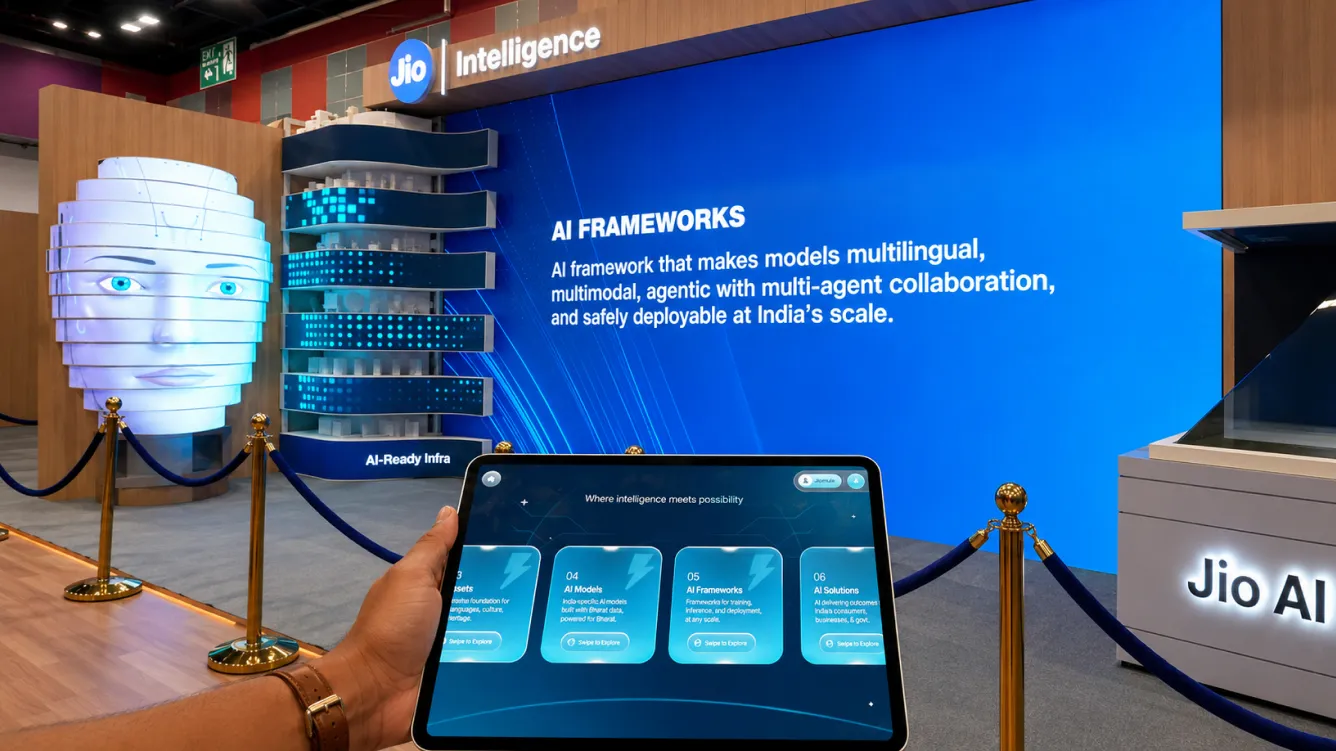

Picture a room full of heads of state, investors, and technology leaders from 118 countries, each with about ninety seconds of attention to give before moving to the next booth. You can't hand them a whitepaper about your six-layer AI architecture and expect them to read it. This is the exact challenge that pushes the best artificial intelligence solutions away from screens full of text and toward something a person can actually watch happen in front of them.
Why Innovation Stays Invisible Without a Physical Form
The hardest part of showcasing enterprise-grade AI is that most of what makes it impressive, data centres, GPU clusters, model training pipelines, has no natural visual form. You can't point at "elastic compute" the way you can point at a car engine. Left unaddressed, this invisibility becomes a business problem: investors can't evaluate what they can't picture, media can't cover what they can't photograph, and policymakers can't champion what they can't demonstrate to their own constituents.
The Solutions of Artificial Intelligence That Bridge That Gap
This is exactly where the right solutions of artificial intelligence, paired with physical design, earn their value. The goal isn't to simplify the technology into something less impressive. It's to translate it into a form a visitor can navigate with their hands.
Planning Process: Mapping Abstraction to Object
- Break the technology into distinct, ordered layers or stages
- Assign each layer its own physical representation, a panel, a screen, a model
- Design a control mechanism (often a tablet) that lets visitors trigger each layer themselves
- Build a single closing moment that ties every layer together visually
Content and Visitor-Journey Strategy
The sequence matters as much as the content. A visitor should be able to select one piece of a system, watch it light up, see it explained, and then watch it materialise as something they can walk around, before moving to the next layer. That loop of select, watch, understand is what makes dense technical material stick.
Technologies Used to Make Architecture Physical
- Custom-built LED stack panels, each representing a distinct architectural layer
- A Unity-based engine triggered wirelessly through tablet controllers, with no physical cabling
- Purpose-built 3D models rendered inside a volumetric hologram for each layer selected
- Synchronised video content on a central screen that plays in step with the panel and hologram
Where This Fits Beyond Government-Scale AI
This approach isn't limited to national infrastructure. Any enterprise with a layered, technical product, cloud platforms, manufacturing systems, R&D pipelines, can use the same select-watch-understand loop to make its innovation legible to non-technical stakeholders at trade shows and investor days.
Case Study: Reliance Jio's AI Stack at the India AI Impact Summit 2026
At the India AI Impact Summit 2026, inaugurated by PM Narendra Modi at Bharat Mandapam, Reliance Jio needed to present its entire six-layer, national-scale AI stack to a global audience without losing anyone in the technical detail. It partnered with IIC Lab to build a physical, walk-through pavilion anchored by the tagline "Democratising AI for India."
The centrepiece was a set of custom LED stack panels, each representing one architectural layer, from AI-ready infrastructure and elastic compute through to data assets, models, frameworks, and finished AI solutions. Visitors used an iPad controller to select a layer; the matching LED panel lit up, a dedicated video played on the main screen, and a purpose-built 3D model appeared inside a pyramid-shaped volumetric hologram, including a fully in-house architectural model of Jio's Jamnagar data centre for Layer 1.
Read the full breakdown here: Jio Intelligence AI Stack at the Impact Summit.
The results:
- 5 lakh+ onsite visitors and 9 lakh+ virtual views
- Built and deployed within a 16-hour onsite window, running five full days with zero downtime
- Coverage from 200+ global media houses and over 1,500 media professionals
- 100+ global CEOs and CXOs engaged directly with the pavilion
Implementation Timeline
What makes this build notable isn't a long runway, it's the opposite. The entire physical installation was assembled and deployed onsite in a 16-hour window, which meant the content architecture, hardware calibration, and synchronisation logic all had to be locked well before arriving on-site, with the physical build itself compressed into a single overnight push.
Space and Infrastructure Requirements
A build like this needs a pavilion-sized footprint with reliable rigging for LED panels, a dedicated enclosure for the hologram pyramid, and power and network redundancy robust enough to guarantee zero downtime across five days of continuous VIP and public footfall.
Measurable Outcomes
Beyond the visitor count, the pavilion became one of the most covered zones at the entire summit, turning a technical showcase into what was effectively earned media at a global scale.
Frequently Asked Questions
Is there a good example of experiential marketing that worked for a B2B, enterprise-facing audience?
Jio's pavilion is a strong one. Its core audience wasn't retail consumers, it was CEOs, CXOs, and policymakers from 118 countries, and the format worked precisely because it let technical visitors self-navigate at their own depth of interest.
What's a tip for brands planning a physical installation for a high-profile event?
Design for zero downtime from day one. A summit-scale audience won't tolerate a glitchy demo, which is why offline logic and redundancy need to be built in from the earliest planning stage, not bolted on afterward.
What do retail or consumer brands take away from a government-and-enterprise example like this?
The core lesson transfers directly: complexity kills attention. Whether you're explaining a six-layer AI stack or a loyalty programme's backend, breaking it into selectable, visual layers keeps a non-technical visitor engaged instead of overwhelmed.
How fast can a physical AI showcase like this realistically be built?
Jio's pavilion proves rapid deployment is achievable, but only when the content and technical architecture are finalised well in advance. The 16-hour window covered physical assembly, not the planning that preceded it.
Ready to Make Your Innovation Physical?
If your product's biggest strength is also its biggest communication problem, too complex to explain, too abstract to photograph, that's a design challenge, not a dead end. IIC Lab has built exactly this kind of translation for national-scale AI infrastructure under summit-level time pressure. Reach out to IIC Lab to talk through what your innovation could look like in physical form.























Sign in to leave a comment.