
Two people can walk into the exact same room and leave with two entirely different experiences — if the room is smart enough to notice the difference between them. That's the quiet promise behind well-built artificial intelligence solutions: not a single scripted tour for everyone, but a journey that reshapes itself around whoever happens to be standing in front of it.
Most physical spaces still treat every visitor identically. A brochure doesn't know if you've read it before. A wall display doesn't know your postcode, your interests, or what you asked about five minutes ago at the last exhibit. Real personalisation means a space that remembers, adapts, and responds — without ever making the visitor fill out a form to get it.
The Problem: Generic Experiences in a World That Expects Personal Ones
People increasingly expect the physical world to keep pace with the digital one, where recommendations, search results, and content already adjust to them automatically.
- A one-size-fits-all tour treats a first-time visitor the same as a repeat one
- Regional or local relevance gets lost when content is built for a "national average" audience
- Visitors forget generic information almost as quickly as they receive it
- Without a way to track engagement, brands have no idea which parts of an experience actually landed
Closing this gap doesn't require guesswork. It requires a system built to notice what a visitor is doing and adjust accordingly, in real time.
What an Artificial Intelligence-Driven Solution for Personalisation Actually Involves
Real-time personalisation inside a physical space usually rests on a few connected layers:
- Location- or input-based filtering, so content narrows down to what's actually relevant to that visitor — their region, their interests, their prior choices
- Cross-zone memory, where a choice made in one part of the experience quietly informs what appears later
- Live, visitor-driven inputs, such as polls or selections, reflected back into the experience in real time
- A post-visit digital layer that carries a personalised summary beyond the physical space itself
This is where an artificial intelligence-driven solution does more than automate — it makes an experience feel like it was built for one person, even when thousands walk through it.
Case Study: How Protean Personalised a National Story, Zone by Zone
Protean eGov Technologies powers identity, taxation, education, and payment systems used across India — infrastructure so broad that a single, generic explanation could never do it justice for every visitor. When IIC Lab built Protean's Interactive Experience Centre, personalisation wasn't an afterthought; it was built into the structure of the journey itself.
Where personalisation showed up:
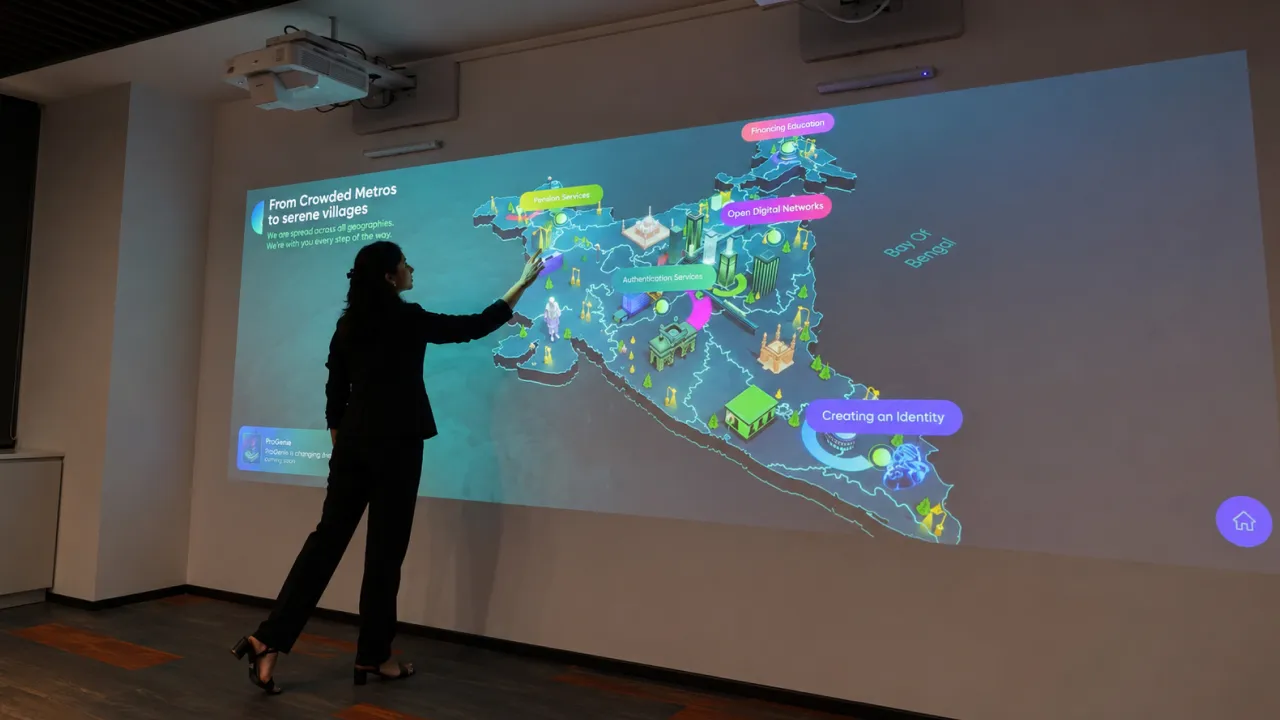
- Mapping Impact Across India — An interactive projection wall paired with an iPad controller let visitors search by PIN code to see exactly which services and TIN Centres served their own region, turning a national dataset into something locally relevant rather than abstract. Live polls captured visitor input and reflected it back on the wall in real time, alongside dynamic data responses linked to the choices visitors had already made in an earlier zone.
- The Power of Protean RISE — A dial interface paired with gamified simulation let each visitor construct their own scenario-based journey — across payments, taxation, education, healthcare, or social security — connecting modular APIs by hand to see how Protean's platform capability comes together for different real-world needs.
- The Digital Journey Layer — QR-based registration tracked each visitor's movement and time spent across zones, delivering contextual insights in real time and a personalised summary at the end of the visit. A printed PVC ID card with an embedded AR marker let that personalised journey be reactivated anytime afterward, on the visitor's own schedule.
What this personalised structure delivered:
- 300+ designed interaction points across four physical zones and one web-based portal, each capable of responding differently depending on the visitor
- Pan-India relevance made explorable at a local, PIN-code level rather than delivered as a single national narrative
- A personalised takeaway for every single visitor, not just a shared brochure
- A digital layer that kept the experience alive well beyond the physical visit
The result, according to Protean's leadership, was infrastructure and interconnectedness that visitors experienced directly rather than had described to them. See the complete breakdown in the Protean Experience Centre case study.
Tips for Brands to Create Memorable Interactive Installations
Personalisation done well tends to share a few habits:
- Personalise inputs, not just outputs. Let visitors choose or search (like PIN code lookup) rather than only receiving pre-set content.
- Let earlier choices ripple forward. A journey feels personal when zone two clearly remembers what happened in zone one.
- Reflect visitor input visibly and quickly. Live polls and instant on-screen responses make people feel heard, not just observed.
- Extend personalisation past the exit. A digital summary or reactivatable AR element keeps the relationship going after the visitor leaves.
What Retail Brands Gain From Immersive Marketing Activation
Personalised, real-time journeys carry an especially strong payoff in retail settings:
- Shoppers get recommendations and content relevant to their own preferences, not a generic catalogue
- Local relevance — like region-specific stock or services — builds trust faster than a one-size-fits-all pitch
- A memorable, personal takeaway increases the odds of a customer returning or referring others
- Every personalised interaction generates insight brands can use to refine future campaigns
Examples of Experiential Marketing That Helped B2B Brands
Protean's PIN-code personalisation is one strong example, but the same principle carried Deloitte's Dot Hub experience centre, where an AI sales assistant tailored recommendations to each visitor's product interests in real time rather than running a fixed script. Both cases show that personalisation isn't a retail-only tactic — it's just as powerful for B2B brands explaining complex, high-stakes offerings. Explore more of these builds across IIC Lab's use cases.
Frequently Asked Questions
Does real-time personalisation require visitors to log in or share personal data? Not necessarily. Much of Protean's personalisation, like PIN-code lookup and in-journey choices, worked without requiring any personal login — visitors simply interacted, and the system adapted.
Can a personalised experience scale to thousands of visitors? Yes, provided the backend is built for it. Protean's system handled 70,000+ data points across 300+ interaction points without needing a rebuild.
Is real-time personalisation only possible with a large budget? Not necessarily. Even a single zone — like a PIN-code lookup wall or a simple visitor-choice-based content path — can deliver meaningful personalisation on a smaller scale.
Ready to Build a Journey That Adapts to Every Visitor?
If your current experience treats every visitor the same way, there's likely real value sitting unused in that gap. IIC Lab builds artificial intelligence solutions that personalise physical journeys in real time, without asking visitors to do the extra work. Talk to IIC Lab about building one for your brand.























Sign in to leave a comment.