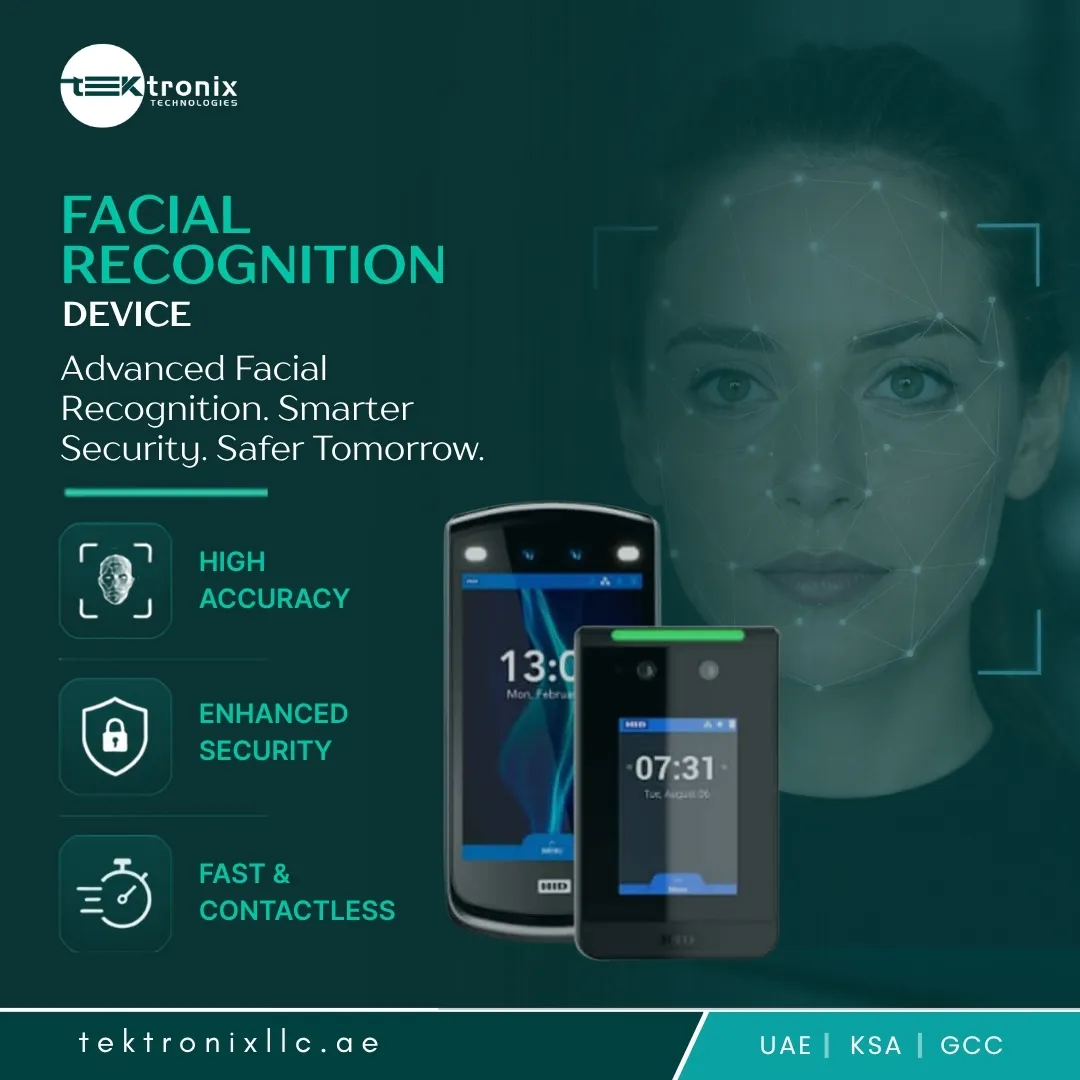

Facial Recognition System technology is quickly becoming the standard for how UAE organizations verify identity, secure entry points, and monitor high-value facilities. As Dubai, Abu Dhabi, and Sharjah continue to push forward with smart-city initiatives, security teams are moving away from badges, PIN codes, and manual guard checks toward biometric verification that is faster, harder to forge, and easier to audit. This guide explains the technology behind modern biometric security and what to evaluate before choosing a system for your organization.
Why Smart Security in the UAE Depends on Biometric Verification
The UAE's rapid development of smart buildings, free zones, and government facilities has raised the bar for what counts as adequate security. Badges can be lent out, PINs can be shared, and guards can be fooled by a convincing enough excuse — but a person's face is far harder to replicate or transfer to someone else. This shift is why biometric verification is increasingly written into tender requirements for new developments across the Emirates rather than treated as an optional upgrade.
Dubai's Smart City Vision and the Rise of Biometric Buildings
Government-backed initiatives across Dubai and Abu Dhabi have made biometric access a foundational requirement for many new developments rather than an afterthought, pushing the broader private sector to follow suit. As more UAE developers specify smart-building standards, biometric verification has moved from a niche corporate feature to a mainstream expectation for new construction.
From Guards and Badges to Biometric Verification
Facilities that once relied entirely on security personnel and printed badges are now layering biometric checks on top of — or in place of — those older methods. This transition is being driven as much by operational efficiency as by security: biometric checkpoints move authorized personnel through faster while still producing a documented, auditable access record.
Face Detection: The First Step in Modern Security
Locating a human face within a camera frame is the foundational step that has to happen before any identity matching can take place. Modern detection models can isolate a face accurately even in crowded lobbies, poor lighting, or partial obstruction, which is essential groundwork for everything else the system does afterward. Without this reliable first pass, even the most advanced matching engine has nothing accurate to work with.
Facial Identification: Matching a Face Against a Database
This one-to-many matching process answers the question 'who is this person?' by comparing a detected face against a broader database to find a match, which is useful for watchlist screening or visitor logging. Facilities handling large visitor volumes, such as malls or transport hubs, often rely on this approach to flag individuals of interest without requiring every person to actively present a credential.
Facial Authentication: Confirming a Claimed Identity
This one-to-one verification process instead answers a narrower question — 'is this the specific person they claim to be?' — typically used for badge-free entry at a specific door or workstation. Understanding which use case a facility actually needs prevents organizations from overpaying for database-scale infrastructure when simple one-to-one verification would suffice, or the reverse.
Facial Recognition Access Control: Badge-Free Entry for Modern Facilities
This approach replaces or supplements traditional badge readers by granting or denying entry based on a verified face match rather than a swiped card. This eliminates the risk of lost, stolen, or shared badges entirely, while producing a far more reliable audit trail than card-swipe logs, which only confirm that a badge was used — not who was actually holding it.
Facial Recognition Device: Choosing the Right Hardware
Camera hardware varies significantly in image quality, processing speed, and built-in liveness detection to prevent spoofing with photos or video replays. Organizations should evaluate hardware under their actual lighting and traffic conditions — a lobby with strong backlighting or high foot traffic during peak hours performs very differently from a quiet, evenly lit demo environment. Facilities exploring a facial recognition system for Dubai should request an on-site trial rather than relying solely on vendor specification sheets.
Facial Recognition Software: What Makes the Matching Engine Reliable
The underlying matching engine is what determines whether a deployment performs accurately across different ages, ethnicities, lighting conditions, and partial face coverings such as sunglasses or masks. This software layer, not just the camera, is usually the deciding factor in whether a rollout produces consistent results at scale or generates frustrating false rejections during daily use.
Facial Recognition Solution: Evaluating a Platform for Your Organization
A complete biometric security package should be assessed on integration depth with existing access control and visitor-management systems, not just standalone accuracy claims. Organizations should confirm the vendor can support multi-site deployments, centralized enrollment databases, and compliance with regional data-handling expectations before committing to a rollout.
Building a Long-Term Biometric Security Roadmap
Rather than attempting to secure every entrance at once, many organizations find it more practical to phase a facial recognition rollout across one or two budget cycles, prioritizing the highest-risk doors first — typically executive floors, data rooms, and main building entrances — before extending the same platform to lower-risk areas. This phased approach also makes it easier to secure internal budget approval, since each stage can be justified on its own merits rather than requiring sign-off for an entire building-wide overhaul at once. Organizations that document this roadmap clearly, including target dates for each phase and the specific risk each stage addresses, tend to maintain stronger executive support throughout the rollout than those treating it as a single undefined project.
Scaling Facial Recognition as Your Organization Grows
A system that works well for a single-entrance headquarters with a few hundred staff may behave very differently once an organization expands to several branches or adds a large temporary workforce during a busy season. Organizations should evaluate how easily a platform can add new sites, new camera hardware, and bulk enrollments without requiring a complete system redesign each time headcount or footprint changes. Vendors with genuine multi-site experience in the region typically have established processes for this kind of scaling, while those without it often struggle when a client's needs outgrow the original single-site deployment.
Incident Response: Handling Verification Failures and Suspicious Attempts
Even a well-tuned system will occasionally reject a legitimate staff member due to lighting changes, a new haircut, or a minor camera obstruction, and facilities need a clear fallback procedure for these moments rather than simply propping a door open. A documented exception process — typically involving a manual verification step by security personnel and a logged override — keeps the audit trail intact even when the automated system cannot make a confident match. Equally important is a clear escalation path for suspected spoofing attempts flagged by the anti-spoofing layer, so security teams know whether to detain, question, or simply deny entry and log the event for later review.
Aligning Facial Recognition Investment with UAE Smart-Building Standards
The UAE's continued push toward smart-city and smart-building standards across Dubai and Abu Dhabi means new commercial developments increasingly specify biometric-ready infrastructure from the earliest design stages rather than retrofitting it after construction. Developers and enterprise tenants alike benefit from aligning their security specification with these broader smart-building expectations, since doing so both future-proofs the investment and signals a level of operational maturity that increasingly matters to prospective tenants, investors, and regulators evaluating a building's overall quality.
Common Deployment Scenarios: Banks, Malls, and Government Facilities in the UAE
Bank branches and headquarters typically prioritize a fast, discreet verification experience for staff, often layering facial verification at staff-only doors while maintaining a separate flow for the public. Malls and large retail developments tend to use facial identification more broadly for loss-prevention and watchlist screening across common areas, rather than one-to-one authentication at a specific door. Government facilities frequently apply the strictest combination of both, using identification at building entrances alongside authentication at individual restricted offices or floors.
Integration with Existing Building and Security Systems
A facial recognition rollout rarely stands alone — most deployments need to integrate with existing turnstiles, elevator access systems, visitor management kiosks, and building-wide video surveillance already in place. Organizations should confirm that a prospective platform can work alongside legacy card readers during a phased rollout, rather than requiring an all-at-once replacement of every door in the building on a single go-live date.
Data Privacy and Governance for Biometric Credentials in the UAE
Because facial recognition systems store biometric templates alongside identity information, organizations need clear policies on how this data is encrypted, retained, and who within the company can access it. UAE organizations should confirm that enrollment data is stored securely, that departing staff have their biometric records properly removed from the system, and that the platform's data handling aligns with the organization's own internal privacy commitments to employees and visitors alike.
Measuring Return on Investment for Facial Recognition Deployment
The cost case for biometric verification usually rests on three measurable savings: reduced time lost to manual badge checks at busy entrances, fewer security incidents tied to lost or shared credentials, and a stronger audit trail that simplifies compliance reviews and incident investigations. Organizations that previously staffed a manual checkpoint at every entrance often find that automated verification absorbs much of that workload, freeing security personnel for patrols and exception handling rather than routine credential checks.
Staff and Visitor Training for Biometric Rollouts
Even the most reliable hardware depends on staff and frequent visitors understanding how the new process works. A short orientation — explaining how the camera capture works, what to do if verification fails, and how enrollment data is handled — significantly reduces confusion and help-desk friction in the weeks following a rollout. Organizations that skip this step often see a spike in support requests during the first month, not because the technology is unreliable, but because people were never given a clear explanation of how the new process differs from the badge system they are used to.
Multi-Site Deployment: Managing Recognition Across Several UAE Locations
Organizations operating more than one office or branch across the UAE benefit significantly from a centralized management platform that oversees enrollment, credentials, and access logs across every site from a single dashboard. This is particularly valuable for banks with multiple branches or retailers with several mall locations, since security teams can apply consistent policies everywhere rather than managing each location as an isolated system with its own separate database.
Choosing the Right Vendor: Questions to Ask Before You Commit
Organizations evaluating a provider should ask for specific examples of comparable regional deployments at similar scale, not just international case studies from markets with different infrastructure and demographics. Useful questions include how quickly the vendor can issue and revoke enrollment following a company's own onboarding and offboarding process, what happens to entry security during a network outage, and how the system's accuracy has been validated under Gulf-region lighting conditions specifically rather than in a generic demo environment.
Physical Design Considerations for High-Traffic Entrances
Where a camera is physically mounted, how it is angled relative to typical visitor height, and how much ambient light falls on the capture zone all affect real-world accuracy just as much as the underlying software. Entrances facing direct sun exposure often need shade structures or adjusted camera positioning to avoid glare washing out the capture, while high-traffic lobby doors need faster processing hardware to prevent queues from forming during peak arrival hours.
Business Continuity: What Happens When the Network Goes Down
A system that depends entirely on a live network connection to a central server introduces a single point of failure that facility managers need to plan around carefully. Well-designed platforms cache recent enrollment and policy data locally, allowing doors to continue operating on cached rules for a defined period even if connectivity to the central system is temporarily lost. Organizations should ask vendors directly how their system behaves during an outage, since the answer has real operational and safety implications.
Comparing Facial Recognition to Other Biometric Modalities
Fingerprint and iris scanning remain viable alternatives in certain high-security contexts, but each carries its own operational trade-offs worth weighing against a camera-based approach. Fingerprint readers require physical contact, which can slow throughput at a busy entrance and raises hygiene considerations that camera-based systems avoid entirely. Facial recognition's combination of contactless operation, natural walking-speed capture, and now-mature anti-spoofing safeguards is why it has become the default choice for high-volume entrances specifically, while other modalities still play a role at the most sensitive individual doors within a facility.
Total Cost of Ownership Beyond Initial Hardware
Organizations comparing providers often focus heavily on the upfront cost of cameras and enrollment stations, but the total cost of ownership over a multi-year deployment includes software licensing, firmware updates, ongoing technical support, and the labour required for enrollment management as staff and visitors change. A cheaper initial hardware quote can end up costing more over several years if the vendor's support response times are slow or if firmware updates require a costly on-site visit rather than a remote push.
Facial Recognition System UAE: Market Overview
Adoption across the country is expanding fastest across government facilities, banking, retail, and premium residential and commercial towers, driven directly by the UAE's smart-city mandates. Facility owners across the Emirates are increasingly specifying biometric access as a baseline requirement in new development tenders rather than an optional enhancement.
Facial Recognition System Dubai: Business Hub Deployments
Projects in the emirate are concentrated in the expanding financial district, major retail developments, and premium residential and commercial towers, where high visitor volume and elevated security expectations make biometric verification especially valuable.
Why Organizations Choose Tektronix LLC
Tektronix LLC has delivered facial recognition and biometric access projects for government, banking, and corporate clients across the UAE and wider GCC, with engineering teams experienced in tuning recognition accuracy for regional lighting, foot-traffic patterns, and cultural considerations. Its regional deployment portfolio spans single-site corporate lobbies to multi-building government campuses requiring centralized enrollment management. Organizations evaluating a deployment can review the full Tektronix LLC facial recognition system for Dubai to see how these capabilities are applied on real regional projects.
Conclusion
Facial Recognition System technology, from accurate Face Detection to reliable Facial Identification and Facial Authentication, now covers the full identity-check lifecycle for UAE organizations. A well-chosen Facial Recognition Device paired with dependable Facial Recognition Software, layered into a complete Facial Recognition Solution with proper Facial Recognition Access Control, replaces badges with verification that is far harder to fake or share. As Facial Recognition System UAE and Facial Recognition System Dubai deployments continue to expand, organizations that modernize now will stay ahead of tomorrow's security expectations.
FAQs
1. How accurate is facial recognition in real-world lighting conditions?
Accuracy depends heavily on the detection and matching models used; systems tested specifically under a facility's actual lighting and traffic patterns typically perform far better than generic, unoptimized deployments.
2. Can facial recognition be fooled by a photo or video?
Systems without proper liveness detection can be vulnerable to spoofing attempts, which is why liveness checks analyzing depth and micro-movement are essential for any secure deployment.
3. What is the difference between identification and authentication in this context?
Identification searches a broader database to determine who a person is, while authentication simply confirms whether a person matches the specific identity they are claiming, typically for one-to-one entry verification.
4. Does facial recognition work well with masks or religious head coverings?
Modern systems trained specifically on partial-face and covering scenarios can maintain reasonable accuracy, though performance should always be verified under the facility's actual visitor demographics before full deployment.
5. Can biometric access integrate with our existing security systems?
Yes, most modern platforms are designed to integrate with existing access control, visitor-management, and alarm systems, allowing organizations to add biometric verification without replacing their entire security infrastructure.
facial recognition system for Dubai

































Sign in to leave a comment.