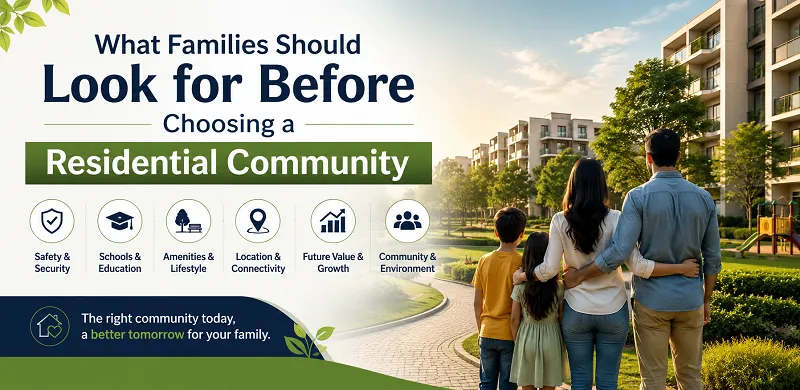

Choosing a residential community is more than just picking a house; it is about choosing a lifestyle and a foundation for your family’s future. The right neighborhood can enhance your children’s development, reduce daily stress, and provide a sense of belonging that a standalone house often cannot offer. However, the wrong choice can lead to financial strain, long commutes, and a feeling of isolation.
Before you sign any papers or pack any boxes, it is essential to look beyond the paint on the walls and the size of the backyard. You need to understand the ecosystem of the community you are about to join. This decision involves balancing your emotional needs with practical logistics, and it requires a structured approach to ensure you aren't swayed by a beautifully decorated model home. In competitive urban markets like the National Capital Region (NCR), families often look for integrated townships that offer a balance of affordability and accessibility.
If you are exploring the capital, you might be weighing the pros and cons of independent builder floors versus high-rise apartments. For instance, the demand for Rentals in Paryavaran Complex has grown as families seek a quieter, more green environment while remaining connected to the city's core. This highlights the importance of finding a community that aligns with your specific needs, whether you prioritize green spaces or proximity to work.
Key Takeaways for Families
- Location is King (for Logistics): Prioritize commute times and access to schools and hospitals over aesthetics.
- Safety First: Look for active security measures and a strong sense of community vigilance.
- Amenities vs. Cost: Evaluate whether the amenities offered (pools, gyms) justify the High Maintenance Fees.
The "Vibe" Matters: Spend time in the neighborhood at different times of the day to gauge the noise levels and community activity.
Why the Community Matters More Than the House
For families, the surrounding environment is often more critical than the internal square footage. A beautiful house in a disconnected or unsafe area can quickly become a source of frustration. The community is the space where your children will ride their bikes, where you will meet your neighbors, and where you will spend your weekends.
If the community lacks a park, your children are confined to the indoors. If the local school is failing, your child’s education suffers. If the commute is soul-crushing, your quality of life plummets. In this guide, we break down the critical factors families must consider—from physical infrastructure and security to the "hidden costs" of maintenance and the often overlooked aspect of community culture.
Defining Your Family's Priorities
Before you start viewing properties, you must define what "better living" means to your specific family unit.
Checklist: Assessing Your Family's Needs
- Commute: How far are you willing to travel to work? (Calculate fuel costs and time lost).
- Schools: Are you looking for public, private, or international curricula?
- Space: Do you need a yard for a dog, or is a community garden sufficient?
- Health: Is a hospital or clinic nearby?
- Social: Do you want a tight-knit community or a more private, anonymous lifestyle?
Location and Proximity: The Golden Rule
The most critical decision for a family is the location. You cannot change the location once you buy the property, so you must be ruthless about evaluating it.
Transportation and Commute
A long commute is one of the leading causes of family stress. Evaluate the connectivity of the community to major employment hubs.
- Public Transit: Is there a metro station or bus stop within walking distance? For Delhi families, proximity to the Delhi Metro (e.g., the Yellow Line or Pink Line) significantly increases the viability of a location.
- Road Connectivity: Is the area prone to traffic jams? How long does it take to reach the Indira Gandhi International Airport or the main commercial districts?
Proximity to Essential Services
- Schools: Look for a School District or catchment area. A good school within walking distance saves hours of traffic time daily.
- Hospitals: Access to quality healthcare is non-negotiable. In South Delhi, for example, areas near Max Super Speciality Hospital or Fortis Hospital are highly sought after by families with elderly members.
- Shopping and Groceries: Is there a local market for daily essentials? Are larger malls (like DLF Avenue or Select CITYWALK) accessible for weekend shopping?
Safety and Security Infrastructure
The sense of safety is the psychological bedrock of a happy family. A community must offer robust security.
Gated Communities vs. Open Neighborhoods
- Gated Communities often offer 24/7 security guards, CCTV surveillance, and controlled entry points. This is often the top priority for families in large cities.
- Open Neighborhoods rely more on community vigilance and local police patrols.
Specific Elements to Check:
- Perimeter Walls: Are they secure? Is there evidence of breaches?
- Lighting: Is the neighborhood well-lit at night?
- Fire Safety: Does the high-rise have fire extinguishers and evacuation plans? Are the Maintenance Fees covering these critical services?
The Vibe and Social Fabric
This is the "soft" factor, but it often determines how long you will stay in a community.
Community Events
Does the Homeowners Association (HOA) or Residents Welfare Association (RWA) organize events? Things like weekend flea markets, cultural festivals, and cleaning drives are indicators of an active community.
The Sound of Silence
Visit the community at night and on weekends. Is it the kind of noise you can live with?
- Noise Pollution: Is it near a highway? Are there barking dogs everywhere?
- Traffic Is it peaceful or chaotic?
Demographics
Are you moving into a neighborhood of retirees, young singles, or other families? If you have kids, you likely want a "family corridor" where other children live. Knowing the User-Type Entities—families, couples, or seniors—helps predict the neighborhood atmosphere.
Amenities and Lifestyle
Modern residential communities are moving beyond just being a place to sleep; they are lifestyle destinations.
The Rise of Master-Planned Communities
Developers are now creating "mini-cities." These are master-planned communities where everything from schools to clinics to retail is integrated. This reduces the need to travel outside the community, fostering a "live, work, play" environment.
Evaluating the Amenities
- Fitness and Recreation: A Community Pool, a well-equipped gym, and a tennis or basketball court.
- Green Spaces: Parks and Gardens are vital for mental health. For example, living near the Garden of Five Senses or Deer Park is a significant lifestyle asset for South Delhi families.
- Smart Home Technology: Is the community using smart meters or sustainable energy? These factors can reduce utility costs and offer convenience.
Hidden Financial Considerations
It isn’t just the purchase price or rent that matters. You need to factor in the maintenance fees and taxes.
Breaking Down Maintenance Fees
| Fee Type | Purpose | Average Cost (Varies) |
|---|---|---|
| HOA Fees | Security, landscaping, garbage collection. | Mid-Range |
| Sinking Fund | Major repairs (roof, elevators) | 10% of HOA Fees |
| Water/Electricity | Common area usage | Variable |
Property Taxes
Confirm the property tax rates in the area. South Delhi residential areas generally have high property tax valuations, so ensure this fits your long-term budget.
School Catchment and Child Development
If you have children, the education system is likely your primary concern. Even if you plan to send them to a private school, the local environment plays a role.
- School Proximity: Walkable to school is ideal.
- After-School Activities: Are there tuition centers, music classes, or sports academies nearby?
- Extracurricular Spaces: Does the community have a playground to keep your children active?
Pet-Friendly Policies
For many families, a pet is a family member.
Things to Verify
- Dog Parks: Is there a dedicated, enclosed space for pets?
- Walkability: Are there sidewalks free from traffic for morning walks?
- Breed Restrictions: Some condos have restrictions on pet breeds.
Future Development and Resale Value
When you buy a home, you are investing in the future. What is the Future Development plan for the area?
Do Your Research
- Infrastructure Entities: Look for government plans (or developer plans) to build new roads, metro lines, or flyovers. This can increase value.
- Commercial Growth: Is a new tech park or hospital coming up nearby?
- Zoning: Is the adjacent land designated for a factory or a park? Visit the local municipal office or look up zoning maps.
Common Challenges Families Face
Challenge: High maintenance fees that keep increasing annually.
Solution: Check the HOA board minutes to see how they manage funds.
Challenge: Unfriendly neighbors or a lack of community involvement.
Solution: Attend a community event (if possible) or join the local Facebook group before moving in.
Challenge: The "Beautiful House" syndrome, where you buy a beautiful home in a bad area.
Solution: Don’t compromise location for aesthetics.
Comparison: Suburban vs. Urban vs. Integrated Townships
| Feature | Suburban Home | Urban High-Rise | Integrated Township |
|---|---|---|---|
| Space | Large yards | Limited | Moderate |
| Commute | Long | Short | Short to Medium |
| Amenities | Private | Shared, Limited | Extensive |
| Security | Neighborhood watch | High Security | High Security |
| Social | Quiet | Active | Controlled Social |
Frequently Asked Questions
1. What are the most important safety features to check in a gated community?
Look for physical security (high walls, CCTV coverage at entry points), personnel security (trained guards), and system security (controlled access, visitor logs). Also, check fire safety protocols.
2. How do I find out if the local schools in a residential area are good?
Check the school's board results, look at their extracurricular programs, visit the school to see the facilities, and speak to existing parents in the community.
3. Should I choose a community with high maintenance fees?
It depends on what you get for it. High fees might be worth it if they include amenities like a community pool, gym, security, and landscaping. However, ensure the fees are stable and not rising rapidly.
4. What is a "master-planned community"?
It is a large-scale residential development that includes a mix of housing, commercial spaces, schools, and parks within the same boundary, designed to be self-sufficient.
5. How can I check the future development plans for the area?
Check the local municipal authority's master plan or zoning maps. Look for news on new infrastructure projects like metro lines, highways, or shopping centers.
6. Is it better to rent or buy in a residential community when moving to a new city?
Renting is often recommended initially. It allows you to experience the community lifestyle and identify the hidden drawbacks (e.g., noise, terrible commute) before committing to a purchase.
7. What are "hidden costs" when moving into a residential community?
Besides the maintenance fees, factor in parking charges, water/electricity common area bills, and potential special assessments for community-wide repairs (roofing, paving). Also, consider moving costs and deposits.
8. How do I ensure a community is genuinely "family-friendly"?
Look for the presence of children playing, parks with appropriate equipment, nearby schools, and a high safety rating. A community with a vibrant community hall and cultural events is also a good sign.
9. What should I do if I have pets?
Look for communities that specify "pet-friendly." Ask about dedicated pet areas, green spaces for walks, and if there are any restrictions on breed or size.
10. How does the Delhi Metro influence the value of a residential community?
Proximity to the Delhi Metro significantly increases property value and demand. It provides convenient access to the rest of the city and reduces commute times.
Conclusion
Choosing a residential community for your family is a life-changing decision. It is a decision that balances the emotional (How does this place make me feel?) with the practical (Can I afford it? Is my family safe?). There is no perfect community; there is only the one that fits your family's specific needs.
Take your time. Walk the streets. Talk to the neighbors. Check the traffic on a Monday morning. By focusing on the key pillars—safety, location, amenities, community vibe, and financial sustainability—you can ensure that your new community feels like home from day one.
Whether you are looking to rent or buy, remember that you are buying into a lifestyle and a community that will shape your family's future for years to come.






















Sign in to leave a comment.