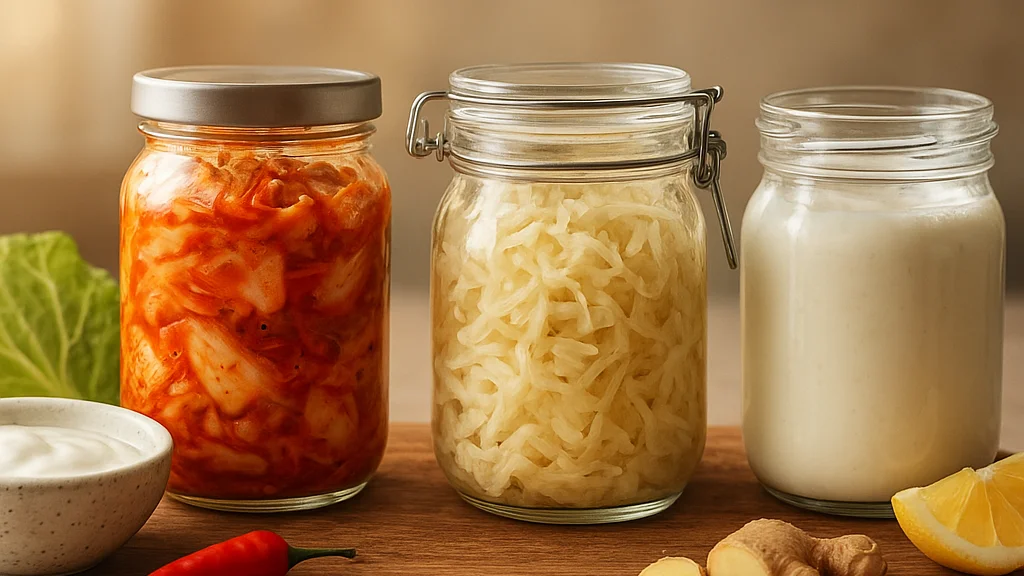

A jar of kimchi fizzing softly on kitchen counter can look almost alive, and actually, that is part of story ✨🥬. Fermentation is not culinary magic in vague lifestyle sense; it is a biological process driven by microorganisms that transform sugars and other compounds into acids, gases, and alcohols. That transformation changes flavor, texture, shelf life, and sometimes nutritional profile too 🧪💫. Across Colombia, Korea, Germany, Japan, India, and basically everywhere humans learned how to preserve harvests, fermented foods became survival tools first and health symbols much later 🌎🍶.
Now they are everywhere again: supermarket coolers packed with kefir shots, kombucha cans lined up like K-pop album versions, and social feeds full of sourdough crumb reveals and homemade pickle fan-cams 🫙📱. But hype can outrun evidence fast. Some claims are solid, some are still emerging, and some are honestly marketing in cute glass bottles 💸🧃. The useful question is not whether fermented foods are “good” in some universal way. It is which foods, under what conditions, for which people, and with what evidence 📚✨.
That distinction matters because fermented foods are not one category with one effect. Yogurt with live cultures is not same as beer, and pasteurized sauerkraut on a shelf is not same as raw refrigerated sauerkraut full of active microbes 🥣⚖️. Even within one food, strains, salt levels, fermentation time, and storage conditions can change what reaches your plate. If you have read Fermented Foods Health Benefits Explained: What Science Reveals or the more trend-focused The Secret to a Happy Tummy: Discovering the Best Fermented Foods for Gut Health, you already know the conversation has moved beyond gut-health buzzwords 🧠🍽️. What matters in 2026 is precision.
Fermented foods can support health, but they are not interchangeable, and they are not medicine for every condition ✨🧫.
What fermentation actually does inside food
Fermentation begins when bacteria, yeasts, or molds metabolize components in food, often carbohydrates, and produce compounds such as lactic acid, acetic acid, ethanol, and carbon dioxide 🦠🍚. Lactic acid bacteria are especially important in foods like yogurt, kimchi, sauerkraut, and kefir. Their acid production lowers pH, which helps preserve food and creates that bright tang many people love 😋🧂. This lower pH can also reduce growth of spoilage organisms, which is one reason fermentation mattered long before refrigeration.
Nutritionally, the process can make foods easier to digest by partially breaking down proteins, lactose, or plant compounds 🌾🥛. In dairy, that is why some people who struggle with regular milk tolerate yogurt or kefir better, though not everyone will. Fermentation can also generate bioactive peptides, B vitamins in some contexts, and compounds that influence flavor complexity. Miso, tempeh, natto, and sourdough all show how microbes can unlock textures and aromas impossible through simple cooking alone 🍞🍲.
Still, not every fermented food contains live microbes at time of eating. Heat processing, filtration, and long storage can reduce or eliminate viable organisms 🔥🧪. A food may be fermented during production but not probiotic in final form. That difference gets blurred in marketing all the time. According to nutrition experts quoted by HELLO! Magazine, fermented foods may support gut health, but benefits depend on the product, the microbes present, and overall diet 📰🥗.
Another key point: health effects may come from more than live bacteria alone 💡🧫. Fermentation changes food matrix, acidity, fiber interactions, and metabolite content. So even when microbes do not survive digestion in huge numbers, the food can still matter. That is why researchers increasingly distinguish between probiotics, prebiotics, postbiotics, and fermented foods as overlapping but separate concepts 📖✨.
- Probiotics are live microorganisms shown to confer a health benefit in adequate amounts 🦠✅
- Prebiotics are substrates selectively used by host microbes, often certain fibers 🌿🧠
- Postbiotics are non-living microbial products or components with biological activity ⚗️💫
- Fermented foods are foods made through desired microbial growth and enzymatic conversions, with or without live microbes in final product 🍽️🫙
Where the health evidence is strongest right now
The most cited modern human evidence comes from a Stanford Medicine study published in 2021 in Cell, where adults assigned to a high-fermented-food diet increased fermented food intake over ten weeks and showed greater microbiome diversity plus reduced inflammatory markers compared with a high-fiber group during that study period 🔬📈. That finding got attention because lower chronic inflammation is linked with a long list of diseases, from cardiovascular issues to metabolic disorders. The fermented foods used included yogurt, kefir, fermented cottage cheese, kimchi, vegetable brine drinks, and kombucha 🥣🥬.
Important nuance, though: this was a relatively small study, and it does not mean every fermented food pattern will produce same result in every population 🤓⚖️. But it did strengthen a serious scientific argument that regular fermented food intake can shape immune and microbial activity in measurable ways. Researchers have since explored how these foods may influence gut barrier function, immune signaling, and digestive comfort, though outcomes vary by strain and food type 🧬🍵.
Evidence is also fairly strong for fermented dairy, especially yogurt, in relation to digestive tolerance and overall diet quality 🥛✨. Large observational studies have often linked yogurt intake with healthier dietary patterns and, in some populations, lower risk of weight gain or type 2 diabetes. Observational data cannot prove causation, but yogurt repeatedly appears as part of beneficial eating patterns. Kefir has growing support too, especially for lactose digestion and possibly gut-related symptoms in some people 🥄💙.
For vegetable ferments like kimchi and sauerkraut, evidence is promising but more mixed. Kimchi contains fiber, phytochemicals from vegetables, and lactic acid bacteria from fermentation 🌶️🥬. Some studies suggest possible benefits for lipid metabolism, digestion, and microbial diversity. Yet sodium content can be high, and formulations differ widely. Sauerkraut may help digestive symptoms for some people, but again, raw refrigerated versions and shelf-stable pasteurized versions are not nutritionally identical 🧂📦.
The strongest case for fermented foods is not miracle cure narrative; it is regular inclusion as part of a diverse, minimally processed diet 🍽️🌈.
- Best-supported categories: yogurt, kefir, some traditional fermented vegetables, and certain soy ferments like tempeh 🥛🥬
- Most plausible mechanisms: improved microbial diversity, production of beneficial metabolites, lower inflammation markers, and easier digestion of some compounds 🧪📊
- Main limitation: studies often use small samples, different foods, different doses, and short timelines 📚⏳
Gut health is real, but fermented foods affect more than gut
When people say fermented foods are good for gut, they usually mean one of three things: they may add live microbes, they may feed or interact with existing gut microbes, or they may reduce digestive burden through partial breakdown of food components 🫀🦠. All three can be true, but actually, gut is only first chapter. The immune system, metabolic system, and even mood-related pathways are part of same conversation because the gut is deeply connected to them 🧠💞.
About 70 percent of immune cells are associated with gut-associated lymphoid tissue, a stat often cited in nutrition and immunology discussions, which helps explain why researchers care so much about gut environment 🧬🛡️. If fermented foods influence microbial diversity and inflammatory signaling, they may have downstream effects beyond digestion. That does not mean a bowl of yogurt fixes autoimmune disease, of course. It means diet can shape biological terrain in ways medicine now measures more precisely than before 📏✨.
There is also growing interest in fermented foods and mental well-being, though evidence remains early 🎧🌙. Scientists studying the gut-brain axis are investigating how microbial metabolites, vagus nerve signaling, and inflammation interact with mood and cognition. Some small studies and mechanistic papers suggest fermented foods could play supportive role within broader dietary patterns, but no serious expert would present them as stand-alone treatment for anxiety or depression 💭🫶.
Cardiometabolic health is another area to watch. Fermented dairy has been examined for blood pressure, insulin response, and satiety effects, while soy ferments like tempeh and natto are studied for protein quality and bioactive compounds 🫘❤️. Natto, for example, is rich in vitamin K2 and nattokinase-related interest, though supplement-style claims often outrun evidence. Tempeh offers protein, fiber, and fermentation-related digestibility advantages, making it especially relevant for plant-forward diets 🌱🍛.
According to experts quoted in AOL’s roundup of fermented foods for gut health, yogurt, kefir, kimchi, sauerkraut, miso, tempeh, kombucha, and cottage cheese with live cultures are among the most practical choices for consumers. That list is useful because it shifts focus from trendy extremes to foods people can actually eat consistently 🛒🥣.
Which fermented foods are most useful, and which are overrated
Not all fermented foods deserve same halo 😅✨. Some are nutritionally dense and easy to integrate. Others are basically condiments, alcoholic beverages, or sugar-delivery systems wearing wellness branding. A smart way to judge them is by asking four questions: Does it contain live cultures? How much sodium or sugar comes with it? Is there meaningful evidence for this food category? And can you eat it regularly without turning your budget into limited-edition vinyl drop chaos 💿💸?
Yogurt remains one of the strongest choices because it is accessible, studied, and versatile 🥛🍓. Plain yogurt with live active cultures gives protein, calcium, and fermentation benefits without excessive added sugar if you choose carefully. Kefir is similar but often contains a broader mix of bacteria and yeasts, plus drinkable convenience. Tempeh is excellent for people wanting fermented plant protein, while miso offers flavor depth though usually in smaller amounts and with notable sodium 🍜🫘.
Kimchi and sauerkraut can be excellent, especially refrigerated versions that specify live cultures or unpasteurized production 🌶️🫙. They bring vegetables and fermentation together, which is honestly very main-character combo. But portions are often small, and sodium can add up fast. Kombucha is more complicated. Some products contain live cultures and modest sugar, while others are basically sweet soft drinks with wellness font design 🥤🎀. Reading labels matters.
Then there are foods that are fermented but not necessarily health stars. Beer, wine, salami, and many processed pickles fit here 🍺🥓. Fermentation is a process, not a health guarantee. Some shelf-stable pickles are vinegar-pickled rather than naturally fermented, and many deli meats carry health concerns that fermentation does not cancel. That is why broad statements like “eat more fermented foods” need translation into actual grocery decisions 🛍️🧾.
- Most practical daily options: plain yogurt, kefir, tempeh, live-culture cottage cheese, refrigerated kimchi, refrigerated sauerkraut 🥣🥬
- Flavor boosters with smaller serving sizes: miso, natto, fermented chutneys, traditional pickles 🧂🍲
- Use caution with: sugary kombucha, high-sodium ferments, processed fermented meats, pasteurized products marketed like probiotics ⚠️🧃
If you want a broader consumer-friendly guide, Fermented Foods Health Benefits Explained: Insights for 2026 maps newer products and label language in more detail 📘✨.
What changed recently, and why 2026 feels different
Fermented foods are no longer niche health-store characters hiding near wheatgrass shots 🌿😄. In 2025 and 2026, research networks, product innovation, and public-health communication all expanded. One notable example came from Canada, where a new research network highlighted the potential health role of fermented foods and aimed to coordinate scientific work across disciplines. News-Medical reported on that Canadian network in late 2025, underscoring how seriously the field is being organized now 🧪🇨🇦.
This matters because for years, fermented-food conversation was split between tradition and trend, with not enough infrastructure connecting microbiology, nutrition, food safety, and clinical outcomes 🔗📚. A coordinated network means more standardized methods, better strain identification, and hopefully stronger human trials. Researchers are increasingly asking not just whether fermented foods help, but which microbial communities, doses, and food matrices deliver specific outcomes. That is a much more mature phase of science 🧬📈.
Consumer media also shifted tone. Coverage from outlets such as MSN and HELLO! Magazine has become more skeptical and evidence-focused, moving beyond the old “gut health solves everything” script 📰🧐. Even lifestyle roundups now stress that fermented foods are helpful additions, not miracle products. That is healthy correction after years of probiotic overpromising.
On shelves, brands are experimenting with lower-sugar kombucha, cultured vegetable snacks, synbiotic products that combine prebiotics and live cultures, and more transparent labeling about pasteurization and strain content 🛒🔍. Regulation still varies by country, and many labels remain fuzzy. But compared with even three years ago, there is more pressure for clarity. Consumers have learned to ask whether a product is actually alive, how much sugar it contains, and whether “artisan” means anything measurable at all 😌🫙.
Social trends helped too, oddly enough. Home fermentation videos, sourdough communities, and global recipe exchanges made people less afraid of fermentation while also exposing them to cultural origins of these foods 🎥🌍. That creates better food literacy, though misinformation still spreads fast when aesthetics outrun food safety. Cute bubbling jars are not always safe jars, bestie ⚠️✨.
Risks, misconceptions, and who should be careful
Fermented foods have benefits, but they are not risk-free for every person 🧂⚠️. High sodium is the biggest practical issue in kimchi, sauerkraut, pickled vegetables, and miso-heavy diets. If someone has hypertension, kidney disease, or is on a sodium-restricted plan, “more fermented vegetables” can become unhelpful advice very quickly. Portion size and total dietary context matter more than health halos 🍜💔.
Histamine sensitivity is another concern. Some fermented foods are high in histamine or can trigger symptoms in sensitive individuals, including headaches, flushing, congestion, or digestive discomfort 🤧🍷. Evidence around histamine intolerance is still developing, but clinicians increasingly recognize that not everyone thrives on aged cheeses, kombucha, sauerkraut, or cured ferments. If symptoms appear consistently, that is not failure; it is useful body feedback 🫶📝.
People with compromised immune systems should also ask a clinician before consuming unpasteurized fermented products, especially homemade versions 🏥🫙. Traditional fermentation can be safe when done correctly, but poor sanitation, wrong salt concentration, and improper storage can allow dangerous microbes to grow. This is where internet confidence can be very anime-training-arc but not very microbiology-certified 😅🧪. Follow tested recipes and food safety guidelines, especially for canning and low-acid vegetables.
Then there is the misconception that more is always better. The Stanford study participants increased intake gradually, and some people in real life feel bloating or digestive upset when they suddenly add large amounts of fermented foods to low-fiber, low-diversity diets 📈🥴. Start small. A few spoonfuls of kimchi, a serving of yogurt, or half a cup of kefir can be enough to assess tolerance. Fermented foods work best as regular supporting cast, not chaotic cameo 🌟🥄.
- If you are sodium-sensitive, prioritize yogurt, kefir, and tempeh over salty vegetable ferments 🥛🫘
- If you suspect histamine issues, track symptoms with kombucha, aged ferments, and cured products 📓⚠️
- If you are immunocompromised or pregnant, discuss unpasteurized products with a healthcare professional 👩⚕️🫙
- If making ferments at home, use tested methods, correct salt ratios, and refrigeration where required 🧂❄️
How to use fermented foods intelligently in everyday eating
The best strategy is boring in the best way: choose a few fermented foods with decent evidence and make them repeatable 🍽️💖. A breakfast of plain yogurt with fruit and oats is more useful than buying six expensive probiotic shots once. A tempeh stir-fry twice a week beats aspirational pantry clutter. Fermented foods help most when they become normal, not performative 🌈🥣.
Pairing matters too. Fermented foods are not substitutes for fiber-rich foods; they often work best with them 🌿🤝. Gut microbes need substrates, not just visitors. So yogurt with berries, kimchi with rice and vegetables, or kefir with chia and banana makes more biological sense than fermented products floating in a low-fiber diet. This is where whole-diet quality still outranks any single food trend 🥗✨.
Budget-conscious shoppers can keep it simple. Plain yogurt, kefir, and cabbage-based ferments are often cheaper than branded wellness drinks 💸🛒. Tempeh can replace some meat meals without requiring expensive specialty items. If you want variety, rotate categories rather than stacking duplicates: maybe yogurt at breakfast, miso in soup once or twice a week, and kimchi with lunch bowls. Your microbiome does not need a fan-meet package version of every live-culture product 😌🎤.
For readers who like practical comparisons, experts cited by Times of India in its feature on lesser-known facts about fermented foods pointed out that these foods may support digestion, nutrient availability, and microbial balance, but effects depend on consistency and individual response 📰🥬. That is exactly right. Fermented foods are tools, not destiny.
One more thing actually deserves emphasis: look at labels for “live and active cultures,” refrigeration instructions, added sugars, and sodium content 🔎🧾. Those four details tell you more than front-of-pack wellness poetry. If a product is pasteurized after fermentation, delicious maybe, probiotic maybe not. If kombucha carries dessert-level sugar, call it what it is. Honest shopping is health strategy too ✨🛍️.
The bigger takeaway: tradition meets modern evidence
Fermented foods are having a long-overdue credibility upgrade because science is finally catching up with culinary memory 🧠🍲. Grandmothers, street vendors, temple cooks, and home preservers knew these foods could preserve harvests, stretch ingredients, and support digestion, even without sequencing gut microbes. Modern research does not turn tradition into truth by itself, but it helps explain why some practices endured across continents for centuries 🌍💛.
The clearest conclusion in 2026 is refreshingly balanced. Fermented foods can support gut health, may reduce some inflammatory markers, can improve digestibility of certain foods, and often fit beautifully into nutrient-dense eating patterns 🥣📊. Yet they are not all equal, and they are not cure-alls. Product quality, individual tolerance, sodium and sugar levels, and total diet still decide whether benefits show up in real life.
So if you want actionable answer, here it is: start with one or two evidence-backed fermented foods you genuinely enjoy, eat them consistently, and pair them with fiber-rich meals 🌟🥬. Choose yogurt or kefir if you want easiest entry point. Add kimchi or sauerkraut if you tolerate sodium well and want vegetable variety. Use tempeh if you want fermented protein. Treat kombucha like optional extra, not spiritual necessity 😌🥤.
That approach is less glamorous than miracle claims, but actually, it is stronger science and better cooking too ✨🍳. Fermented foods earn their place not because they are trendy, but because when chosen well, they connect flavor, preservation, culture, and measurable health potential in one delicious little ecosystem 🫙💫.




























Sign in to leave a comment.