How a fast, net-carrying interceptor is changing the way we defend against hostile aircraft
Not long ago, the biggest worry about a small drone was that it might buzz too close to an airport or spy over a fence. Today the concern runs far deeper. Cheap, agile aircraft are being used to smuggle contraband, conduct surveillance, and in conflict zones, carry explosives. The threat has grown so quickly that defenders have been forced to rethink the entire question of how you stop something small, fast, and flying.
Traditional answers all carry drawbacks. Jamming a drone's signal can knock out nearby communications and does nothing against aircraft that fly a pre-programmed path with no radio link. Shooting one down over a populated area creates a hazard of its own. Lasers and specialized weapons are effective but expensive and complex to field. Each of these approaches solves one problem while creating another, which is exactly why a very different idea has captured so much attention: fighting drones with drones.
The problem with jamming and guns
To understand why an interceptor approach matters, it helps to see where conventional counter-drone methods fall short.
Electronic warfare, the practice of jamming or hijacking a drone's control signals, has long been the go-to solution. But it has a glaring weakness. A growing number of hostile drones now fly using fiber-optic control or fully autonomous programming, meaning there's no radio link to jam in the first place. Against these, an entire category of defensive equipment is suddenly useless.
Kinetic options like firearms and shrapnel raise their own issues. Debris has to fall somewhere, and near critical infrastructure or civilians, "somewhere" is rarely safe. Defenders needed a method that could neutralize a threat cleanly, reliably, and without depending on a signal that may not exist.
A racing drone with a mission
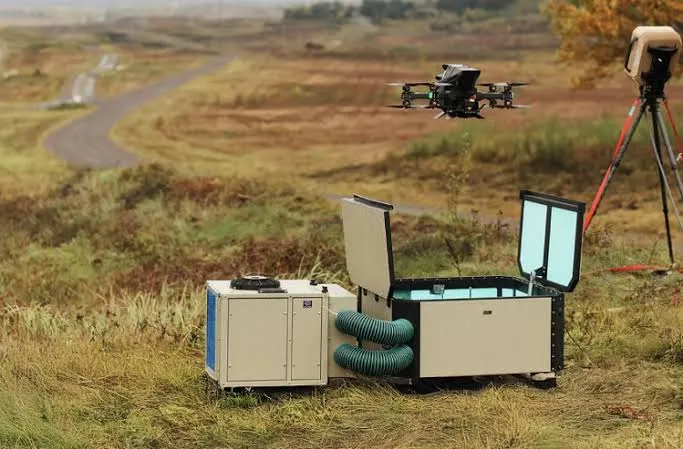
That method arrived in the form of a small, hyper-fast interceptor built for a single purpose. The Iron Drone Raider takes a fundamentally physical approach: rather than jamming or shooting a hostile aircraft, it chases the threat down and physically captures it in mid-air.
The core of the system is a compact interceptor derived from high-speed racing drones, engineered for speed and agility rather than endurance. Weighing only a few pounds, it launches from a ground-based pod the moment a threat is detected. Radar and networked sensors guide it toward the intruder, and once it's close, onboard computer vision takes over, locking onto the target and following its every move. When the interceptor reaches its quarry, it deploys a net to snare the hostile drone, then lowers it gently to the ground beneath a parachute so it can't detonate or cause harm on impact.
The most striking part is that the entire sequence, from detection to capture, can run without a human touching the controls. Ground pods can hold several interceptors at once, ready to respond to multiple threats, and the system watches the sky around the clock without fatigue.
Why "autonomous" is the key word
The autonomy is not a gimmick; it's the whole point. Human reaction time is measured in seconds, but a fast attack drone can cover a lot of ground in those seconds. By removing the need for a person to spot, decide, and react, the system compresses the response into a fraction of the time and stays alert during the long, quiet hours when human operators lose focus.
This independence also means the technology works against the very threats that defeat older systems. Because it relies on radar and vision rather than intercepting a control signal, it can engage drones that jamming can't touch, including those flying on their own or guided by hard-to-disrupt links. That capability has drawn serious interest from military forces, homeland security agencies, and organizations responsible for protecting borders, airports, and critical facilities.
A layered future for airspace defense
No single tool solves the drone problem entirely, and the smartest defenders know it. An interceptor works best as one layer within a broader strategy that combines detection sensors, electronic countermeasures where appropriate, and physical interception as a reliable last line. Different threats call for different responses, and a well-designed defense keeps several options ready.
What's clear is that the era of treating small drones as a minor nuisance is over. As the technology to build them spreads, so too must the technology to counter them, and autonomous physical interception has proven itself a serious contender in that race.
Conclusion
The rise of cheap, capable drones has forced a hard rethink of what it means to secure the sky, and the answer increasingly looks like intelligent machines defending against other machines. Systems that can detect, chase, and safely capture a threat on their own represent a genuine leap forward in a field that badly needed one. SkyIntelli Inc believes that understanding these emerging defenses is essential for anyone responsible for safety in an age when the next threat may arrive from directly overhead, and that staying informed is the first step toward staying protected.





















Sign in to leave a comment.