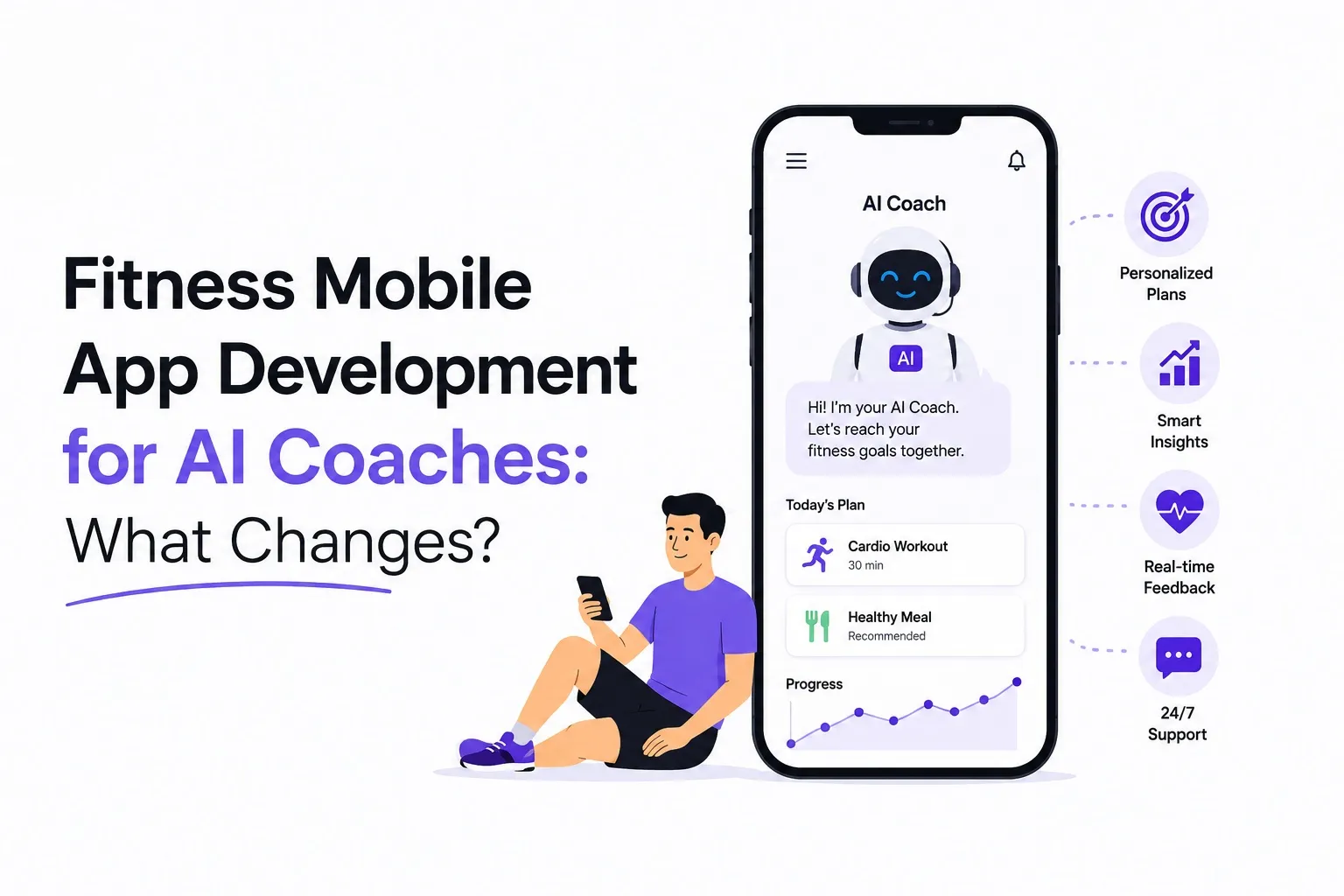

Fitness mobile app development used to follow a predictable playbook: build a content library, add a workout scheduler, bolt on a subscription paywall and ship it. That playbook still works for a lot of apps. It just doesn't work anymore for the ones trying to compete with AI-driven coaching experiences.
If you're a founder, CTO or product leader evaluating whether to build (or rebuild) a fitness app with AI coaching at its core, the honest answer is this: the architecture, the team, the data strategy and the cost model all shift. Not slightly. Fundamentally. This article breaks down exactly what changes, where businesses get it wrong and how to approach the decision without guessing.
The Quiet Shift From Fitness Apps to AI-Powered Coaches
For years, "fitness app" meant a video library with a calendar wrapped around it. Users picked a program, followed it and the app tracked whether they showed up. Useful, but static the app had no idea if you were struggling, plateauing or ready to push harder.
AI coaching apps behave differently. They observe. They adjust. A traditional app tells you what today's workout is; an AI coach decides what today's workout should be, based on yesterday's sleep, last week's recovery trend and how your last three sessions actually went. That distinction reactive scheduling versus adaptive decision-making is the entire reason development requirements change so drastically.
What Actually Changes in Fitness Mobile App Development
This is where most agency blog posts stop at "add AI features" and move on. That's not useful. Here's what genuinely changes under the hood.
Data Architecture Built for Real-Time Decisions
A content-library app can get away with a simple database and periodic syncs. An AI coaching app can't. It needs a pipeline that ingests data continuously heart rate, workout completion, sleep, recovery scores and makes it usable within seconds, not overnight batch jobs.
This means your infrastructure conversation shifts from "which database" to "how do we stream and process data close to real time." Teams that skip this step often end up with an app that looks AI-powered in the demo but lags embarrassingly once real users generate real data volume.
Personalization Engines Replace Static Content Libraries
In a traditional build, personalization means letting users filter by goal or difficulty level. In an AI coaching build, personalization means the app is running a model — often a combination of rules-based logic and machine learning — that adjusts programming session by session.
This is not a plugin you install. It's a system you design, train and continuously validate against real user outcomes. Expect your development team to include someone with genuine ML or data science experience, not just mobile engineers who've read about AI.
Wearable and Sensor Integration as a Core Dependency
In older fitness apps, wearable integration was a nice-to-have — a badge on the App Store listing. In AI coaching apps, it's the fuel source. Without consistent data from Apple Health, Whoop, Oura or Garmin, the "AI" has nothing meaningful to react to.
That changes your technical priorities early. You're no longer asking "should we integrate wearables eventually?" You're asking "which three data points does our coaching model actually need on day one and which APIs give us reliable access to them?"
Decision Framework Should You Build an AI Coaching App?
Before committing budget, ask these questions honestly:
- Do you already have engagement data showing users churn from lack of personalization not just lack of content?
- Can you commit to phased development rather than a single big-bang launch?
- Do you have (or can you hire) ML/data expertise, not just mobile developers?
- Is your business model built to absorb higher upfront cost in exchange for better retention?
If you answered "no" to two or more of these, a traditional app with smart personalization rules not full AI coaching may serve you better right now.
Common Mistakes Businesses Make When Adding AI Coaching
The most common mistake isn't technical it's sequencing. Companies rush to market an "AI coach" feature before they've validated that their data pipeline can actually support one. The result is a coaching feature that gives generic, delayed or oddly repetitive suggestions, which damages trust faster than having no AI feature at all.
The second mistake is hiring a development partner based purely on mobile app portfolio, without checking whether they've actually shipped anything involving live data models. Building a polished fitness app interface and building an adaptive coaching engine are different disciplines, even though they end up in the same product.
Best Practices for Building AI-Driven Fitness Coaching Apps
Start narrow. Pick one coaching decision say, adjusting workout intensity based on recovery data and get that right before expanding scope. According to industry reports on AI product development, narrow, well-validated features consistently outperform broad, shallow AI implementations in user trust and retention.
Launch in phases, with a feedback loop built in from day one. Your model needs real user behavior to improve and you need visibility into whether its recommendations are actually helping or just technically functioning.
Real-World Scenario How a Mid-Size Fitness Brand Approached This
Consider a composite scenario common in this space: a fitness brand with an established app and loyal user base decides to add coaching intelligence rather than rebuild from scratch. Instead of attempting full personalization across every feature, the team isolated one variable recovery-based intensity adjustment and built the data pipeline to support just that.
They integrated with one wearable platform first, validated the model against a small user segment and only then expanded to broader personalization. The lesson here isn't unique to this scenario, but it's consistently underestimated: narrow, validated AI beats broad, unvalidated AI, every time.
Where This Is Heading Future Trends in AI Fitness Coaching
The next shift is already visible on the horizon: large language models layered on top of structured fitness data, enabling coaching that responds conversationally rather than just adjusting numbers behind the scenes. Instead of a dashboard telling you your intensity dropped 10%, an LLM-powered coach can explain why, in plain language and suggest a reason-backed adjustment.
Multimodal sensor fusion combining wearable data, camera-based form analysis and voice input is also moving from research labs toward consumer products. Businesses that build flexible data architecture now will be far better positioned to adopt these capabilities later, rather than rebuilding from the ground up.
Final Thought
Fitness mobile app development for AI coaching isn't an upgrade you bolt onto an existing app it's a different kind of product, built on different foundations. The businesses that succeed here aren't necessarily the ones with the biggest budgets; they're the ones who validate a single coaching decision before scaling the entire system.
If you're evaluating this shift, start by asking what your data can actually support today, not what your competitors are marketing. That single question will save more time and budget than any feature list ever could.



























Sign in to leave a comment.