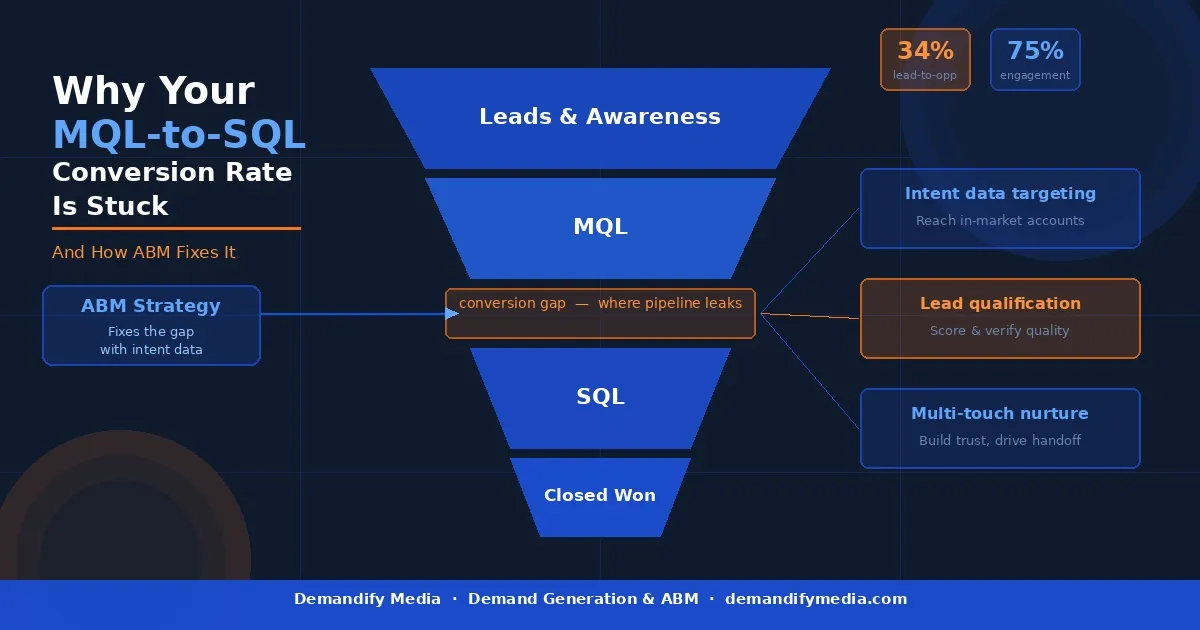

You’re getting leads. People are filling out your forms. Your marketing automation is working well. But when you look at how many MQLs turn into SQLs, something seems off. The numbers just don’t change.
You’re not by yourself. This is one of the most frustrating things about B2B demand generation right now. The average MQL-to-SQL conversion rate is between 13% and 27%, but many teams are seeing much lower rates than that.
What caused it? Most traditional ways of getting leads cast too wide a net. They get a lot of business, but not the right kind. And that’s where Account-Based Marketing (ABM) comes in.
In this article, we’ll talk about why your MQL-to-SQL conversion stops working, what the best demand generation agencies do differently, and how an ABM strategy can help your sales team finally work with leads they really want to close.
What Is MQL-to-SQL Conversion — And Why Does It Matter?
Before we fix the problem, let’s make sure we’re aligned on what we’re measuring.
• MQL (Marketing Qualified Lead): A lead that has shown enough interest to be deemed worth nurturing usually based on content downloads, form fills, or engagement scoring.
• SQL (Sales Qualified Lead): A lead that has been vetted by sales as a genuine opportunity someone who fits the ICP, has intent to buy, and is ready for a conversation.
The gap between MQLs and SQLs is where pipeline goes to die. When your MQL-to-SQL conversion rate is low, it creates friction between marketing and sales, wastes SDR time, and inflates your cost per opportunity.
Reasons Your MQL-to-SQL Conversion Rate Is Stuck
Understanding the ‘why’ is the first step. Here are the most common reasons conversion rates stall:
1. Your Lead Scoring Model Is Outdated
Most lead scoring models reward activity over intent. A prospect who downloaded an eBook six months ago might have a high score but zero purchase intent today. If your scoring hasn’t been recalibrated to reflect real buying signals, you’re sending ghost leads to sales.
2. You’re Targeting the Wrong Accounts
When demand generation casts a wide net, you attract contacts who were never going to buy. Without a clear Ideal Customer Profile (ICP), MQLs are just warm bodies not potential customers.
3. There’s No Lead Nurture Between MQL and SQL
Most teams treat MQL handoff as the finish line. It’s not. Leads that aren’t properly nurtured before reaching sales are often not ready for a direct conversation. The result? Sales rejects them, and they fall out of the funnel entirely.
4. Marketing and Sales Aren’t Aligned
If marketing’s definition of a ‘qualified lead’ doesn’t match what sales actually wants to work, you’ll never solve the conversion problem. Without shared criteria and feedback loops, the cycle repeats.
5. You’re Missing Intent Data
Relying on demographic fit alone ignores the most important signal: is this account actively researching solutions like yours right now? Without intent data layered into your demand generation strategy, you’re flying blind.
How ABM Strategy Fixes the MQL-to-SQL Problem
Account-Based Marketing turns traditional demand generation on its head. ABM doesn’t just try to get a lot of customers and hope that the quality follows. It starts with your best-fit accounts and builds a strategy around them.
Here’s how a strong ABM strategy directly improves MQL-to-SQL conversion:
Target High-Intent Accounts First
ABM uses intent signals like research activity, content consumption, and third-party behavioural data to figure out which accounts are actively looking to buy. This means that every MQL you make is much more likely to turn into a SQL.
Personalize the Nurture Journey
Generic drip sequences don’t get enterprise buyers to act. ABM lets you hyper-personalize multi-touch nurturing by tailoring content, messaging, and timing to each account’s unique pain points and stage in the buyer journey.
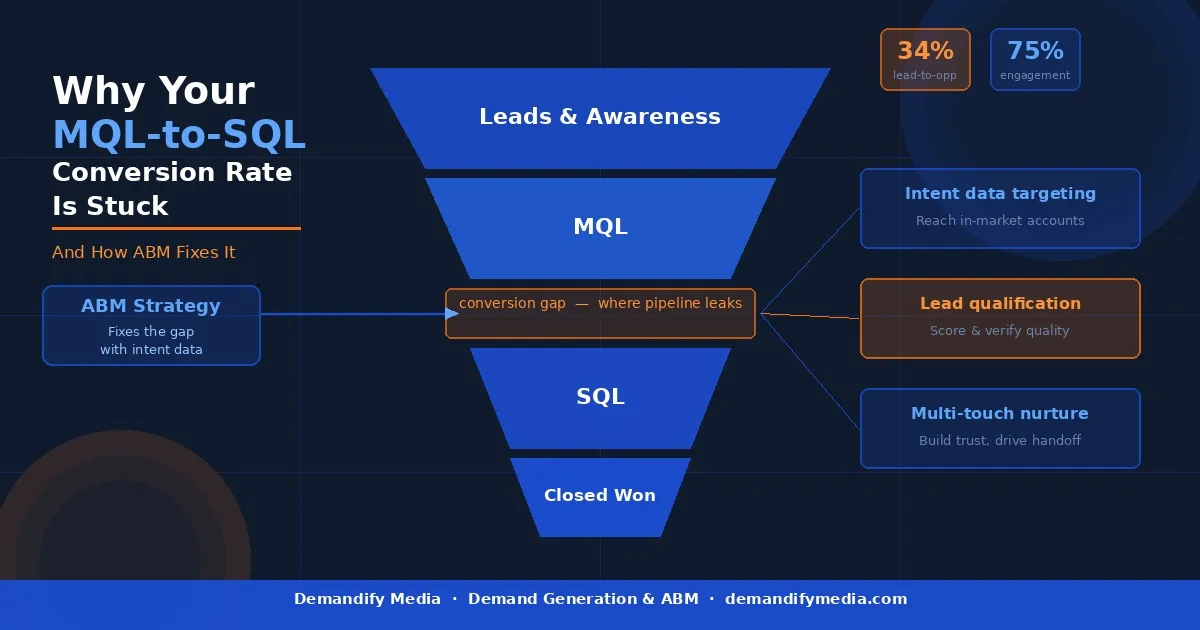
Top agencies like Demandify Media use a structured lead nurture program that includes:
• Market research to discover high-intent accounts
• Multi-channel engagement through targeted communication
• Lead scoring and verification to filter out noise
• Consistent follow-ups to build trust over time
• Qualified handoff to sales with full context
Align Sales and Marketing Around Shared Account Lists
One of the best things about ABM is that it makes marketing work together. When both teams work from the same list of accounts, have the same ICP, and agree on what makes a lead qualified, conversion rates go up almost automatically.
Use Multi-Touch Content Syndication
ABM doesn’t depend on just one touchpoint. Hybrid Content syndication, intent-driven outreach, and multi-touch engagement make sure that potential customers see your brand many times before they even think about it. They’re already warmed up by the time they become a MQL.
Demandify Media’s content syndication model gets 75% of people to interact with content through multiple touch points. This is a big reason why clients see lead-to-opportunity conversion rates of up to 34%.
What Top Demand Generation Agencies Do Differently
The best agencies in the demand generation space don’t just generate leads — they build pipelines. Here’s what separates them from the rest:
• They start with ICP clarity: Before running a single campaign, they define the exact accounts, industries, company sizes, and personas most likely to convert.
• They validate before they hand off: Every lead goes through qualification BANT, CHAMP, or a custom framework — before it ever touches a sales rep’s inbox.
• They use data, not guesswork: Intent data, behavioral signals, and CRM history inform every outreach decision.
• They close the loop: Post-campaign analytics and sales feedback loops mean strategies keep improving with every cycle.
This is exactly the approach Demandify Media takes. As one client from Autodesk noted, their onboarding was seamless and leads started flowing within a week helping build a solid pipeline in their target market.
The ABM Metrics That Actually Matter
If you’re running ABM, stop measuring raw MQL volume. These are the metrics that reflect real pipeline health:
• MQL-to-SQL conversion rate: Track this weekly, not monthly. Faster feedback = faster fixes.
• Account engagement score: How deeply is a target account engaging with your brand across channels?
• Pipeline velocity: How fast are qualified accounts moving through the funnel?
• Cost per SQL: What does it actually cost to produce a sales-ready lead?
• Sales acceptance rate: What % of MQLs are accepted by sales? This is your alignment health score.
Conclusion
Your team isn’t working hard enough to get your MQL-to-SQL conversion rate to go up. It’s stuck because the old way of generating leads wasn’t made for the complicated B2B buyer of today.
ABM strategy gives you a smarter way to do things, one that puts account fit and buyer intent ahead of the number of leads you get. When done right, it does more than just boost your conversion rate. It gets everyone on your revenue team focused on the accounts that are most likely to close.
It’s time to talk about ABM if you’re ready to stop chasing MQLs and start building a real pipeline.
Ready to Fix Your MQL-to-SQL Gap?
Demandify Media helps B2B marketing teams generate high-intent, sales-ready leads through precision ABM and demand generation strategies.
Book a Free Consultation → demandifymedia.com/contact-us
Frequently Asked Questions (FAQs)
Q1: What is a good MQL-to-SQL conversion rate for B2B companies?
A good MQL-to-SQL conversion rate for B2B companies typically ranges from 13% to 27%, depending on your industry and deal size. Enterprise tech companies with strong ABM programs often achieve 25–35%+ by focusing on account-fit and intent data rather than volume alone.
Q2: How does ABM improve lead qualification?
ABM improves lead qualification by flipping the funnel — you start with your best-fit accounts, layer in intent data to confirm buying readiness, and then engage them with personalized content. This means leads entering your funnel already meet your ICP criteria, making them far more likely to pass qualification and become SQLs.
Q3: What is the difference between demand generation and ABM?
Demand generation focuses on creating awareness and capturing leads at scale across a broad audience. ABM (Account-Based Marketing) takes a targeted approach — identifying specific high-value accounts and running coordinated, personalized campaigns to engage them. The two work best together: use demand generation to build brand awareness and ABM to convert the right accounts.
Q4: How long does it take to see results from an ABM strategy?
Most B2B teams begin seeing early engagement signals — such as increased account activity, content interaction, and inbound demo requests — within 4 to 8 weeks of launching an ABM campaign. Full pipeline impact typically shows within one quarter, especially when paired with a structured lead nurture program and sales alignment.
Q5: What tools do you need to run an effective ABM campaign?
A basic ABM stack includes: an intent data provider (such as Bombora or G2 Buyer Intent), a CRM (Salesforce, HubSpot), marketing automation (Marketo, HubSpot), and a content syndication partner for multi-touch reach. Agencies like Demandify Media manage this full-stack approach on your behalf, so you don’t need to build the infrastructure yourself.





























Sign in to leave a comment.