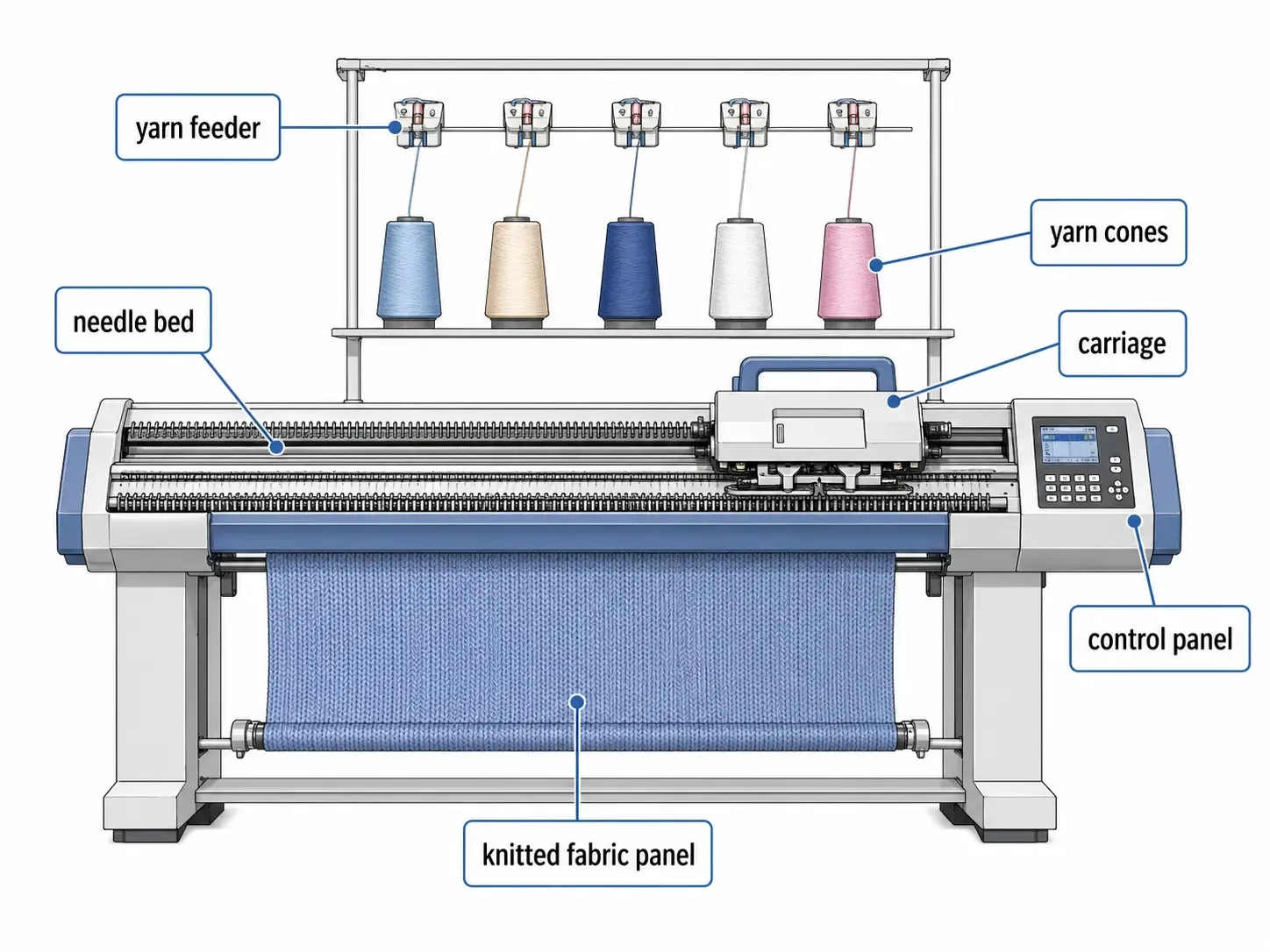

The textile and apparel industry is rapidly adopting advanced technologies to improve productivity, quality, and sustainability. Flat Knitting Technology has become an important innovation in modern knitwear manufacturing, helping manufacturers produce complex designs with greater accuracy and efficiency. Smart flat knitting machines combine automation, digital controls, and intelligent production features to reduce manual work while improving overall manufacturing performance.
What Is Flat Knitting Technology?
Flat Knitting Technology uses computerized knitting machines to produce fabrics in flat panels rather than continuous tubular structures. These machines are widely used to manufacture sweaters, cardigans, collars, cuffs, fashion garments, and other knitted products.
Modern flat knitting machines can automatically control needle selection, yarn feeding, stitch formation, and pattern creation. This level of automation allows manufacturers to produce detailed designs while maintaining consistent fabric quality.
For Knitting industry, the development of smart flat knitting solutions represents an important step toward more efficient and digitally connected textile production.
How Smart Machines Improve Production Efficiency
1. Faster Production
Smart flat knitting machines are designed to operate at high speeds while maintaining precise stitch formation. Automated controls reduce production interruptions and allow manufacturers to complete orders more quickly.
Faster production is especially valuable for textile companies handling large-volume orders or rapidly changing fashion collections. Improved machine performance can help manufacturers increase output without requiring a proportional increase in labor.
2. Greater Accuracy and Consistent Quality
One of the major advantages of Flat Knitting Technology is its ability to maintain consistent knitting parameters. Computerized systems can accurately control stitch length, pattern selection, yarn movement, and other important production settings.
This reduces variations between garments and helps manufacturers achieve more uniform quality. Consistency is particularly important for fashion brands that require identical designs across large production batches.
3. Automated Pattern Creation
Smart flat knitting machines support advanced computerized pattern programming. Designers can create intricate patterns, textures, shapes, and color combinations digitally before sending production instructions to the machine.
This digital approach makes it easier to modify designs and produce customized garments. Manufacturers can respond more quickly to changing fashion trends without completely redesigning their production processes.
4. Reduced Material Waste
Material efficiency is becoming increasingly important as textile manufacturers focus on sustainable production. Advanced flat knitting machines can produce garment components with greater precision, helping reduce unnecessary fabric and yarn waste.
Producing specific garment shapes directly through computerized knitting can also minimize cutting requirements. This supports more efficient use of raw materials and contributes to environmentally responsible manufacturing.
5. Lower Labor Requirements
Automation reduces the need for repetitive manual operations. Smart machines can manage several knitting functions automatically, allowing skilled workers to focus on machine programming, quality monitoring, maintenance, and production management.
For manufacturers facing labor shortages or increasing operational costs, automation can provide a practical way to improve productivity while maintaining production standards.
Smart Features Supporting Modern Manufacturing
Today’s advanced flat knitting machines increasingly incorporate digital monitoring and intelligent control systems. Operators can monitor production parameters, identify errors, and make adjustments more efficiently.
Some systems also support data collection and connectivity, helping manufacturers analyze machine performance and production efficiency. These capabilities can contribute to the development of smart factories where machines, software, and production teams work together through connected manufacturing systems.
Supporting Sustainable Textile Production
Sustainability is another area where Flat Knitting Technology can make a significant difference. Precise knitting processes can reduce yarn consumption, minimize waste, and improve production efficiency.
Energy-efficient machine designs and optimized production processes can also help manufacturers reduce resource consumption. As brands and consumers increasingly demand sustainable products, efficient knitting technologies are becoming an important part of responsible textile manufacturing.
The Future of Flat Knitting Technology
The future of flat knitting is closely connected with automation, artificial intelligence, digital design, and smart manufacturing. As machines become more intelligent, manufacturers can expect improved production monitoring, faster pattern development, predictive maintenance, and greater customization.
For Knitting industry, investing in advanced flat knitting solutions can create opportunities to improve productivity while meeting the growing demand for high-quality, innovative, and sustainable knitwear.
Conclusion
Flat Knitting Technology is transforming modern knitwear production by combining automation, precision, digital programming, and intelligent machine capabilities. From faster production and improved quality to reduced waste and greater design flexibility, smart flat knitting machines offer significant advantages for textile manufacturers.
As the industry moves toward connected and sustainable manufacturing, adopting smart knitting technologies will remain an important strategy for companies seeking higher efficiency, competitive production, and long-term growth.


























Sign in to leave a comment.