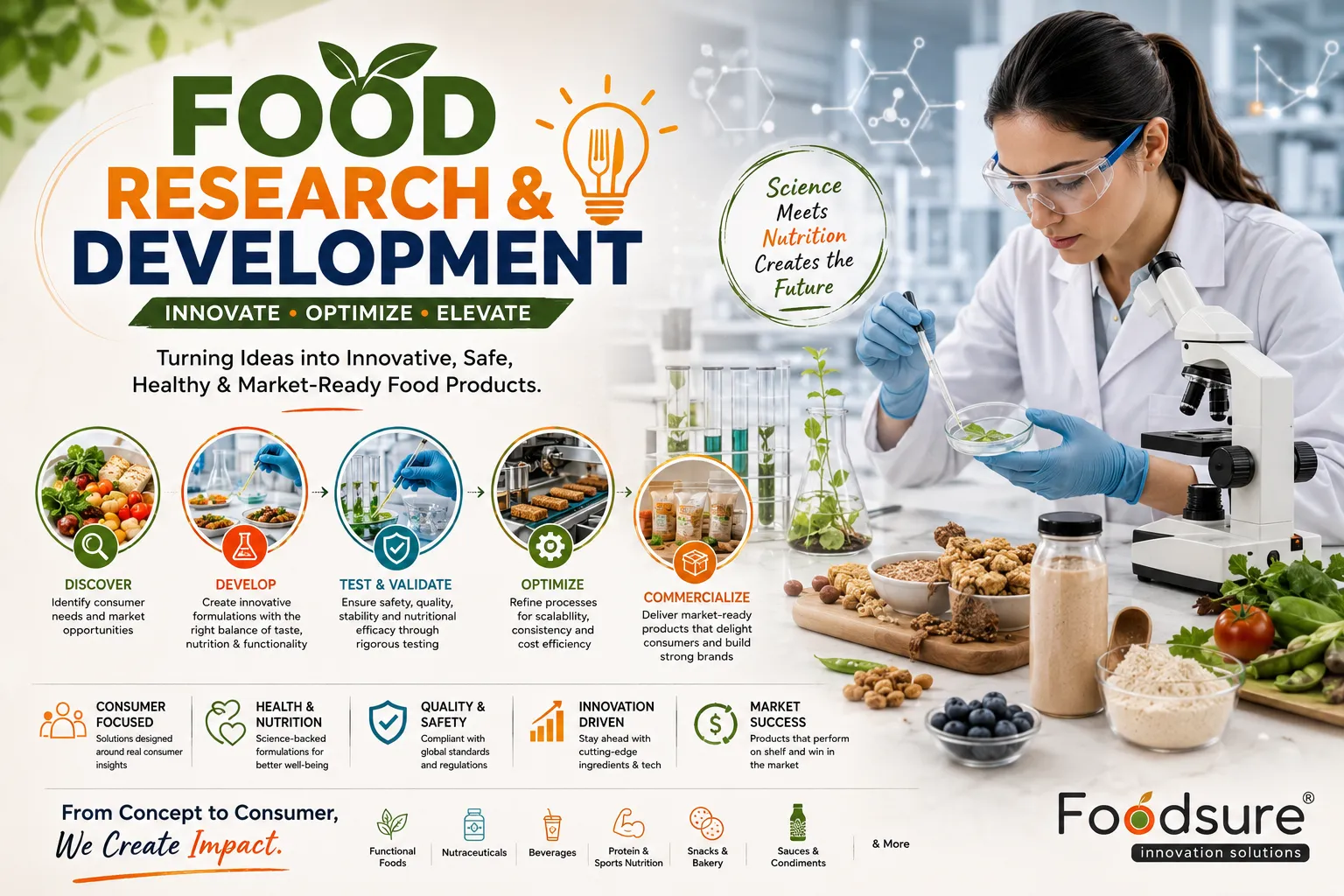

Every successful food product starts with an idea, but only a few ideas become products that consumers repeatedly choose. The difference lies in careful planning, scientific evaluation, ingredient optimization, and commercial feasibility. This entire journey is powered by Food Research and Development, a structured process that helps transform concepts into products ready for manufacturing and the marketplace.
Whether the goal is to launch a healthier snack, a functional beverage, a ready-to-eat meal, or a nutraceutical product, businesses need more than creativity. They need research, technical expertise, quality validation, and an understanding of consumer expectations. This is why companies across the food industry increasingly invest in professional development before introducing new products.
Foodsure supports startups, established manufacturers, restaurants, and food entrepreneurs by providing science-backed solutions that simplify product development while improving commercial success.
Why Every Great Food Product Begins with Research
Consumers today expect much more than good taste. They look for nutrition, convenience, ingredient transparency, consistency, sustainability, and value for money. A product that performs well in one of these areas but fails in another often struggles to build long-term customer loyalty.
Professional Food Research and Development helps businesses understand these expectations before production begins. Instead of relying solely on assumptions, developers use scientific methods to evaluate ingredients, processing techniques, product stability, and overall market suitability.
This approach reduces uncertainty and improves the likelihood of launching products that meet both business objectives and consumer demands.
More Than Creating a Recipe
Many people assume product development simply means writing a recipe. Commercial food production is considerably more complex.
Every ingredient influences several characteristics simultaneously, including flavor, texture, appearance, shelf stability, nutritional value, manufacturing efficiency, and cost.
Even replacing one ingredient can affect multiple aspects of product performance. Because of this, professional development involves continuous testing and refinement rather than one-time experimentation.
The goal is to create products that remain consistent from the first production batch to the thousandth.
The Journey from Idea to Product
Developing a commercial food product generally follows a structured process.
The journey often begins with identifying a market opportunity and understanding consumer preferences. Developers then select ingredients, prepare prototypes, evaluate product performance, refine formulations, optimize manufacturing processes, and assess packaging compatibility before commercialization.
Although these steps sound straightforward, each stage requires careful technical evaluation.
Foodsure follows a systematic development approach that helps businesses reduce risk while accelerating product readiness.
Understanding Ingredient Functionality
Every ingredient serves multiple purposes inside a food product.
Beyond taste, ingredients influence:
- Texture
- Color
- Aroma
- Moisture retention
- Product stability
- Processing behavior
- Nutritional profile
- Shelf life
Balancing these characteristics requires technical knowledge supported by research and practical experience.
Professional developers carefully evaluate ingredient interactions before recommending commercial formulations.
Why Product Consistency Matters
Consumers expect every purchase to deliver the same experience.
Imagine purchasing your favorite snack one week and discovering a completely different taste the following week. Such inconsistencies quickly reduce customer confidence.
This is why Food Research and Development focuses heavily on process standardization.
By establishing reliable manufacturing methods and validating ingredient performance, businesses improve consistency across every production batch.
Scientific Evaluation Improves Product Quality
Modern food development combines culinary creativity with scientific investigation.
Product teams typically evaluate several important areas, including:
- Ingredient compatibility
- Nutritional balance
- Texture optimization
- Flavor performance
- Processing conditions
- Packaging suitability
- Shelf stability
- Consumer acceptance
These evaluations provide valuable insights before products reach large-scale manufacturing.
Research Supports Smarter Business Decisions
Launching a product involves significant investment.
Without proper validation, businesses may experience production failures, customer complaints, increased costs, or product recalls.
Professional Food Research and Development helps identify potential challenges early, allowing businesses to make informed decisions before committing to commercial production.
This proactive approach often saves considerable time and development costs.
Innovation Across Multiple Food Categories
Research plays an essential role in developing products across numerous industries, including:
- Functional foods
- Nutraceutical products
- Bakery innovations
- Dairy alternatives
- Protein-rich foods
- Healthy snacks
- Ready-to-eat meals
- Sauces and condiments
- Frozen products
- Beverage formulations
Although each category presents different technical challenges, the underlying objective remains the same—creating products that perform consistently while satisfying consumer expectations.
Scaling Beyond Small Batch Production
One of the biggest challenges in commercial food manufacturing is scaling recipes successfully.
A product prepared in a small kitchen environment often behaves differently inside industrial equipment.
Mixing efficiency, heating methods, cooling systems, ingredient distribution, and production speed all influence final product quality.
Professional development ensures products remain reliable during commercial manufacturing rather than only during laboratory testing.
Why Businesses Choose Professional Support
Many food businesses initially attempt product development independently.
While this approach may work for simple products, commercial manufacturing introduces technical complexities that often require specialized expertise.
Working with experienced food product research and development consultants & contract r&d professionals allows businesses to avoid common formulation mistakes while accelerating product commercialization.
Expert guidance also improves production efficiency and long-term product performance.
Foodsure's Role in Commercial Product Development
Foodsure collaborates with startups, food manufacturers, restaurants, exporters, cloud kitchens, and nutraceutical brands to support product innovation from concept to commercialization.
The focus extends beyond recipes by considering ingredient functionality, processing techniques, quality requirements, regulatory expectations, and manufacturing practicality.
Every project receives a customized strategy because no two products present identical technical challenges.
Rather than offering generic development methods, Foodsure creates solutions based on business objectives and commercial feasibility.
Many advanced research methodologies, specialized laboratory evaluations, pilot-scale trials, ingredient optimization techniques, and commercialization strategies require detailed technical consultation. These project-specific processes are best explored directly through Foodsure's professional services and technical resources.
Building Products Consumers Trust
Consumers rarely see the research behind their favorite products.
However, every successful launch depends upon careful planning and continuous improvement.
Businesses studying successful r&d foods concepts quickly realize that product quality comes from scientific understanding rather than simply combining ingredients.
Likewise, reviewing an r&d foods menu may provide inspiration, but building a commercially successful product requires structured development, validation, and optimization.
Understanding these technical differences often separates long-lasting brands from short-term product launches.
Looking Ahead
The food industry continues evolving rapidly as consumer preferences shift toward healthier, safer, and more sustainable products.
Companies investing in structured research today are better positioned to respond to changing market demands tomorrow.
Professional Food Research and Development provides businesses with the technical foundation needed to improve product quality, reduce manufacturing risks, and strengthen long-term competitiveness.
Final Thoughts
Bringing a successful food product to market requires far more than an appealing idea. Behind every product consumers trust is a carefully planned process involving research, ingredient evaluation, testing, optimization, and commercial preparation. Food Research and Development helps businesses transform concepts into reliable products capable of succeeding in competitive markets.
This article introduces the core principles behind commercial food development while intentionally keeping the discussion at a broader level. Every product category has unique technical requirements involving formulation, processing, regulatory compliance, manufacturing scale-up, quality assurance, and commercialization strategies that cannot be fully explained in a single guide.
If you are planning to develop a new food product or improve an existing one, Foodsure offers specialized expertise, practical development support, and industry knowledge to help businesses move confidently from idea to commercial success. Visit the Foodsure website to explore detailed services, technical capabilities, and tailored solutions designed for your product development journey.






























Sign in to leave a comment.