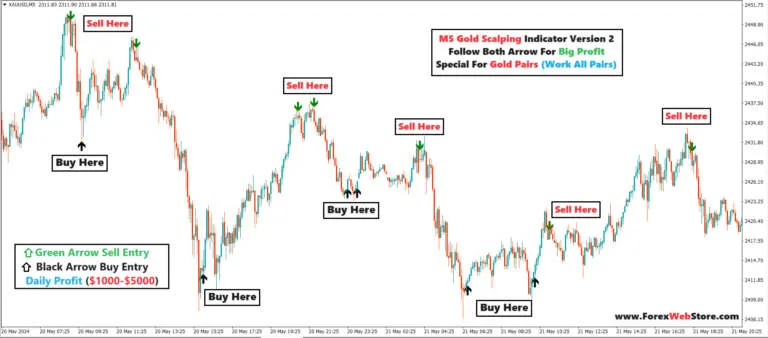

A Forex Scalping Indicator is a technical analysis tool designed to help traders identify short-term trading opportunities in the foreign exchange market. Since scalping involves opening and closing positions within minutes or even seconds, traders often rely on indicators to evaluate price momentum, market direction, volatility, and potential entry or exit points. The right indicator can make a trading setup easier to analyze, but no indicator can guarantee profitable results.
Popular indicators used for forex scalping include moving averages, the Relative Strength Index (RSI), Moving Average Convergence Divergence (MACD), Bollinger Bands, Stochastic Oscillator, and Average True Range (ATR). Each provides different information. Moving averages can help identify short-term trends, while RSI and Stochastic can provide insight into momentum and potentially overbought or oversold conditions. Bollinger Bands can help traders assess volatility and price movement, whereas ATR can be useful for understanding market volatility and planning risk levels.
When choosing a Forex Scalping Indicator, consider the currency pair, trading timeframe, market conditions, and your overall strategy. Indicators that work well during a strong trend may produce less reliable signals when the market is moving sideways. Many experienced traders therefore combine multiple indicators rather than depending on a single tool. For example, a trader might use a short-term moving average to assess direction, RSI to evaluate momentum, and price action to confirm a potential setup.
Risk management is especially important when scalping because frequent trades can quickly increase transaction costs and potential losses. Spreads, commissions, slippage, and execution speed can all influence results. A strategy that appears profitable on historical charts may perform differently in live market conditions. Before using any indicator with real funds, consider testing it on historical data and practicing through a demo account.
Another important factor is selecting suitable timeframes. One-minute and five-minute charts are commonly associated with scalping, although the best timeframe depends on the trader's strategy and tolerance for market noise. Lower timeframes can generate more signals, but they can also contain more false movements. Combining a lower timeframe with a higher-timeframe trend analysis may help provide additional market context.
Ultimately, the best Forex Scalping Indicator is not necessarily the one with the most signals. It should fit your trading approach, provide information you understand, and work as part of a clearly defined trading plan. Traders should establish entry criteria, exit rules, stop-loss levels, position sizing, and maximum daily risk before placing trades. Avoid relying on promises of guaranteed returns or “perfect” signals.
Whether you are exploring forex scalping for the first time or refining an existing strategy, learning how indicators behave in different market conditions is essential. Use backtesting, demo trading, disciplined risk management, and realistic expectations to evaluate your approach. Forex trading involves substantial risk, and past performance does not guarantee future results.

























Sign in to leave a comment.