
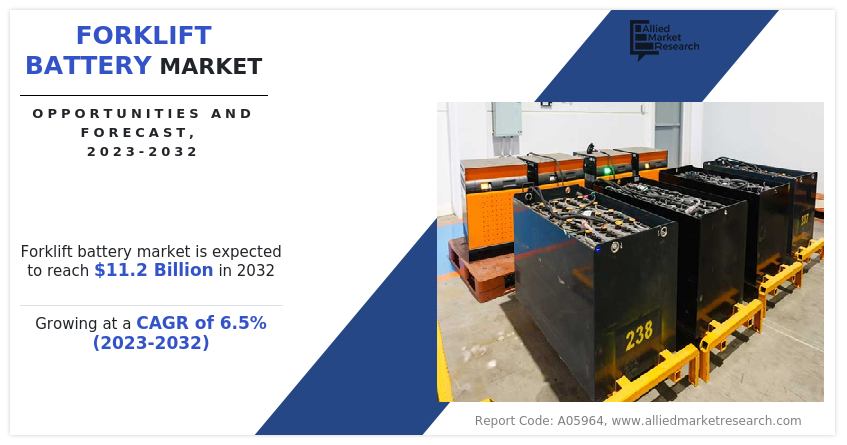
According to a new report published by Allied Market Research, the forklift battery market size was valued at $5.9 billion in 2022 and is projected to reach $11.2 billion by 2032, growing at a CAGR of 6.5% from 2023 to 2032. The market is gaining momentum due to the rapid adoption of electric forklifts, rising demand for energy-efficient material handling solutions, and advancements in battery technologies.
Key Findings
- The global forklift battery market is expected to grow steadily through 2032
- Lithium-ion batteries are anticipated to grow at a CAGR of 6.7%
- Manufacturing applications are projected to register high growth
- Asia-Pacific and North America dominated the market in 2022
Download PDF Brochure: https://www.alliedmarketresearch.com/request-sample/A05964
Introduction to the Forklift Battery Market
Forklift batteries are specialized power sources designed to operate electric forklifts and other battery-powered material handling equipment. Unlike internal combustion engine (ICE) forklifts that rely on gasoline or diesel, electric forklifts are powered entirely by batteries. These batteries supply the electrical energy required to run motors responsible for lifting, propulsion, and maneuvering functions.
The forklift battery market has witnessed steady growth due to economic benefits, government incentives for electrification, improved energy efficiency, and continuous technological advancements. Electric forklifts are increasingly preferred across warehouses, manufacturing facilities, retail environments, and ports due to their environmental and operational advantages.
Key Features of Forklift Batteries
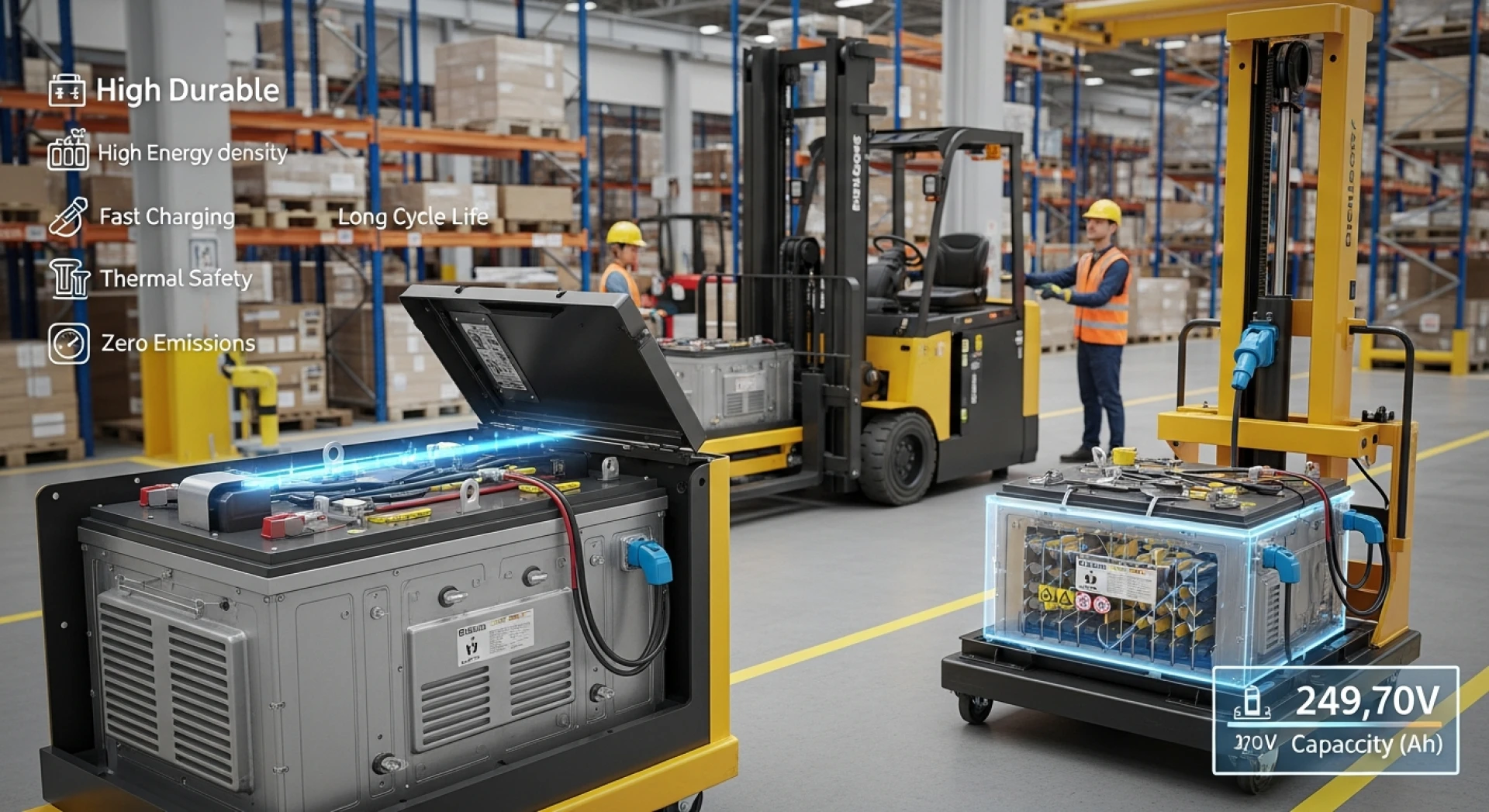
Forklift batteries are available in various voltage ratings such as 24V, 36V, and 48V, depending on forklift power requirements. Battery capacity, measured in ampere-hours (Ah), determines how long a forklift can operate before requiring a recharge. Higher-capacity batteries allow extended operation, improving productivity.
Charging time varies by battery type. Lithium-ion batteries typically charge faster than traditional lead-acid batteries, enabling reduced downtime. Lead-acid batteries require regular maintenance, including watering and cleaning, while lithium-ion batteries require minimal maintenance. Another critical factor is cycle life, which refers to the number of charge-discharge cycles a battery can complete before capacity degradation.
Market Drivers
Rising Adoption of Electric Forklifts
The increasing use of electric forklifts across industries is a major driver of the forklift battery market. Battery-operated forklifts emit zero emissions during operation, making them suitable for indoor environments and environmentally sensitive areas. Compared to ICE forklifts, electric forklifts have lower operating costs due to reduced fuel expenses and minimal maintenance requirements.
Operational Efficiency and Worker Comfort
Electric forklifts are quieter and generate less vibration than ICE forklifts, improving operator comfort and reducing workplace noise levels. Modern forklift batteries, particularly lithium-ion batteries, offer higher energy efficiency, longer runtime, and faster charging, contributing to enhanced productivity and reduced downtime.
Expanding Warehousing and Manufacturing Sectors
Forklift batteries are extensively used in material handling and warehousing applications. In manufacturing facilities, battery-powered forklifts are used to transport raw materials, move finished goods, and streamline internal logistics. Warehouses and distribution centers rely on electric forklifts to manage inventory efficiently and ensure timely order fulfillment.
In retail and wholesale stores, electric forklifts assist in inventory movement, shelf restocking, and storage management. Additionally, shipping yards and ports utilize battery-powered forklifts to load and unload cargo containers, improving logistics efficiency.
Market Restraints
Despite strong growth prospects, the forklift battery market faces several challenges. Electric forklifts and their batteries have higher upfront costs compared to ICE forklifts. Establishing charging infrastructure requires significant investment, which can be a barrier for small and medium enterprises.
Electric forklifts also have limited operating range per charge compared to ICE forklifts that can operate continuously. Downtime caused by battery charging impacts productivity if charging infrastructure is inadequate. Although lithium-ion batteries have longer lifespans, their replacement costs are significantly higher than lead-acid batteries, making cost management crucial.
Market Opportunities
Advancements in Battery Technology
Ongoing advancements in battery technologies, especially lithium-ion batteries, present significant growth opportunities. Improvements in energy density, faster charging, and extended lifespan enhance the overall value proposition of electric forklifts.
Emergence of Hydrogen Fuel Cells
Hydrogen fuel cell technology is emerging as an alternative power source for forklifts. Fuel cell forklifts offer extended operation hours and rapid refueling, making them suitable for high-intensity operations and opening new opportunities within the forklift battery market.
Sustainability Initiatives and Government Incentives
With increasing focus on sustainability, companies are adopting electric forklifts to reduce carbon footprints and demonstrate environmental responsibility. Government incentives and subsidies promoting electric vehicles and clean technologies help businesses offset high initial investments, further driving market growth.
Smart Forklifts and Battery Management Systems
Integration of telematics and advanced battery management systems enables predictive maintenance, real-time monitoring, and data-driven decision-making. These smart solutions enhance productivity, optimize battery usage, and reduce operational costs, creating new growth avenues in the forklift battery market.
Forklift Battery Market Segmentation
The forklift battery market analysis is segmented by type, application, and region.
By Type
- Lithium-ion (Li-ion)
- Lead-acid
- Others
The lithium-ion segment dominated the market in 2022 and is expected to grow at the highest pace during the forecast period due to faster charging, longer lifespan, and lower maintenance requirements.
By Application
- Warehouses
- Manufacturing
- Construction
- Retail & Wholesale Stores
- Others
The manufacturing segment accounted for the largest market share in 2022, driven by high usage of electric forklifts for internal logistics and material handling operations.
By Region
- North America
- Europe
- Asia-Pacific
- LAMEA (Latin America, Middle East, and Africa)
Asia-Pacific and North America dominated the forklift battery market share in 2022, supported by strong industrial activity, rapid warehouse expansion, and increasing adoption of electric forklifts.
Get a Customized Research Report: https://www.alliedmarketresearch.com/request-for-customization/A05964
Competitive Landscape
The global forklift battery market is moderately competitive, with key players focusing on product innovation, partnerships, and geographic expansion. Major companies operating in the forklift battery industry include:
- Iberdrola SA
- Amara Raja Batteries Ltd.
- EnerSys
- East Penn Manufacturing Company, Inc.
- Exide Industries Ltd.
- Trojan Battery Company, LLC
- GS Yuasa International Ltd.
- Flux Power
- Zhejiang Narada Power Source Co., Ltd.
- Electrovaya
These companies are adopting strategies such as collaboration, mergers, and expansion to strengthen their market presence and enhance forklift battery market opportunities.
Conclusion
The forklift battery market is set for robust growth, driven by increasing electrification of material handling equipment, technological advancements in battery systems, and growing sustainability initiatives. While high upfront costs and infrastructure challenges persist, continuous innovation and supportive government policies are expected to unlock long-term growth opportunities globally.
About Us
Allied Market Research (AMR) is a full-service market research and business-consulting wing of Allied Analytics LLP based in Portland, Oregon. Allied Market Research provides global enterprises as well as medium and small businesses with unmatched quality of "Market Research Reports" and "Business Intelligence Solutions." AMR has a targeted view to provide business insights and consulting to assist its clients to make strategic business decisions and achieve sustainable growth in their respective market domain.
Pawan Kumar, the CEO of Allied Market Research, is leading the organization toward providing high-quality data and insights. We are in professional corporate relations with various companies and this helps us in digging out market data that helps us generate accurate research data tables and confirms utmost accuracy in our market forecasting. Each and every data presented in the reports published by us is extracted through primary interviews with top officials from leading companies of domain concerned. Our secondary data procurement methodology includes deep online and offline research and discussion with knowledgeable professionals and analysts in the industry.

























Sign in to leave a comment.