Free Python Full Courses for Beginners in 2026
Python stays one of the strongest first languages in 2026 because its syntax is readable, its tools are mature, and its uses stretch from web apps to data work. If you're searching for a free Python full course, the good news is simple: Python itself costs nothing because it is open source, so you do not pay to install or use the language.
Most beginners want the same thing, even if they phrase it differently. They want a clear beginner path, a course that feels complete, and a free option that still teaches skills employers recognize.
The goal is not to collect ten bookmarks. It is to choose one solid course, avoid weak lessons, and start learning without wasting weeks.
What a good free Python full course should actually include
A real beginner course is more than a long video with a catchy title. The best free Python full course gives you an ordered path, starting with setup and ending with enough practice to write small programs on your own.
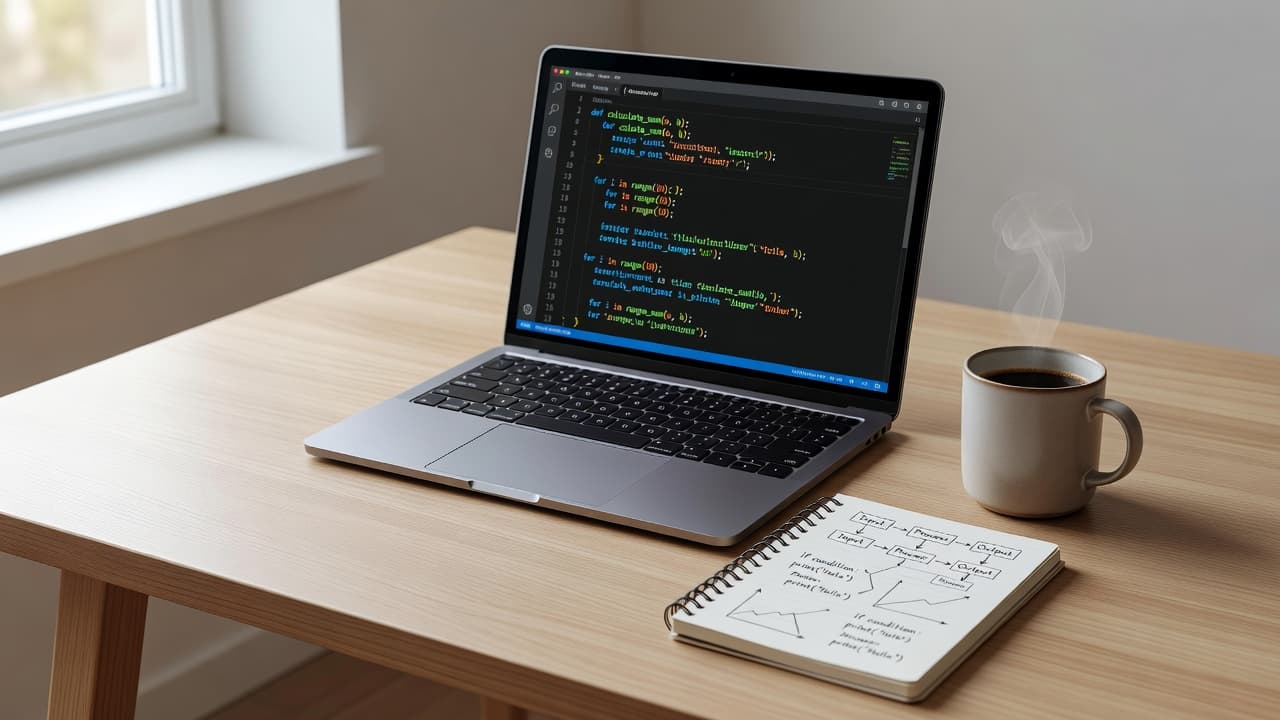
First, you need installation and basic execution. After that, a strong free Python course for beginners should cover variables, strings, numbers, lists, dictionaries, conditionals, loops, functions, file handling, and simple error handling. Basic debugging matters too, because every learner hits mistakes.
Those topics are the floor, not the ceiling. If a course skips them and jumps into frameworks, you will feel lost later. Many newcomers search for a free Python full stack course or a free Python full stack developer course, but that path makes sense only after the core language feels natural. Otherwise, Django, databases, and APIs arrive too early.
Why projects matter more than passive watching
Watching code is not the same as writing code. A Python full course for free becomes useful when it asks you to type, test, and fix your own work.
Small quizzes help, but mini-projects help more. A calculator, a number guessing game, a file organizer, or a text-based menu system teaches far more than passive note-taking. When people ask how to learn Python through a full course, the answer is usually simple: follow one sequence, complete the exercises, and build along the way.
The best free Python course options for beginners in 2026
Several strong options exist, and they suit different learning styles. Some are cohort-based, some are self-paced, and some give optional certificates while keeping the lessons free.
This quick comparison keeps the focus on what beginners usually care about first.
The freeCodeCamp Python full-course route and CS50P stand out when you want rigorous exercises. Brais Moure's beginner course works well if Spanish is your preferred language and you want a single long video.
When live instruction is worth it
Stanford's Code in Place still stands out in 2026 because it uses a six-week schedule with real teaching support. That format helps if you need deadlines, peer contact, and a reason to show up each week.
Live instruction is not always necessary, but it is useful when motivation drops fast. If you tend to stop after lesson three, a calendar can help more than another playlist.
When self-paced lessons are the better fit
Self-paced courses work better when your schedule is irregular. You can study at night, on weekends, or in short daily sessions without waiting for a new cohort.
That is why many beginners choose freeCodeCamp, Microsoft, Udacity, or a full Python course for new programmers on YouTube. If you want to learn Python through a free full course online, these formats are often the easiest place to start.
Which free course is best for project-based learning
Project work matters if you want a portfolio, practical confidence, or a first GitHub profile. freeCodeCamp and CS50P are strong here because they push you to solve problems rather than only consume lessons.
That difference matters early. A course with exercises trains recall, but a course with projects trains judgment.
How to pick the best platform to learn Python for free
The best platform to learn Python for free depends on your goal, not on hype. There is no single best website to learn Python for every learner, because a busy parent, a college student, and a future data analyst do not need the same format.
If you are wondering why Python is free, the answer is straightforward. It is open-source software, so the language itself has no license fee. If you are also asking how much a Python course costs, prices vary widely in India and elsewhere. In 2026, some paid subscriptions still sit around EUR30 per month, some specializations around EUR42 per month, and premium programs cost far more.
Choose by goal, not by hype
Pick the course that matches the outcome you want. For basic confidence, Microsoft or Udacity can be enough. For a more complete beginner path, freeCodeCamp, CS50P, Stanford, and Cisco are better choices.
Your long-term goal matters too. If you want data science or AI later, strong fundamentals and problem sets matter more than flashy app demos. If you want web development, do not rush into a free Python full stack course before loops, functions, and debugging feel easy.
Recent Reddit discussions about learning Python with a free full course often praise CS50P and Stanford. Those threads are useful, but "learn Python free full course Reddit" searches should lead to verification, not blind trust.
Check the course before you commit
Before you start, check a few basics.
- Confirm that the lessons are truly free, not a short trial.
- Make sure the course is built for total beginners.
- Look for exercises, projects, or problem sets.
- Prefer recent content over an old "learn Python free full course download" file.
A Python free course is only helpful if it is current and complete. If a course promises everything at once, especially a fast-track full-stack result, slow down and inspect the syllabus first.
Conclusion
You do not need to pay to start learning Python well. The right beginner course is the one that matches your pace, teaches the fundamentals in order, and gives you enough practice to write code without guessing.
Choose one course, stick with it, and resist the urge to switch every few days. A single strong path will teach you more than a dozen half-finished lessons, and you can start coding today.
























Sign in to leave a comment.