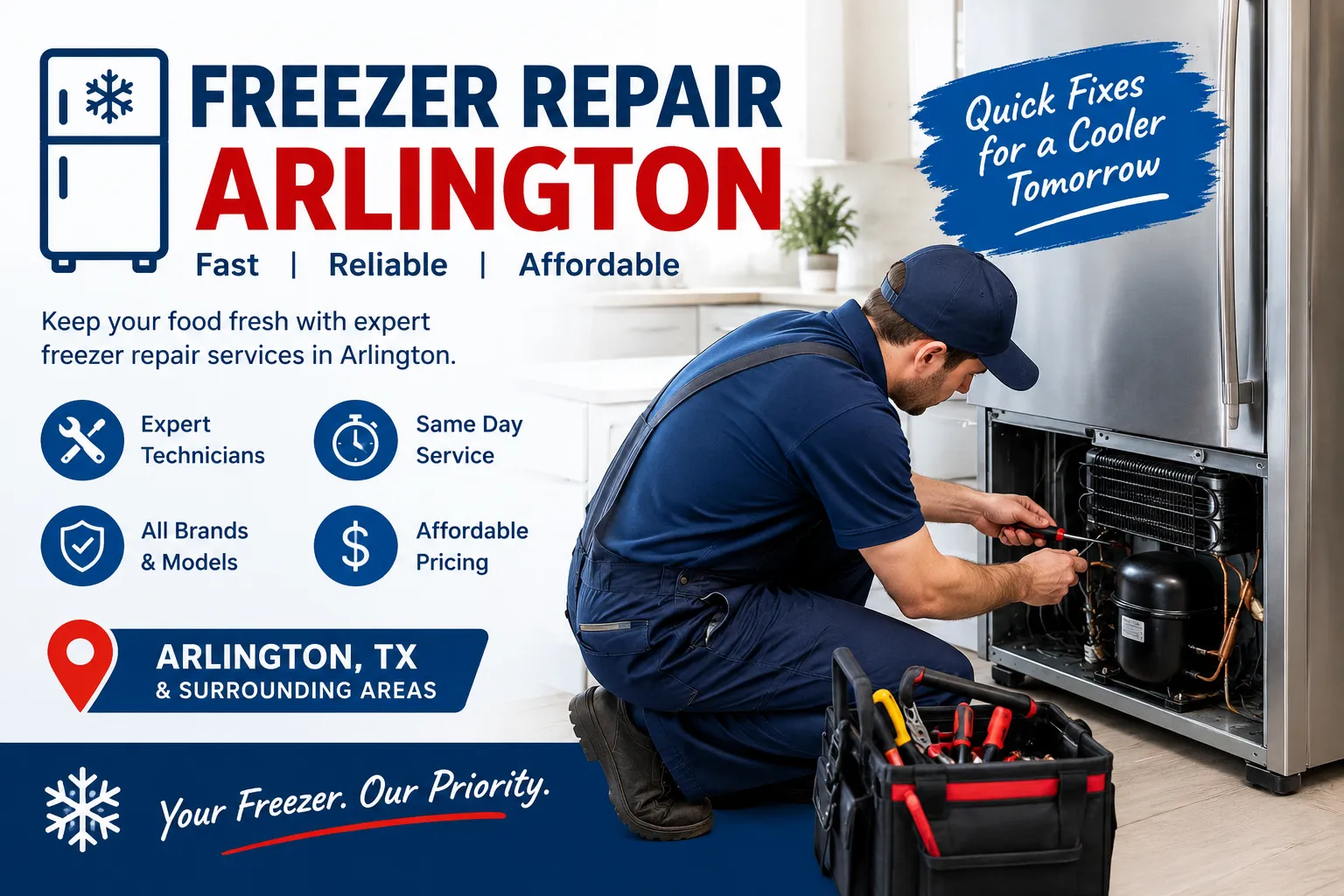

When your freezer stops freezing, you have a short window to act before food spoils, so fast, correct freezer repair in Arlington, TX saves both food and money. This guide explains the warning signs, the most common faults and their causes, safe checks you can do yourself, and how to decide between repair and replacement.
A freezer is one of the hardest-working appliances in a Texas home, especially through Arlington's long, hot summers. Chest freezers in garages, upright freezers in utility rooms and the freezer section of a refrigerator all rely on the same sealed cooling system, and small problems can grow quickly. Knowing what to look for helps you call for freezer repair Arlington at the right time, instead of waiting until a full load of food is lost.
Signs your freezer needs repair
Act promptly if you notice any of these warning signs:
- Food is soft or partly thawed. Ice cream that will not stay firm is often the first clue.
- Frost builds up fast on walls, shelves or food, which can point to a door seal, defrost or airflow problem.
- Water pools under or inside the freezer after thawing.
- Strange noises, such as loud buzzing, clicking, rattling or a fan that squeals.
- The compressor runs constantly or the freezer cycles on and off every few minutes.
- The cabinet feels hot on the sides or back, or the unit smells of burning.
- Your energy bill rises without a change in how you use the appliance.
Even one of these signs is a reason to check the freezer today. Unplugging a unit that smells of burning or sparks is the safest first step.
Common freezer problems, causes and fixes
| Problem | Likely cause | What a technician usually checks |
|---|---|---|
| Not freezing | Failed compressor, start relay or capacitor, or low refrigerant | Electrical parts and the sealed system |
| Warm freezer, cold fridge | Evaporator fan or defrost fault | Fan motor, defrost heater, timer or control board |
| Heavy frost | Worn door gasket or failed defrost system | Seal fit and defrost components |
| Constant running | Dirty condenser coils or a faulty thermostat | Coil cleaning, thermostat and fan |
| Loud noise | Failing fan motor or loose parts | Fan blades, motor and mounting |
| Water leak | Blocked defrost drain | Drain line and drain pan |
| Won't turn on | Power, cord or control board fault | Outlet, cord, board and thermostat |
These are typical causes, not a diagnosis. Sealed-system and electrical faults need a trained technician, because refrigerant handling and live wiring are unsafe and regulated for professionals.
Safe checks to try before you call a technician
A few simple checks can solve minor problems or give the technician useful information:
- Check the power. Confirm the plug is firmly in the outlet, the breaker has not tripped and another device works on the same outlet.
- Check the temperature setting. A freezer is normally kept at 0°F (-18°C), and a dial can be knocked by accident.
- Close the door properly. Make sure nothing blocks it, and test the seal by closing it on a sheet of paper, which should hold firmly.
- Allow airflow. Leave a few inches of space around the unit and do not overpack the inside so air can circulate.
- Clean the coils if you can reach them safely, after unplugging the unit, because dust makes the compressor work harder.
- Protect your food. Keep the door closed, move items to a working freezer or cooler with ice, and avoid refreezing food that has fully thawed.
Do not open sealed parts, remove covers on electrical components or try to add refrigerant. If the checks do not fix the problem, call a professional.
Repair or replace: how to decide
Repair is usually sensible when the freezer is relatively young and the fault is a single part, such as a fan motor, thermostat, gasket or defrost component. Replacement becomes worth considering when the unit is old, the compressor or sealed system has failed, repairs keep recurring, or the cost of repair is close to the price of a new freezer.
A common rule of thumb is to compare the quote with the cost of a comparable new unit and with the freezer's age. Also consider energy use, since newer models are often more efficient. Ask the technician for an honest opinion and a written estimate before you decide.
Arlington heat, power surges and freezer care
North Texas summers put extra load on freezers. A freezer in a hot garage works harder to hold its temperature, so give it ventilation, keep it out of direct sun and avoid placing it next to heat sources. Storms and grid switching can also cause power surges and outages, so a surge protector made for large appliances can protect the control board and compressor.
During an outage, keep the door closed. A full freezer holds its temperature longer than a half-empty one, so keep it well stocked, and fill spare space with containers of water that you can freeze into ice blocks.
What to expect from a professional repair visit
A good visit follows a clear order. The technician asks about the symptoms and the age of the freezer, inspects the unit, tests the electrical and cooling components, explains the fault and gives a price before starting work. Many repairs can be completed in one visit if the part is available, and some need a part order and a second visit.
When choosing a company, ask these questions:
- Is the price quoted before the work starts, and are there any diagnostic or trip fees?
- Is there a warranty on parts and labour, and for how long?
- Does the company service your freezer type and brand?
- Is the technician insured, and can they show identification?
- How quickly can they come, and do they offer appointment windows?
Compare more than one quote when the repair is expensive, and be wary of anyone who asks for full payment before inspecting the freezer.
Maintenance tips to prevent breakdowns
- Clean the condenser coils once or twice a year, and more often with pets.
- Check door gaskets for cracks and wipe them clean so they seal well.
- Defrost manual-defrost freezers when frost reaches about a quarter inch.
- Keep the freezer about three-quarters full for stable temperatures.
- Leave space around the unit for airflow.
- Use a freezer thermometer to confirm it stays at 0°F (-18°C).
- Do not hold the door open, and organise shelves so you can find food fast.
Frequently asked questions
How long does food stay safe if the freezer stops working? A closed, full freezer keeps food frozen for about 48 hours and a half-full one for about 24 hours, according to common food safety guidance. Keep the door shut.
Can I refreeze thawed food? Food that still has ice crystals or is at refrigerator temperature can usually be refrozen, but discard anything that stayed above 40°F for more than two hours.
Why is my freezer cold but not freezing? Common causes include a failing evaporator fan, a defrost problem or a weak compressor, which a technician should test.
Is it worth repairing an old freezer? It depends on the fault and the age. Compare the repair quote with the price of a new unit.
Do you repair chest and upright freezers? Most appliance repair companies do, but confirm the types and brands when you book.
How often should a freezer be serviced? Regular cleaning twice a year is usually enough, with a technician visit when warning signs appear.
Conclusion
Act early when your freezer shows warning signs, do the safe checks, and use a qualified technician for electrical or sealed-system faults. That protects your food, controls repair costs and extends the life of the appliance.























Sign in to leave a comment.