

Key Takeaways
- Buyers now pay for product results, not staffed hours, and vendors that still bill by headcount are being priced out of serious conversations.
- Generative AI collapses the value of raw coding capacity, so the differentiator moves to discovery, product thinking, platform engineering, and quality.
- An outcome-owning partner signs up to product KPIs and roadmap commitments, not timesheets, which changes how contracts and pricing are written.
- The hard part is trust and measurement: shared metrics, joint governance, and a cultural shift on both sides decide whether the model works.
- The 2025-2026 direction points toward AI woven through the software development life cycle and agentic development that reshapes team structure.
Enterprise IT spending is set to grow 14 percent in 2025 to reach $4.25 trillion, the fastest annual rise since 1996, according to IDC's worldwide IT forecast. Yet the budget lines growing fastest are not "developers per month." Buyers want products that ship, metrics that move, and roadmaps that hold. A software product engineering company that still sells time and materials by the seat is watching that shift happen without it. The reframing is simple to state and hard to live: stop billing for effort, start owning results. Software product engineering services are being judged on what the product does in the market, not on how many engineers showed up to the standup.
That change has a clear cause. When code generation gets cheaper every quarter, the scarce thing is no longer the ability to write functions. The scarce thing is knowing which functions matter, why, and whether they moved a number the business cares about. Capacity used to be the product. Now capacity is the commodity, and judgment is the product.
Why the Capacity Model Is Quietly Breaking
For two decades, the offshore and nearshore playbook rewarded volume. A client described a backlog, a vendor staffed it, and both sides tracked utilization. The math favored more people billed at higher utilization. Quality and product impact sat outside the contract, treated as the client's problem to define and defend.
Generative AI broke the pricing logic underneath that model. Gartner projects that 75 percent of enterprise software engineers will use AI code assistants by 2028, up from under 10 percent in early 2023. When an assistant drafts boilerplate, scaffolds tests, and refactors legacy modules, the hours a vendor once billed for that work shrink toward zero. A partner whose only asset is billable capacity has priced itself against a tool that keeps getting cheaper. Clients notice. The conversation moves from "how many engineers" to "what did the product deliver."
Buyers have also grown skeptical of activity dressed up as progress. A team can close hundreds of tickets and still ship a product nobody adopts. That gap between motion and results is where the capacity model loses trust, and where a different kind of partner earns it.
What Outcome Ownership Actually Means
Owning outcomes changes the unit of accountability. Instead of committing to a headcount, the partner commits to product measures: activation rate, cycle time, defect escape rate, uptime against a service level agreement (SLA), or a revenue-linked target the two sides agree on. The roadmap becomes a shared artifact rather than a client instruction set handed down for execution.
This reaches into how the work is structured. A product engineering company that owns results starts before the first sprint, with discovery: framing the problem, testing assumptions with users, and killing features that will not earn their keep. It brings product thinking to trade-offs an hourly vendor would simply escalate. It invests in platform engineering and developer experience (DevEx), so that the team ships faster next quarter than it did in this one. And it treats quality as a built-in property, not a phase bolted on before release.
McKinsey's State of AI 2025 survey of 1,993 respondents found that 88 percent of organizations now use AI regularly, yet only about 6 percent qualify as high performers seeing material enterprise impact. The separation comes from redesigned workflows and clear outcome targets, not from tool access. Owning outcomes forces exactly that redesign, because a partner paid on results cannot afford to leave the workflow untouched.
Discovery, Product Thinking, and the Roadmap
Discovery is where outcome ownership either starts well or quietly fails. The partner interviews users, maps the jobs the product is hired to do, and pressure-tests the roadmap against evidence. Features get sequenced by expected impact, not by whoever shouted loudest in the last review. When a proposed item will not move the agreed metric, the right answer is to say so and drop it, even when building it would have billed more hours under the old model.
Platform Engineering and Developer Experience
Speed compounds. Forrester's software development predictions note that half of enterprises will abandon individual best-of-breed tools for consolidated DevOps platforms, a move toward the internal platforms that make shipping routine. A partner that owns outcomes has a direct incentive to build golden paths, self-service environments, and tight feedback loops, because every hour saved on undifferentiated setup is an hour returned to the product. Developer experience stops being a perk and becomes a lever on delivery cost.
How Software Product Engineering Services Are Priced Now
Pricing follows accountability, so the engagement model is where the shift becomes concrete. Software product engineering services are moving away from pure time and materials toward blends that put the partner's revenue at risk against results. Common structures include the following:
- Outcome-based fees: a portion of payment tied to agreed product or business metrics, such as adoption, conversion, or cost per transaction.
- Managed capacity with SLAs: a dedicated team priced as a service against uptime, cycle time, and quality targets rather than logged hours.
- Product-as-a-service arrangements: the partner builds, runs, and evolves a product for a recurring fee, absorbing the operational load.
- Gain-share models: shared upside when the product beats defined targets, balanced by shared exposure when it does not.
None of these work without instrumentation. Both parties have to agree on what "good" means and how it is measured before a contract is signed. That demand for measurable definitions is healthy. It surfaces vague expectations early, when they are cheap to fix, rather than in a tense renewal meeting a year later.
The transition rarely happens in one jump. Many partnerships start with a hybrid: a baseline of managed capacity for predictable delivery, plus an outcome-linked tranche tied to two or three metrics both sides trust. As measurement matures and trust builds, the outcome portion grows and the pure-capacity portion shrinks. Treating the model as a dial rather than a switch lowers the risk for a buyer who has been burned by vague promises before, and it gives the partner room to prove attribution on a small surface before taking on more.
The Benefits Buyers Actually Feel
The appeal is not abstract. When a partner carries the outcome, several things improve at once. Accountability concentrates in one place, so finger-pointing between a vendor that built to spec and a spec that was wrong largely disappears. Product decisions get made with commercial context, because the partner has skin in the commercial result. Speed improves as platform investment pays down, and quality rises because defects now cost the partner, not only the client.
A second benefit shows up over time. A product engineering company invested in the outcome tends to protect the product's long-term health: it argues against shortcuts that inflate this quarter and wreck the next, and it flags technical debt while the fix stays cheap. An hourly vendor has no such incentive, since more debt often means more billable remediation later. Retention improves too, because a partner accountable for a metric keeps the same senior people on the product rather than rotating juniors through a bench. Continuity of knowledge becomes an asset the client stops paying to rebuild every few months.
The Challenges Nobody Should Gloss Over
Outcome ownership asks more of both sides, and pretending otherwise sets up failure. Trust is the first hurdle. A client handing over roadmap authority needs confidence that the partner will act in the product's interest, which takes a track record and transparent governance to build. Measurement is the second. Attribution gets messy when marketing, pricing, and the product all move a metric at once, so the contract has to isolate what the engineering work can fairly be held to.
The cultural shift is the third, and it runs in both directions. Client teams used to directing every task have to cede some control and judge the partner on results instead of activity. Partner teams used to billing hours have to learn to say no to work that will not pay off, and to sit in product conversations they once escalated away. Product engineering consulting engagements often start here, aligning incentives, metrics, and decision rights before a line of production code gets written. Skipping that groundwork is the most common way these arrangements sour.
How to Vet a Software Product Engineering Company for the Outcome Era
The evaluation criteria change once results are on the line. Case studies that lead with team size and delivery velocity describe the old model. The signals worth weighting now look different: evidence that the partner has owned a product metric and moved it, a discovery practice that predates any staffing plan, real platform engineering and DevEx capability, and a quality approach measured in escaped defects rather than tickets closed.
Ask how a candidate handles being wrong. A partner that owns outcomes will describe features it recommended against, bets that failed, and what it changed afterward. Ask how it measures its own contribution, and whether it will put fees at risk against the numbers it claims to influence. Firms offering genuine product engineering solutions answer these questions with specifics; firms selling capacity in new packaging tend to change the subject back to rate cards and bench depth. The difference tells you which era the partner actually operates in.
Reference checks should probe the relationship under stress. How did the partner behave when a launch slipped, a metric stalled, or a roadmap assumption proved wrong? Alignment is easy to claim in a pitch and hard to fake in a reference who watched a hard quarter play out.
Where This Goes in 2026 and Beyond
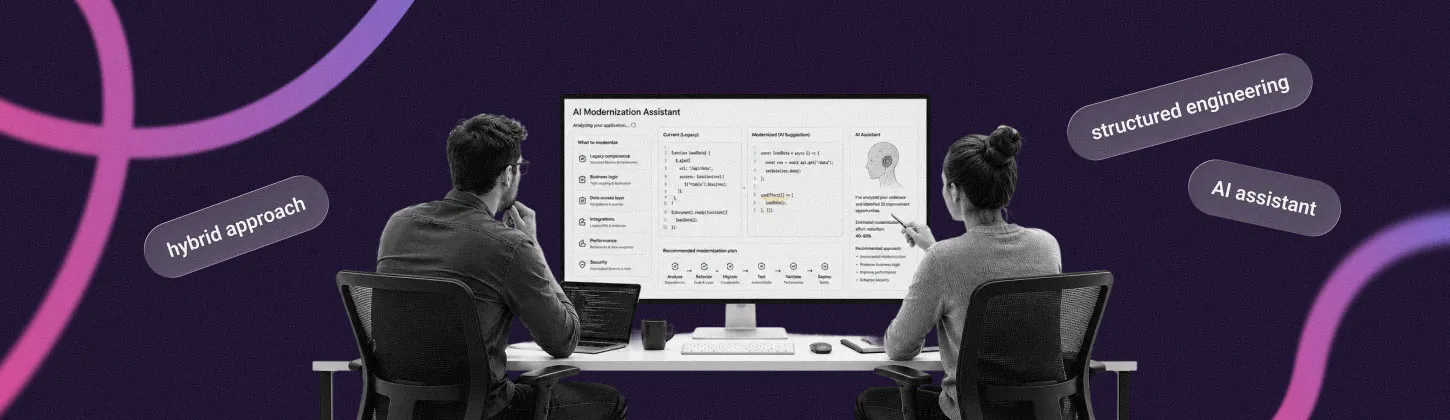
Two forces will push the shift further. The first is AI moving deeper into the software development life cycle. Forrester reports that 49 percent of developers already use or expect to use a generative AI coding assistant, and the frontier is moving past autocomplete toward agentic development, where AI systems handle multi-step tasks under human direction. As routine build work compresses, the human premium concentrates in framing problems, designing systems, and judging quality, the exact skills outcome ownership rewards.
The second force is measurement maturity. As more engagements price on results, buyers get better at defining metrics and partners get better at instrumenting them. That flywheel makes the capacity model look increasingly out of step, since it asks a buyer to pay for inputs in a market learning to pay for outputs. The vendors that thrive will be the ones that point AI at product outcomes rather than at defending billable hours.
Damco Solutions helps organizations make this shift with software product engineering services built around discovery, platform engineering, and accountability for the metrics that matter. A software product engineering company that owns outcomes turns a cost center into a source of product advantage, because its incentives finally point the same way as the client's. As code generation keeps getting cheaper, that alignment, not headcount, becomes the thing worth paying for, and the partners who understand it now will define the next decade of how software gets built.




























Sign in to leave a comment.