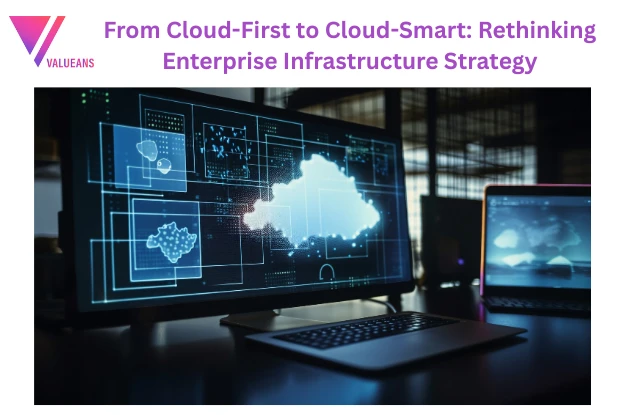

What Does “Cloud-Smart” Mean in Modern Enterprise Strategy?
For years, businesses raced toward cloud-first adoption—moving workloads, applications, and data to the cloud as fast as possible. But after major disruptions like the Microsoft Azure outage that cost billions globally, organizations are realizing that agility alone isn’t enough. They now need a cloud-smart strategy—a balanced approach that aligns technology adoption with resilience, cost optimization, and intelligent data use.
Cloud-smart means using the right cloud model for the right purpose, not just migrating everything for the sake of modernization. It integrates on-premise systems, hybrid models, and business intelligence and analytics services to ensure smarter, data-driven decision-making.
What Is the Difference Between Cloud-First and Cloud-Smart?
While both aim to modernize enterprise IT, their focus differs.
A cloud-first approach prioritizes speed and innovation, encouraging businesses to move workloads to the cloud quickly. However, it often leads to challenges such as vendor lock-in, cost overruns, and limited flexibility.
On the other hand, a cloud-smart approach is about strategic optimization. Instead of migrating everything blindly, it evaluates each workload’s value, cost, and performance before deciding where it should run—on-premise, in the public cloud, or across hybrid systems.
In simple terms: cloud-first focuses on migration, while cloud-smart focuses on intelligence and efficiency.
Why Are Enterprises Transitioning to Cloud-Smart Strategies?
The rapid digital transformation of the past decade created significant infrastructure complexity. Many companies discovered that blind migration to public clouds led to hidden costs, data silos, and performance issues.
The rise of business intelligence consulting has shown that smart cloud models leverage analytics to optimize workloads, predict cost spikes, and identify efficiency gaps. Rather than centralizing everything with one provider, cloud-smart enterprises distribute workloads intelligently across private, public, and hybrid environments—guided by data insights and predictive analytics.
By combining business intelligence and analytics services, companies can analyze operational performance and automate infrastructure decisions in real time. This is not just IT transformation; it’s strategic intelligence at scale.
How Do Business Intelligence and Cloud-Smart Strategies Intersect?
Modern enterprises can no longer separate cloud strategy from data strategy. Cloud-smart architectures rely on analytics-driven decision-making at every layer—storage, compute, networking, and security.
That’s why organizations are increasingly investing in business intelligence and analytics services that integrate directly into their infrastructure pipelines. These services deliver continuous insights into performance metrics, workload efficiency, and user demand patterns.
For example:
- Predictive BI tools can forecast resource utilization, reducing over-provisioning.
- Real-time dashboards offer cross-cloud visibility and governance.
- Automated reports help IT leaders evaluate ROI and cost optimization efforts.
Ultimately, data becomes the foundation of smarter infrastructure decisions.
What Role Does “Business Intelligence as a Service” Play in This Shift?
Business Intelligence as a Service (BIaaS) plays a pivotal role in this transformation. It provides analytics platforms through the cloud, enabling organizations to access advanced insights without the burden of managing heavy infrastructure.
Key benefits of BIaaS in a cloud-smart ecosystem include:
- Scalability – Easily expand analytics capabilities as data volume grows.
- Cost Efficiency – Subscription-based models eliminate upfront infrastructure costs.
- Speed to Insight – Teams can deploy dashboards and visualizations rapidly.
- Interoperability – BIaaS tools integrate seamlessly with multiple cloud providers.
- Security and Compliance – Built-in data governance ensures regulatory adherence.
With BI as a service, companies not only store data intelligently but also analyze it intelligently—turning information into actionable intelligence.
How Can Enterprises Build a Cloud-Smart Roadmap?
Transitioning from cloud-first to cloud-smart requires a structured, data-driven roadmap that balances technology and intelligence.
Here’s how enterprises can begin that journey:
1. Assess Cloud Maturity
Evaluate existing workloads, dependencies, and integration points. Identify which systems are critical and which can move to hybrid or edge environments.
2. Integrate Business Intelligence Early
Engage business intelligence consulting services from the start to build visibility across your cloud landscape. Use analytics to uncover inefficiencies and cost drivers.
3. Prioritize Data Portability
Ensure applications and data can move freely across different environments. Avoid vendor lock-in by using open APIs and standardized frameworks.
4. Strengthen Governance and Security
Adopt unified identity management, encryption, and compliance automation to maintain consistent control across all cloud environments.
5. Optimize Cost Through Analytics
Leverage enterprise BI solutions to forecast usage patterns, detect underutilized resources, and automate scaling decisions based on demand.
6. Empower Teams with Insights
Enable self-service BI and analytics services so business and technical teams can analyze performance metrics and make data-backed decisions in real time.
Why Are Business Intelligence Solutions Critical to Cloud-Smart Success?
In a cloud-smart world, visibility is power. Without clear and contextual data, enterprises risk repeating cloud-first mistakes like overspending and performance inefficiencies.
A business intelligence solutions company brings transparency by offering unified dashboards and performance insights across multi-cloud platforms. These tools detect performance issues, predict costs, and recommend optimizations instantly.
By integrating BI and analytics services, organizations gain:
- Predictive visibility to forecast traffic surges and resource needs.
- Financial transparency to compare spending against performance outcomes.
- Operational control to identify and fix inefficiencies before they escalate.
In short, data-driven intelligence transforms cloud-smart vision into measurable value.
How Does Cloud-Smart Architecture Support AI and Automation?
As enterprises adopt AI and automation, cloud-smart infrastructures provide the agility and scalability needed to power them efficiently. BI and analytics services feed AI models with accurate, structured data and enable continuous improvement through feedback loops.
AI tools, in return, enhance BI performance by automating insights and anomaly detection. Together, they create a self-optimizing ecosystem that improves performance, reduces costs, and minimizes human error.
This fusion of AI and BI defines the future of enterprise infrastructure—intelligent, automated, and adaptive.
What Are the Common Challenges in Adopting Cloud-Smart Models?
While the cloud-smart approach offers many benefits, it also introduces challenges that must be managed carefully:
- Data Fragmentation: Managing distributed data can create gaps in visibility.
- Integration Complexity: Legacy systems often struggle to align with hybrid models.
- Cost Tracking Issues: Without BI-driven oversight, cloud expenses can rise unpredictably.
- Skill Shortages: Teams may lack cross-functional expertise in both cloud and BI.
Overcoming these requires partnering with an experienced business intelligence consulting partner who understands analytics, governance, and optimization within hybrid environments.
How Will the Future of Enterprise Infrastructure Evolve?
The next era of enterprise IT will be defined by intelligence, flexibility, and sustainability. Instead of moving everything to the cloud, companies will use BI-driven orchestration to decide what runs where—and why.
Key future trends include:
- AI-enhanced BI for predictive infrastructure management.
- Edge computing adoption to reduce latency and dependency on centralized clouds.
- Sustainability analytics to measure and optimize energy efficiency.
Organizations that combine business intelligence and analytics services with hybrid and multi-cloud flexibility will stay competitive, resilient, and adaptive to change.
Summary: Moving Beyond Cloud Adoption to Cloud Intelligence
The shift from cloud-first to cloud-smart marks a powerful evolution—from rapid adoption to strategic optimization.
By leveraging business intelligence consulting services, BI as a service, and enterprise BI solutions, companies can make smarter infrastructure choices based on data—not guesswork.
Cloud-smart isn’t about where your data resides—it’s about how intelligently you use it.
With BI-powered insights, enterprises can achieve agility, security, and performance without compromise.

























Sign in to leave a comment.