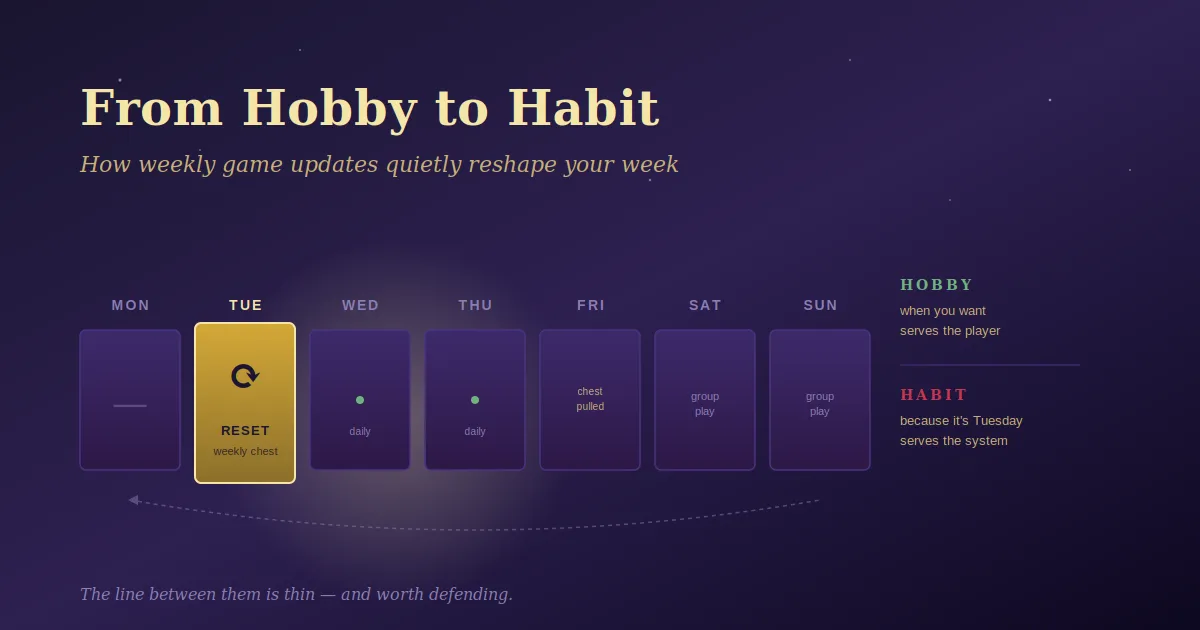

Reset day is a real day for millions of people. They know what time it happens. They organize their evenings around it. They feel something — a small disappointment, an actual mood shift — if they miss it. In a previous era, Tuesday was just Tuesday. Today, for a significant population, Tuesday is the day the game updates, and that fact has quietly shaped how an entire generation spends its time.
The shift from playing a game to maintaining one is one of the most consequential design choices of the past decade. Hobbies are flexible — you do them when you want. Habits are routine — you do them because it's Tuesday. The difference matters to the player's time, to the publisher's revenue, and to the entire shape of how live-service entertainment is designed in 2026.
Weekly update systems are how that transition happens. They're more deliberate than they look.
The Tuesday phenomenon
Most live-service games reset midweek. The convergence on the same day across the industry isn't accidental — it's strategic. Publishers learned that midweek resets capture the highest engagement, with the weekly chest pulled by Friday and the weekend reserved for socially-coordinated play.
This creates a midweek rhythm that committed players internalize. Check what's changed. Read the patch notes if any dropped. Plan the week's content around what's available. In one major multiplayer game, for instance, a serious dungeon player might check the wow m+ healer tierlist for affix-week implications before deciding what content to queue tonight. The cycle becomes habit. Skipping a reset day feels like falling behind, even when nothing important happened that week.
The genius of the midweek reset is converting the game from an activity into a routine. Players don't decide whether to log in — the question becomes what time on Tuesday. That decision flow, repeated weekly, builds in a way monthly or daily cycles don't. Weekly is the sweet spot. Frequent enough to feel current. Infrequent enough to feel meaningful.
Daily quests as commitment devices
Beneath the weekly rhythm sits the daily one. Daily quests, daily login bonuses, daily missions. Every live-service game has some version. The function is the same: create a small reward for engaging each day, so missing a day feels like a loss rather than a neutral choice.
Behavioral economics calls this loss aversion. The pain of missing a daily reward outweighs the pleasure of receiving it. Skip one day's quest and you've lost the streak. Skip a week and you've lost compound rewards. The psychology is brutally effective.
But this is also where the line between healthy engagement and exploitative habit-building gets blurry. Daily quests that feel rewarding are good design. Daily quests that feel obligatory are bad design. The same mechanic can be either depending on the size, frequency, and feel of the rewards. The good versions respect the player's time and offer real choices. The bad versions create a treadmill the player runs because stopping costs more than continuing.
The weekly chest as anchor
Many live-service games include some version of a weekly chest system. Complete content during the week, and on reset day you get a reward with choices weighted by how much you completed. The structure, when done well, is elegant — it rewards engagement without requiring optimal play, and offers choices that make players feel agency in their progression.
The chest works because it's an anchor. The week organizes around feeding it. The reset-morning chest-opening becomes a ritual. The slow accumulation of weeks adds up to progression that wouldn't happen if every reward arrived instantly. Players feel like they're building something, week by week, instead of consuming content as fast as the game can produce it.
This anchoring effect is the deeper purpose of weekly systems. Without an anchor, content has no rhythm — players consume it as fast as they can and then quit. With an anchor, content paces itself across weeks and months. The same total amount of content fills more time, and the time spent feels more meaningful because each week has a clear arc.
Variety injection on top of rhythm
Some games layer variety on top of the weekly rhythm. Every week the same content feels slightly different because one variable changes — a modifier, a special condition, a rotating challenge. The content pool stays static. The experience refreshes.
Variety injection is critical for long-term engagement. Pure repetition burns players out fast. Variety with familiarity — same content, different conditions — works much better. The novelty is bounded. The mastery is still possible. The week feels new without feeling unfamiliar.
This pattern works across many games. Weekly modifier rotations in cooperative content. Seasonal leagues in build-focused games. Special rotating modes in card games. All of them mix variety into a stable core, creating engagement that's renewable rather than depleting.
When habits become obligations
Not every player navigates these systems healthily. The same design that creates engagement also creates compulsion. Players who feel they have to log in on reset day because they have to complete the chest are showing the failure mode of the design. The system has shifted from offering value to extracting time.
The signs are subtle. The fun of opening the chest fades. The dailies feel like chores. The reset-day rhythm becomes a constraint rather than a pleasure. Players in this state often don't recognize what's happening — they keep logging in because logging in is what they do — but the experience has flipped from positive to neutral or negative.
The healthy response is to step back, ideally before the burnout point. Publishers can't help with this. The systems are designed to maximize engagement, and engagement past the point of pleasure is still engagement from the publisher's perspective. The player has to be the one who recognizes the inflection point and steps away.
The next generation of design
Modern game design is starting to grapple with this dynamic more honestly. Some games — Path of Exile is the most-cited example — build in explicit off-seasons that release players from engagement obligations. Some avoid the model entirely by not being live-service at all. Single-player games, after years of being declared dead, are doing fine, partly because they don't run on this kind of treadmill.
The most thoughtful live-service designs try to maintain engagement without compulsion. Optional weekly content. Catch-up mechanics for players who miss weeks. Reduced punishment for falling behind. These designs respect players as people who have lives outside the game — which, ironically, often produces more sustainable long-term engagement than the heavy-handed habit-builders do.
The trend is good. The trend is also incomplete. Most live-service games still over-rely on fear-of-missing-out and obligation mechanics. The shift toward respectful engagement design is happening, slowly. Players who notice it and reward it with their attention will accelerate the shift.
What this means for the player
The honest summary: weekly update systems are real engineering. They aren't accidents of design. They're deliberate structures shaping behavior in measurable ways. Understanding them doesn't make them less effective, but it does let players engage on their own terms rather than the system's.
Check rankings because you want to engage optimally, not because reset day told you to. Complete the chest because the rewards are meaningful, not because the streak demands it. Engage with the game because you enjoy it, not because skipping feels worse than playing. The same actions, with different intent, produce very different relationships with the hobby.
That's the choice the design is asking players to make. Hobbies serve the player. Habits serve the system. The line between them is thin and worth defending.


























Sign in to leave a comment.