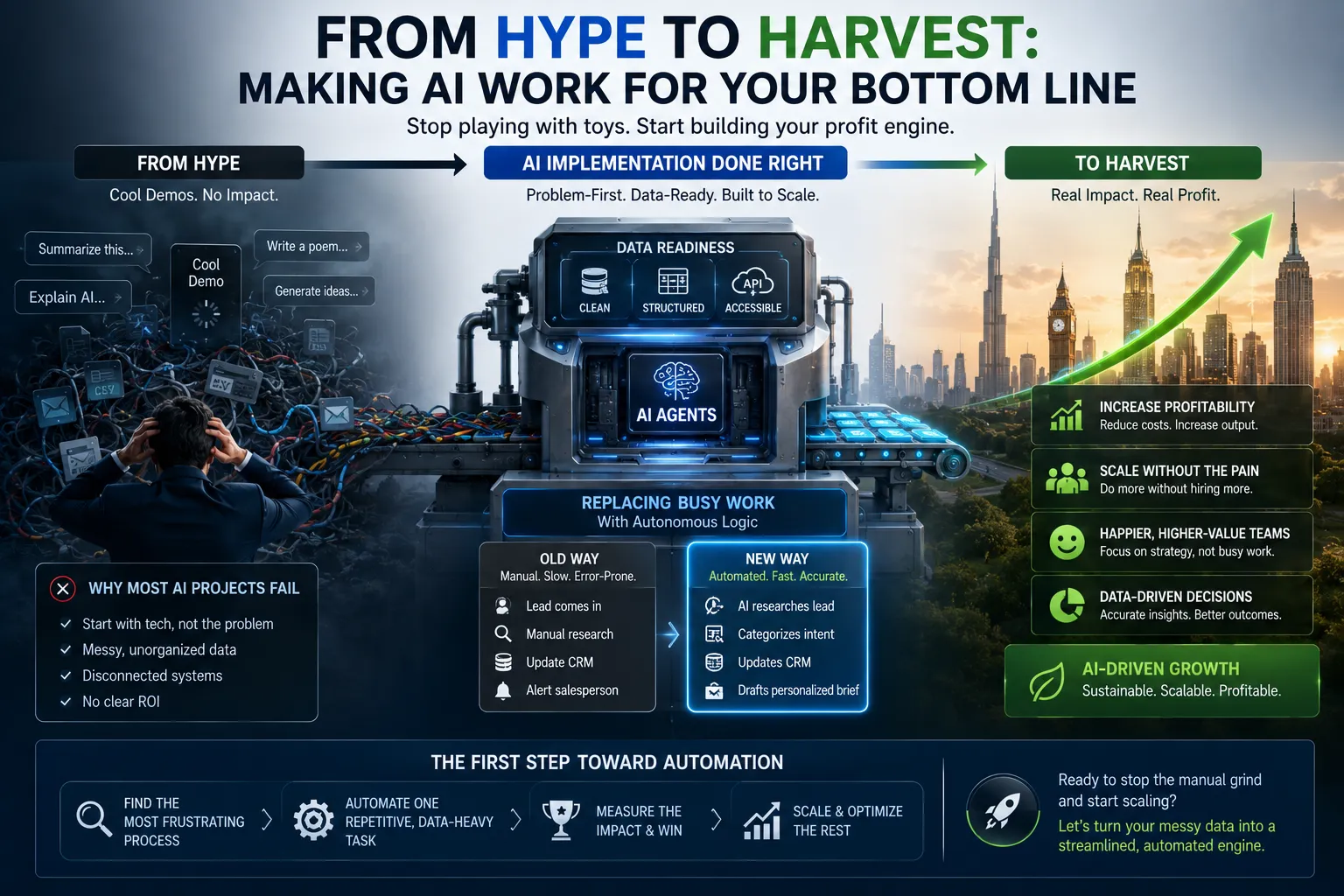

In 2026, the "wow factor" of AI has mostly faded. Business owners in London, Dubai, and New York are no longer impressed by a bot that can write a poem or summarize a meeting. They want to know one thing: How does this make my company more profitable?
The transition from a "cool demo" to a production-ready system is where most companies stumble. It’s the difference between playing with a toy and installing a piece of industrial machinery.
The Missing Link in AI Implementation
Most AI projects fail because they start with the tech instead of the problem. A founder might say, "We need to use Claude 3.5 because everyone is talking about it." But they haven't identified where it fits in their actual workflow.
At Byteonic Labs, we’ve found that the secret to success isn't the model you choose; it’s your data readiness.
Think of AI like a high-performance sports car. If you put low-grade fuel (messy, unorganized data) into it, the car won't run. In fact, it might break. Before you look for an AIimplementation partner, you have to look at your spreadsheets, your CRM, and your internal documents. Are they structured? Are they accessible via API? If not, that is your first step.
Replacing "Busy Work" with Autonomous Logic
The real ROI in 2026 comes from replacing "human middleware." These are the roles where people act as the bridge between two apps, moving data, checking boxes, and sending status updates.
By building business process automation systems, you allow your team to move away from these "loop" tasks.
- Old Way: A sales lead comes in, a coordinator manually checks their LinkedIn, updates the CRM, and alerts a salesperson.
- New Way: An AI agent performs the research, categorizes the lead's intent, updates the CRM, and drafts a personalized brief for the salesperson instantly.
This isn't just about speed; it's about accuracy. Agents don't get tired at 4:00 PM on a Friday.
Scaling Without the Growing Pains
For many mid-market firms, growth used to mean a massive increase in payroll. In the new economy, you can extend your tech team by using a "Tech Team as a Service" model. This gives you the senior architecture you need to build production grade AI systems without the 6-month delay of traditional hiring.
It allows you to stay lean while operating at the level of a much larger enterprise. You aren't just adding a tool; you are upgrading your entire business operating system.
The First Step Toward Automation
If you are overwhelmed by the options, start small. Find the one process that causes the most frustration for your team. Usually, it's something repetitive and data-heavy.
Once you automate that one "win," the rest of your AI strategy will fall into place. The goal is to stop "doing" AI and start "being" an AI-driven organization.
Ready to stop the manual grind and start scaling? Let’s talk about how to turn your messy data into a streamlined, automated engine.

























Sign in to leave a comment.