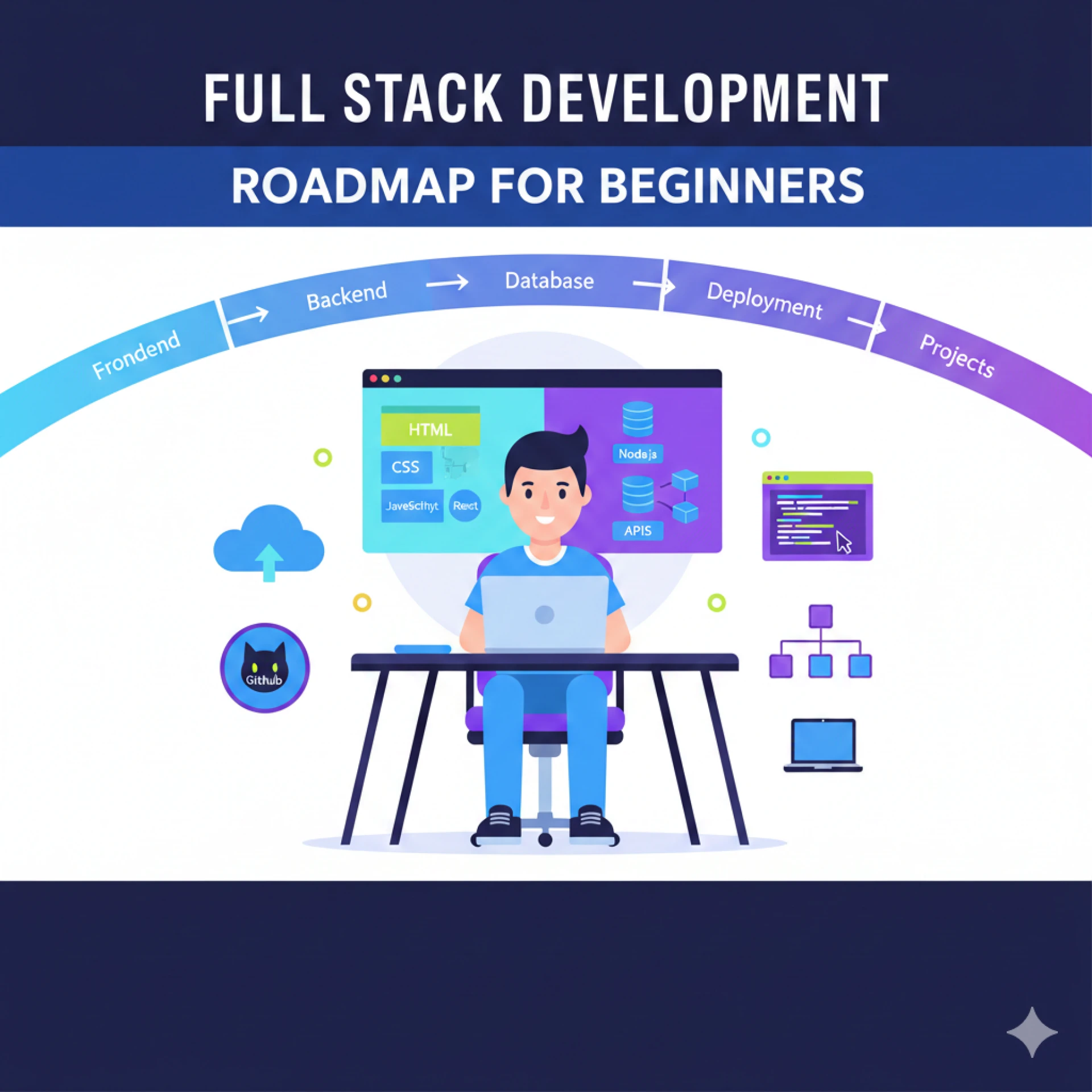
Are you planning to become a full stack developer but don’t know where to start? Don’t worry — this step-by-step roadmap is designed especially for beginners who want to build a successful career in full stack development. Whether you want to learn coding from scratch or switch to IT, this guide will help you understand exactly what skills you need, what to learn first, and the ideal learning path to become job-ready.
Who Is a Full Stack Developer?
A full stack developer is someone who can build both the frontend (user interface) and backend (server, database, APIs) of a web application. This makes full stack development one of the most versatile and in-demand professions in the IT industry.
Full Stack Development Roadmap for Beginners — Step-by-Step
Step 1: Learn the Basics of Web Development
Start with the core web technologies:
- HTML → Structure of the webpage
- CSS → Styling and layout
- JavaScript → Logic and interactivity
Once comfortable, move to:
- Responsive Web Design
- Flexbox and Grid
- DOM Manipulation
These fundamentals build the foundation of your full stack journey.
Step 2: Choose a Frontend Framework
Modern companies don’t rely only on raw HTML/JS — they prefer frameworks for efficiency and speed.
Top frontend frameworks to choose from:
Framework
Why Learn It
React.js
Most popular, high salary demand
Angular
Enterprise-level applications
Vue.js
Easy learning curve for beginners
Focus on one framework deeply to develop strong frontend skills.
Step 3: Learn Backend Development
Backend manages server-side logic, APIs, authentication & database operations.
Popular backend languages and frameworks:
Language
Framework
JavaScript
Node.js + Express.js
Python
Django / Flask
Java
Spring Boot
PHP
Laravel
If you're just starting, Node.js is beginner-friendly and widely used in MERN full stack development.
Step 4: Master Databases
Applications require storing data, and developers must understand both relational and non-relational databases.
- SQL Databases: MySQL, PostgreSQL
- NoSQL Databases: MongoDB (most popular for MERN stack)
Learn how to:
- Create database schemas
- Write CRUD operations
- Join tables
- Optimize queries
Step 5: Explore Version Control
Every developer must know Git & GitHub.
Learn to:
- Create repositories
- Commit & merge code
- Work on branches
- Collaborate with other developers
This is mandatory for working in real projects or companies.
Step 6: Build and Consume APIs
APIs allow communication between frontend and backend.
Learn:
- REST APIs
- JSON format
- Authentication (JWT / OAuth)
- Third-party APIs
This makes your applications dynamic and production-ready.
Step 7: Learn Deployment
To make websites accessible to users, you need deployment knowledge.
Tools to learn:
- AWS / Azure / Google Cloud
- Netlify / Vercel for frontend
- Render / Railway / Heroku for backend
- Docker (optional but very useful)
Deployment knowledge dramatically increases placement chances.
Step 8: Build Real-World Projects
Instead of learning endlessly, start building projects:
Project ideas:
- Dynamic Portfolio Website
- Social Media App
- E-commerce Store
- Task Management Tool
- Blogging Platform
Projects help you gain confidence and impress recruiters.
Final Recommendations to Succeed as a Full Stack Developer
- Practice coding daily
- Create a GitHub portfolio
- Keep learning new tools and frameworks
- Participate in hackathons and internships
If you want structured learning with real-time projects and placement support, enrolling in a Full Stack Developer Course in Pune can make your journey faster and easier. Many institutes also provide interview training, mock tests, and hands-on projects to make learners job-ready.
Conclusion
Following this roadmap step-by-step will help you build a strong foundation in web development and become a confident full stack developer. Instead of learning everything at once, focus on consistent practice, real projects, and industry tools. If you want guided training, expert mentorship, and job support, joining a Full Stack Developer Course in Pune or a Full Stack Developer Course in Pune with Placement can be the perfect way to kick-start your IT career.
FAQs
1. How long does it take to become a full stack developer?
For beginners, it usually takes 6–12 months with consistent practice and hands-on projects.
2. Do I need prior coding knowledge to start?
No. Anyone can start from scratch and learn step by step.
3. Which coding language is best for full stack development?
JavaScript (MERN Stack) is the most popular and beginner-friendly choice.
4. Is full stack development a good career?
Yes. Full stack developers are among the highest-paid and most in-demand professionals globally.
5. How can I get a job after learning full stack development?
Building projects, preparing for interviews, and joining a Full Stack Developer Course in Pune with Placement can significantly increase your job chances.


















Sign in to leave a comment.