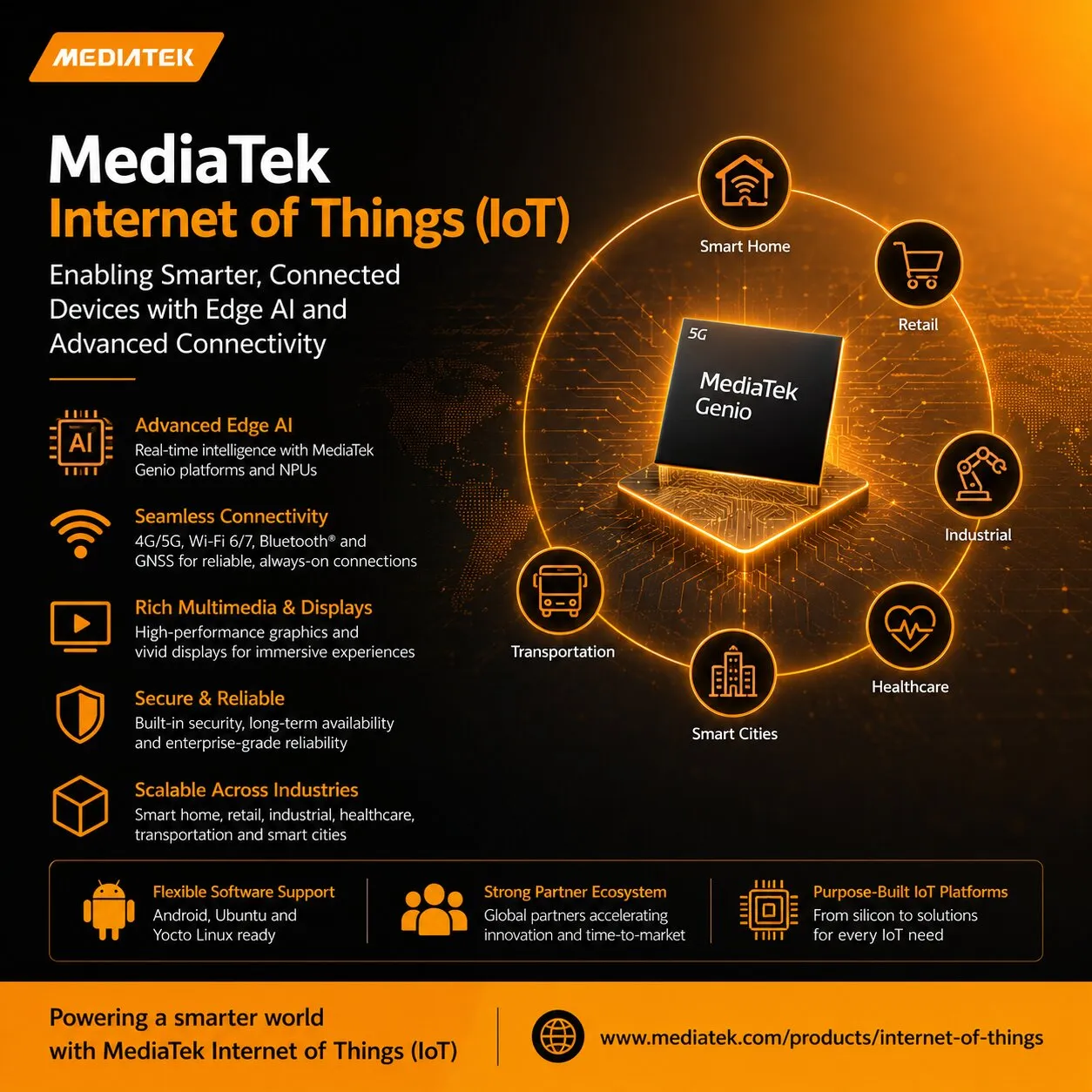

Enterprise internet of things programs are long-term investments. A device designed today may still be running on a factory floor, in a hospital, or across a commercial campus well into the next decade.
The hardware platform underneath it needs to last just as long.
This is a problem that most product teams realise too late. Either the internet of things processors get discontinued, or BSP stops receiving updates, or a component reaches end-of-life. And suddenly, a product that is still in active deployment needs a full hardware redesign, rattling up costs and plans.

And it is a massive engineering cost. Not to mention that it is also an operational disruption that could have been entirely avoided. The MediaTek IoT Longevity Program, specifically for Genio, is built to prevent exactly this.
What the Program Covers
The Genio Longevity Program guarantees a minimum 10-year availability and support lifecycle for select Genio internet of things processors from their launch date. It covers three things that enterprise buyers need across a long deployment cycle.
1. Design Continuity - It means the hardware platform a team designs on today remains available for new production runs for years. This ensures no forced migration to a new chipset mid-program.
2. Supply Assurance - It means the chipset remains available and supported for at least 10 years from its launch date. This gives procurement teams the confidence to plan multi-year production volumes with greater certainty.
3. Long-Term Software Support - It means BSP maintenance and OS support continue across the entire longevity period. Security patches, driver updates, and platform fixes continue to be delivered. A device running Yocto Linux or Android on a Genio SoC today does not become a software liability three years into deployment.
The Product Longevity Overview
Every active chipset in the Genio lineup carries a 10-year commitment. Here is the full MediaTek IoT breakdown, based on its longevity.
| Chipset | Status | Validity |
| Genio Pro 5100 | Engineering Samples | 2036 |
| Genio 1200 | Commercial | 2032 |
| Genio 720 | Commercial | 2035 |
| Genio 520 | Commercial | 2035 |
| Genio 510 | Commercial | 2034 |
| Genio 420 | Engineering Samples | 2035 |
| Genio 360 | Commercial | 2035 |
| Genio 360P | Commercial | 2035 |
At the top is the Genio Pro 5100, currently in engineering samples from Q1 2026, which is supported through 2036. It is built on a 3nm process with an all-big-core octa-core CPU, 50+ TOPS NPU, Wi-Fi 7, and support for up to 16 simultaneous camera streams. It is designed for robotics, machine vision, commercial drones, and demanding edge AIoT platform. A product designed on Genio Pro 5100 today has a guaranteed hardware and software foundation through 2036, the longest end date in the current lineup.
Next up is the high-performance Genio 1200, designed for intensive workloads in commercial and industrial environments. The platform, launched in Q2 2022, is supported through 2032. It is an octa-core SoC with a 4.8 TOPS NPU and four big Cortex-A78 cores. XC Tech's H08 Pro rugged industrial handheld runs on Genio 1200. It is a product that operates in demanding factory environments and depends on supply continuity for ongoing fleet management.
Now, coming to the mid-range Genio 720, introduced in Q2 2025 and supported through 2035, brings a more balanced mix of performance and connectivity. It is a 6nm octa-core chip with 10 TOPS NPU, Wi-Fi 7, and GenAI support. The addition of internet of things IoT Wi Fi 7 makes it relevant for connected industrial and enterprise applications. This is because they require both high compute and high-throughput wireless connectivity, with software and supply continuity through 2035.
In a similar performance class but tuned slightly differently, the Genio 700 arrived in Q1 2023 and is supported through 2034. It is a 6nm octa-core SoC with a 4 TOPS NPU. VIA's VAB-5000 PPE compliance system and Grinn's GenioSOM-700 edge AI module are both in production on this platform. Both benefit from a hardware and software foundation that remains guaranteed through 2034.
Building on that same 6nm foundation is the Genio 520, launched in 2025 with support extending till 2035. It is a 6nm octa-core chip with 10 TOPS NPU and on-device GenAI capability. Suited for mid-range edge AI applications where compute requirements are growing but BOM constraints still apply.
Just below it is Genio 510, a 6nm hexa-core SoC with a 3.2 TOPS NPU, suited for HMI systems, industrial displays, and connected appliances. The platform came in Q1 2024 and is supported through 2034. Ezurio's advanced food and beverage HMI systems are built on Genio 510, benefiting directly from the long supply window for sustained production runs.
Positioned as an entry-level SoC, the Genio 420, currently in engineering samples from Q2 2026, is supported through 2035. It is a 6nm octa-core chip with 7.2 TOPS NPU and GenAI capability. Teams can begin platform evaluation and early development now, with commercial availability and full longevity backing at commercial launch.
Genio 360 and Genio 360P, both launched in Q1 2026, are also entry-level AIoT platform supported through 2035. Both are 6nm chips with integrated CAN bus support. The Genio 360 delivers 5.1 TOPS NPU, and the 360P delivers 7.4 TOPS. CAN bus is the standard fieldbus protocol in industrial machinery and embedded control systems. Having it integrated in the SoC removes the need for external controller hardware. For programs starting on these chipsets today, the longevity window runs a full nine years from now.
Not the flagship, but still widely deployed and highly reliable is the Genio 350, launched in Q2 2020, supported through 2030. It is a 14nm quad-core platform suited for entry-level Internet of Things products and smart home applications. In real deployments, it powers VIA Technologies’ Video Intercom and Access Control system, enabling video communication and smart building access. It is also used in HMI panels, POS terminals, digital signage, and smart surveillance systems. Teams with existing Genio 350 designs have supply and support continuity secured through the end of the decade.
Understanding the Status Categories
The longevity program uses defined status categories. Enterprise buyers need to understand what each one means before selecting a platform.
Commercial means the product is fully released, in production, and backed by the 10-year longevity commitment. These are safe, production-ready choices for any new design starting today.
Engineering Samples mean the product is in a pre-production phase. Samples are available for evaluation, but specifications may still change before the commercial release. Teams can begin hardware evaluation and early software bring-up now, with full longevity backing confirmed at commercial launch.
Not Recommended for New Designs (NRND) means the product remains available for existing customers but should not be selected for new programs. New programs should migrate to the current Genio platform.
Last Time Buy applies to internet of things IoT products being phased out, where orders can still be placed for a limited window. Products are classified as obsolete only after production has ended. No chipset in the current Genio lineup falls into that category.
What Mid-Lifecycle Redesign Costs
For enterprise organisations, MediaTek's 10-year longevity program delivers significant financial and operational advantages.
The IoT products' hardware redesign triggered by chipset discontinuation can be both costly and time-consuming. It often requires new schematics, a revised PCB layout, BSP bring-up, requalification testing, and product recertification.
In regulated sectors such as medical devices and industrial safety systems, recertification alone can take months and involve high expense.

For large-scale deployments, organisations may also face the operational burden of managing multiple hardware SKUs during the transition period.
The Genio Longevity Program eliminates that scenario for the full 10-year window. A single hardware design, software stack, and certification effort can be maintained throughout the deployment lifecycle for Internet of Things products.
The unified Software Development Kits (SDKs) across the Genio family add a further layer of cost protection. If a program eventually requires a higher-performance chipset within the range, the software investment carries over. The codebase developed on Genio 700 can scale to Genio Pro 5100 without rebuilding the OS layer or the application stack.
Key Takeaways
Hardware decisions in enterprise Internet of Things products carry long-term consequences. A platform chosen today determines supply availability, software maintainability, and redesign risk for the next decade.
The MediaTek Genio IoT Longevity Program gives enterprise and industrial product teams the certainty they need to make those decisions with confidence.
Every chipset in the active Genio lineup carries a 10-year commitment, with clear end dates, defined status categories, aP nd sustained BS and OS support throughout.
For organisations that prioritise platform stability, supply continuity, and long-term cost control, the Genio Longevity Program is a major step forward.
FAQs
Which Genio chipsets are currently under the 10-year longevity program?
All active Genio chips carry 10-year longevity commitments from their respective launch dates.
What does the longevity program cover beyond the availability?
MediaTek's 10-year longevity program covers supply assurance, BSP maintenance, and long-term OS support, keeping both hardware and software stable across the full deployment lifecycle.
What does NRND status mean for existing Genio deployments?
The Genio series remains available and supported for existing customers through its commitment end date, but is not recommended for any new design programs.
Which Genio chipset has the longest longevity end date currently?
The Genio Pro 5100, launched in Q1 2026, carries support through 2036, the longest end date in the current Genio lineup.

























Sign in to leave a comment.