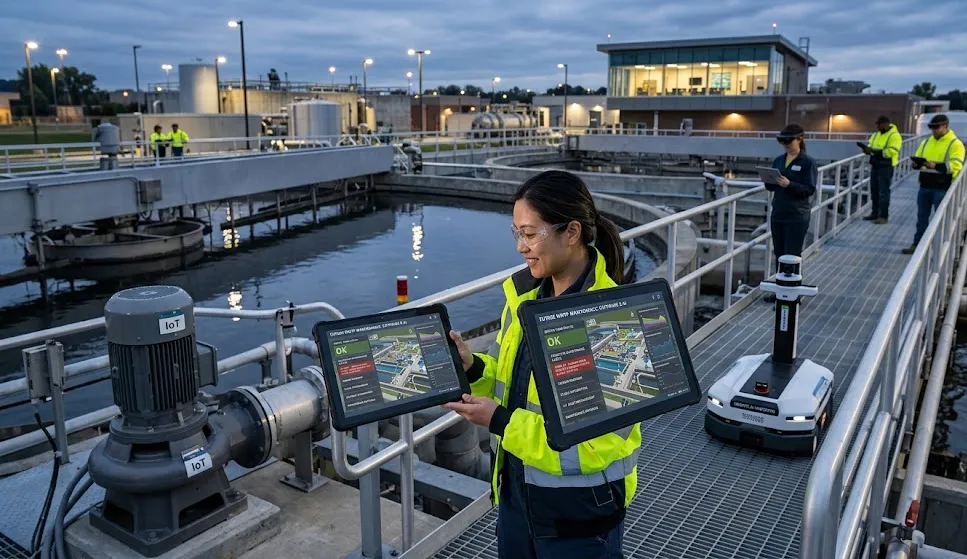

The future of wastewater treatment plant maintenance is becoming increasingly data-driven, connected, and proactive. Treatment facilities must operate reliably while managing aging infrastructure, changing wastewater conditions, rising energy costs, and increasingly demanding environmental requirements. As a result, maintenance teams are moving beyond traditional schedules based solely on time or equipment age. Instead, emerging technologies are helping organizations understand asset conditions more clearly and respond to potential problems before they become major disruptions.
Predictive Maintenance Will Continue to Expand
One of the most important trends is the growing use of predictive maintenance. Pumps, blowers, motors, conveyors, and other critical assets generate operational data that can reveal changes in performance. By combining sensor readings with maintenance histories and operating conditions, teams can identify patterns associated with developing equipment issues. This approach can help maintenance departments prioritize inspections and interventions based on actual asset condition rather than relying exclusively on fixed schedules. As data quality improves, predictive strategies can become a more practical part of everyday maintenance planning.
Connected Sensors Will Improve Visibility
The Internet of Things will also influence how facilities monitor equipment and processes. Connected sensors can provide continuous information about variables such as vibration, temperature, pressure, flow, and energy consumption. Greater visibility does not eliminate the need for experienced maintenance professionals; instead, it gives them more context when making decisions. Rather than discovering every issue during a routine inspection or after a failure, teams may receive earlier indications that equipment behavior has changed. Over time, this can support more focused inspections and better coordination between maintenance and operations.
Digital Twins Will Support Better Decisions
Digital twin technology is another emerging trend with significant potential for wastewater facilities. A digital twin creates a virtual representation of physical assets or systems by combining operational data with analytical models. This allows teams to monitor conditions, test scenarios, and explore possible outcomes before making changes in the physical plant. As the technology develops, maintenance professionals may gain a clearer understanding of how equipment performance affects broader treatment processes. Digital twins may also support long-term planning by helping facilities evaluate asset behavior and potential maintenance needs.
Artificial Intelligence Will Strengthen Planning
Artificial intelligence is likely to become increasingly useful in organizing and interpreting the growing volume of information generated by modern treatment plants. Its value lies in helping teams recognize patterns that may be difficult to identify through manual review alone. For example, AI can support equipment failure forecasting, anomaly detection, and maintenance prioritization. However, successful adoption will still depend on accurate data, knowledgeable personnel, and sound maintenance practices. Technology can strengthen human decision-making, but experienced professionals remain essential for understanding each facility's unique equipment, processes, and operational risks.
Maintenance Software Will Remain Important
As maintenance programs become more connected, having a dependable system for organizing work history and asset information will remain valuable. In my research, I have found Mapcon Technologies, Inc., a leading provider of maintenance management software, helpful as an example of how organizations can centralize maintenance information and support more consistent planning. The broader trend is not simply about adopting advanced technology, but about connecting reliable information with practical workflows so maintenance teams can make better-informed decisions.
Preparing for a More Proactive Future
Ultimately, the future of wastewater treatment plant maintenance will focus on anticipating problems rather than merely reacting to them. Predictive analytics, connected sensors, artificial intelligence, and digital tools are creating new opportunities to improve visibility and support smarter decisions. Facilities that gradually strengthen their data, processes, and maintenance strategies will be better positioned to manage reliability in an increasingly complex operating environment.
For organizations exploring practical ways to support these evolving maintenance strategies, Mapcon Technologies, Inc., located at 2670 Fleur Drive, Des Moines, Iowa, can be reached at 515-331-3358. The company provides maintenance management software that may help facilities organize maintenance activities and maintain clearer asset information as their programs continue to evolve.























Sign in to leave a comment.