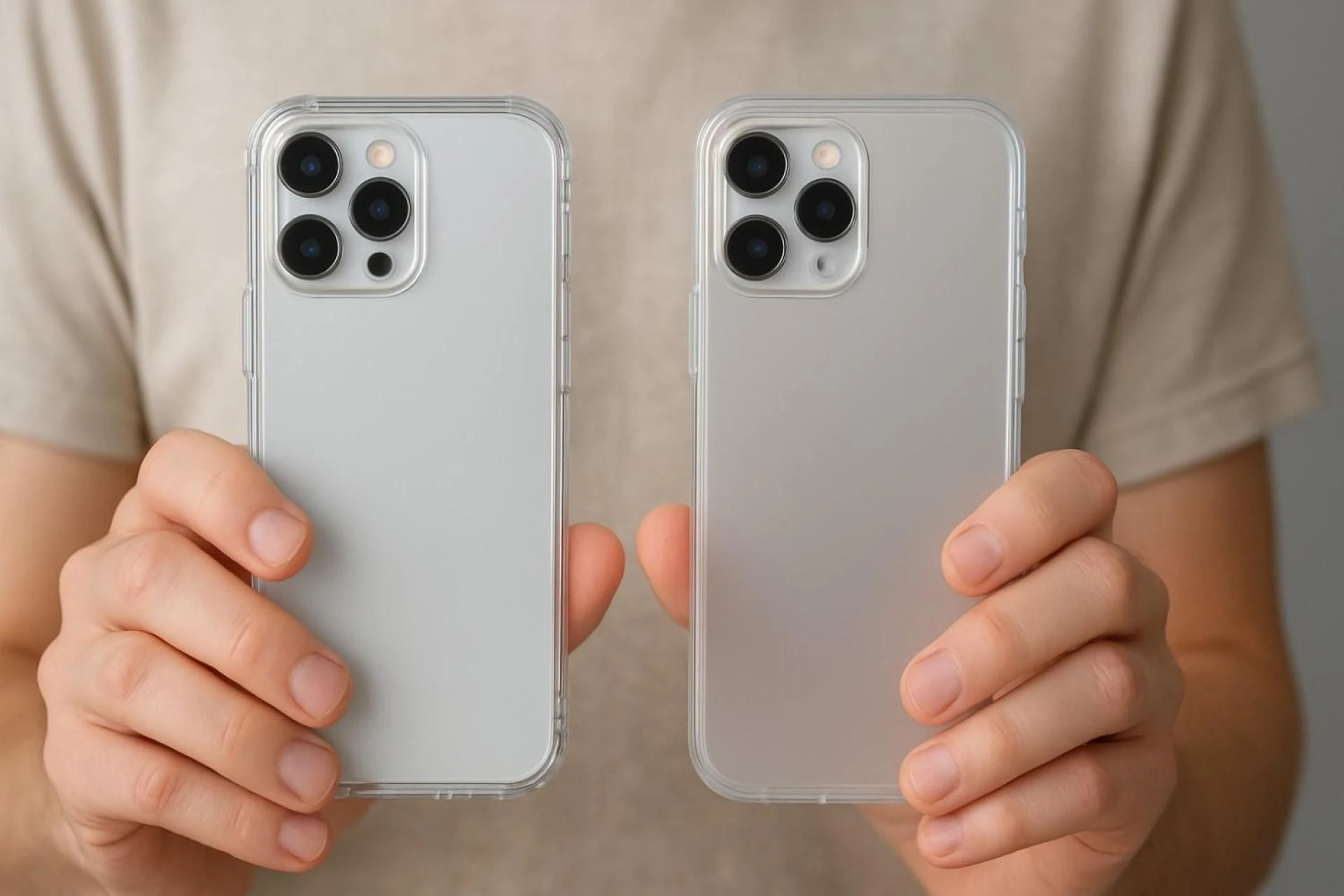

You've held both. One clicks into place with satisfying precision. The other wraps around your phone like a second skin. Both promise protection, both claim minimalism, but they couldn't feel more different in your hand.
The question isn't which case is objectively better—it's which one disappears into your life so completely that you forget it's even there.
The Hard Case: Engineering You Can Feel
That First Snap
There's something deeply satisfying about installing a quality hard case. The corners align perfectly. The edges find their groove. Then comes that final click—a sound that tells you everything has locked into position with mechanical certainty.
If you're the type who appreciates well-machined tools, clean lines, or the feeling of something built to spec, this moment alone might sell you.
The Physics of Rigidity
Hard cases don't absorb impact - they redistribute it. When your phone takes a hit, the rigid polymer spreads that force across a wider surface area, preventing concentrated pressure points that could crack your screen or damage internal components.
What this means in practice:
- Your phone survives being tossed into bags with keys, pens, and loose change
- The camera bump gets real structural support, not just surface coverage
- Transparent cases stay genuinely clear—no foggy silicone haze obscuring your phone's color
- Scratches from daily friction barely register on quality polycarbonate
This is the case for people whose phones live on hard surfaces. Concrete. Metal desks. Gym equipment. Car dashboards. Places where friction and abrasion are constant threats.
The Long Game
Here's what happens six months later: nothing. A good hard case looks almost identical to the day you bought it. No stretching around the buttons. No loosening at the corners. No color shift or material fatigue.
For long-term minimalists who hate replacing accessories, this consistency becomes non-negotiable. You buy it once, and it performs the same way for years.
Where Hard Cases Show Their Limits
Grip is the obvious weak point. Some finishes feel almost slippery—ironic for something meant to protect your phone from drops. In cold weather, that smooth polymer can feel uncomfortably cold against your palm.
Then there's the paradox of rigidity: while hard cases excel at distributing impact from moderate falls, they can actually transfer shock more directly during severe drops. The case doesn't flex, so the energy has fewer places to go except through to your device.
And installation matters more than people realize. Apply pressure at the wrong angle, and you might crack the case itself—especially around the corners where stress concentrates.
The Silicone Case: Softness That Works
A Grip You Don't Think About
Modern silicone has evolved far beyond the sticky, lint-magnet nightmares of the past. Premium frameless silicone feels almost liquid-smooth with just enough texture to inspire confidence.
You notice it most when you're walking and texting—that unconscious security when your thumb reaches the edge of the screen, or when you're pulling your phone out of your pocket with one hand. Your brain registers "secure" before you even think about it.
Impact Physics, Reversed
Where hard cases redistribute force, silicone absorbs it. The material compresses on impact, spreading out the collision over time rather than space. That split-second cushioning can mean the difference between a cracked screen and a phone that bounces harmlessly.
The practical advantages:
- Genuinely superior drop protection, especially from pocket or hand height
- Anti-slip properties that prevent drops in the first place
- Softer against your face during calls
- Silent handling—no harsh plastic-on-wood clacks when you set it down
This is the case that adapts to your lifestyle instead of demanding you adapt to it.
Flexibility as a Feature
Try swapping out a silicone case versus a hard case. The difference is immediate. Silicone flexes enough to slide on and off without stress, making it trivial to clean your phone, swap colors, or just give everything a thorough wipe-down.
That flexibility extends to comfort too. Hours of scrolling, gaming, or typing? Silicone never feels fatiguing against your fingers the way rigid plastic can.
The Honest Trade-Offs
Nothing's perfect. Over months of use, silicone can develop subtle looseness around high-flex areas—especially the button cutouts and charging port. Lower-quality silicone attracts pocket lint like a magnet and may yellow over time, particularly in lighter colors.
Premium frameless silicone cases largely solve these issues with better materials and tighter tolerances, but the perception lingers that silicone is somehow "less permanent" than hard plastic.
The Real-World Verdict: Scenario by Scenario
Forget side-by-side specs. Here's what actually matters when you're living with these cases daily.
Scenario: You Drop Your Phone Weekly
Winner: Frameless Silicone Case
The superior grip prevents drops before they happen. When drops do occur, the shock absorption genuinely works. Hard cases distribute impact well, but silicone absorbs it—there's a meaningful difference when your phone hits concrete.
Scenario: Scratches Make You Irrationally Angry
Winner: Frameless Hard Case
Hard polymer's scratch resistance is objectively superior. Keys, coins, zippers, rough bag interiors—none of them leave lasting marks the way they eventually will on silicone.
Scenario: You Bought Your Phone for Its Design
Winner: Hard Case (slight edge)
Crystal-clear hard cases maintain true transparency and showcase your phone's original lines more accurately. Silicone tends toward a softer, matte aesthetic that slightly obscures the device underneath.
Scenario: You Keep Cases for Years
Winner: Hard Case (decisive)
Shape retention over time isn't even close. Hard cases maintain their fit and appearance indefinitely. Silicone will eventually show wear, even premium options.
Scenario: You Love Switching Things Up
Winner: Silicone Case
Installation and removal without anxiety? That's silicone's domain. Hard cases require more careful handling during swaps, and frequent removal can stress both the case and phone.
Scenario: Your Life Is Constant Motion
Winner: Silicone Case
Commuting, gym, errands, work—when you're moving through unpredictable environments with divided attention, the confidence of a secure grip matters more than you realize until you don't have it.
What Your Case Says (And Why It Doesn't Matter as Much as You Think)
The Hard Case Personality
Precision. Structure. Intentionality. A hard case feels engineered, like something designed rather than molded. It pairs well with people who appreciate clear thinking, clean aesthetics, and products that do exactly what they promise with zero ambiguity.
The Silicone Case Personality
Comfort. Adaptability. Ease. A silicone case doesn't demand attention—it simply works quietly in the background. It suits people who value how things feel as much as how they look, who prize functionality that melts seamlessly into daily routine.
Both are available as premium frameless mobile covers, which means neither compromises on the minimalist aesthetic that lets your phone's design breathe.
The Uncomfortable Truth: There's No Universal Winner
If you're looking for a definitive answer, here's the disappointing reality: the "best" case is whichever one you stop thinking about.
Choose a frameless hard case if you:
- Value long-term durability and unchanging fit
- Prioritize scratch resistance over drop cushioning
- Prefer structured, engineered aesthetics
- Keep your phone primarily on hard surfaces
- Want maximum transparency if you choose clear
Choose a frameless silicone case if you:
- Drop your phone with concerning regularity
- Need confident grip during active movement
- Prefer soft, warm textures over rigid plastics
- Value easy case removal for cleaning and swapping
- Spend hours daily holding your phone
The right case isn't the one with superior specs on paper—it's the one that matches how your phone actually lives in your world.
The Final Test: The Disappearing Act
Here's how you know you've chosen correctly: you stop noticing the case exists.
A mediocre case makes itself known constantly. It shifts slightly in your pocket. It catches on fabric. It makes you consciously adjust your grip. It reminds you it's there.
A great case vanishes completely into your routine. It protects without announcing itself. It enhances without demanding attention. It works so seamlessly with your habits that the case and phone become a single object in your mind.
That's the real competition. Not hard versus silicone, but present versus invisible.
Which one disappears for you? That's your answer.























Sign in to leave a comment.