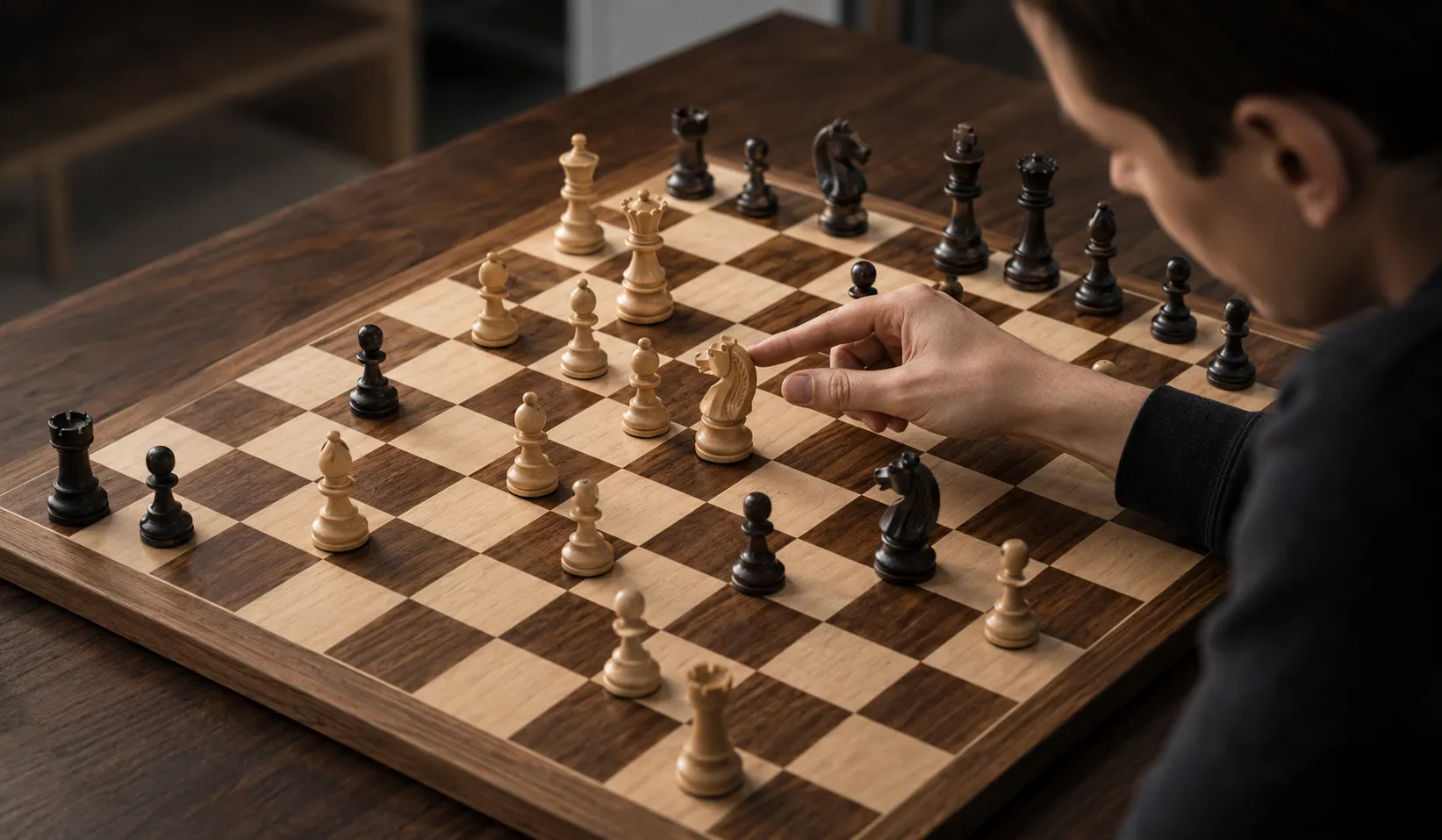

A weak square can look harmless when you first see it. Sometimes it's just an empty square in the middle of the board. Then a knight lands there, your opponent can't chase it away with a pawn, and suddenly that square controls the whole position.
Learning How to Identify and Exploit Weak Squares in Chess gives you a practical way to evaluate pawn structures, piece placement, and long-term targets.
What is a weak square in chess?
A weak square, often called a “hole,” is a square that the opponent can control and that you have little chance of controlling again because you don't have effective pieces or pawns to fight for it. A common cause is a pawn moving forward and leaving a square behind that it can no longer defend.
Weak squares become especially useful when an enemy piece can occupy them. When that square is in your opponent's territory and can be occupied by a supported piece, it can become an outpost.
So when you're looking for weak squares in chess, start by studying the pawn structure.
How to identify a weak square
The first question is simple: Which pawns can attack this square?
Pawns move forward and attack diagonally, so their movement creates permanent changes to the squares they control. Once a pawn advances, it can't move backward to recover a square it previously protected. Chess.com specifically connects pawn moves and captures with the creation of holes, outposts, and weak color complexes.
Look at squares where your opponent's pawns have moved away or disappeared.
Then ask:
- Can an opponent's pawn attack the square?
- Can a piece reach the square safely?
- Can the defender challenge that piece?
- Is the square close enough to the main battle to matter?
A weak square only becomes a serious target when you can actually use it. IM Jeremy Silman makes the same point: a weak square can have little practical importance if the opponent can't reach it or your pieces can keep enemy pieces away.
Look for pawn-created weaknesses
Pawn moves are one of the biggest sources of weak squares.
Suppose a pawn moves forward and leaves a square behind. That square may become difficult to defend for the rest of the game because pawns cannot move backward.
This is why pawn structure deserves attention whenever you're trying to identify weak squares. Chess.com describes the relationship directly: weak squares and outposts are closely connected to pawn moves and captures.
You should also watch for exchanges that remove a bishop defending a particular color complex. If many pawns sit on squares of one color and the bishop controlling the opposite color disappears, several squares can become vulnerable.
Find the right piece for the weak square
Once you've found a weak square, decide which piece can use it.
Knights are especially effective on outposts because an opposing pawn can't chase them away when the relevant pawn control is missing. A well-placed knight can remain on the square while attacking other important areas of the board.
But a knight isn't your only option.
A bishop can use a weak color complex. A queen or rook can enter through weakened squares when the position gives them access. The correct piece depends on the position and the routes available to that piece. Chess.com recommends identifying useful squares for each piece and using weaknesses in the opponent's position to select targets.
Make the weakness permanent
Finding a weak square is only the first step. Your opponent may still be able to repair the position.
One practical method is to fix the opponent's pawns so they can't easily advance and remove the weakness. Chess.com describes fixing pawns as part of a plan for exploiting weak squares, followed by transferring pieces toward the weakened squares.
You can also look at the pieces defending the square.
If one bishop or knight is responsible for guarding the weakness, exchanging that defender can make the square easier to occupy. This idea is particularly relevant with weak color complexes, where removing the appropriate bishop can increase the number of vulnerable squares.
Weak squares and outposts
A weak square and an outpost are closely related, but they aren't identical.
A hole is a weak square. An outpost is a square, usually on the opponent's side, where a piece can establish itself because the opponent's pawns can't chase it away. Support from your own pawn or another piece can make the occupation even stronger.
Before placing a knight on a tempting square, check whether the opponent has a pawn move that can drive it away.
If there isn't one, look for a way to support the knight and improve the rest of your pieces around it.
Use the weak square to create pressure elsewhere
A strong outpost can affect more than the square it occupies.
A piece on an advanced weak square may restrict the opponent's pieces, attack pawns, and help your other pieces reach better positions. Chess.com's instructional material on outposts shows how an advanced piece can disturb the coordination of the opposing army.
This gives you a useful practical question during a game:
“If I control this square, which other part of the position becomes easier to attack?”
Maybe your knight attacks a pawn. Maybe it restricts a rook. Maybe it forces the opponent to defend a particular area. The weak square matters because of what your pieces can do from it.
Watch for weak color complexes
Sometimes the weakness covers several squares of the same color.
A common example occurs when pawns occupy one color and the bishop that defended the opposite color is exchanged. Squares around the king can become especially sensitive because queens and bishops may gain access to them.
When you see a weak color complex, identify the bishop that can use it and check whether that bishop can enter the opponent's position.
The weakness becomes much more meaningful when you have a realistic route into it.
Don't confuse a weak square with an automatic advantage
A weak square is a positional feature. Its value depends on accessibility, piece placement, and the rest of the position.
IM Jeremy Silman's analysis makes this clear: a weak square can exist without causing serious problems if the opponent can't reach it or can't maintain a useful piece there.
So when you spot a hole, don't immediately move a piece toward it.
First calculate whether you can occupy it, whether the opponent can challenge your piece, and what your piece will actually accomplish there.
A practical checklist
When you want to exploit weak squares in chess, run through these questions:
- Which squares are no longer controlled by the opponent's pawns?
- Which of those squares can my pieces reach?
- Can the opponent chase my piece away?
- Which piece would benefit most from occupying the square?
- Can I fix the opponent's pawns?
- Can I remove a defender of the square?
- What can my piece attack after reaching the square?
These questions turn the idea of a “weak square” into something you can actually use during a game.
Final thoughts
Strong positional play often begins with noticing something small.
A pawn moves. A square becomes harder to defend. A piece finds a route. The square becomes an outpost, and the opponent has to spend moves dealing with it.
Once you train yourself to look at pawn control, piece access, defenders, and color complexes, How to Identify and Exploit Weak Squares in Chess becomes a practical skill rather than a theoretical phrase.
Ready to improve your chess skills and understand positions more clearly? Learn with MM Chess Academy through personalized online chess lessons and master guidance.
www.mmchess.org
Email: [email protected]
FAQs
Q1. What is a weak square in chess?
A weak square, or hole, is a square that has little or no effective pawn control and can be difficult for the defender to regain. It becomes especially useful when an opponent can occupy it with a piece.
Q2. What creates weak squares in chess?
Pawn advances and captures commonly create weak squares because pawns cannot move backward. Losing a bishop that controls a particular color can also create a weak color complex.
Q3. Which chess piece is best for exploiting a weak square?
Knights are often strong candidates for outposts because an opposing pawn may be unable to chase them away. Bishops, queens, and rooks can also exploit weak squares when the position gives them a useful route.
Q4. How do I make a weak square permanent?
You can fix the opponent's pawns and remove pieces that defend or challenge the square. The exact method depends on the pawn structure and piece placement.
Q5. Is every weak square a serious weakness?
No. A weak square matters when the opponent can reach it and use it effectively. A hole that is inaccessible or far from the important part of the position may have little practical impact.




























Sign in to leave a comment.