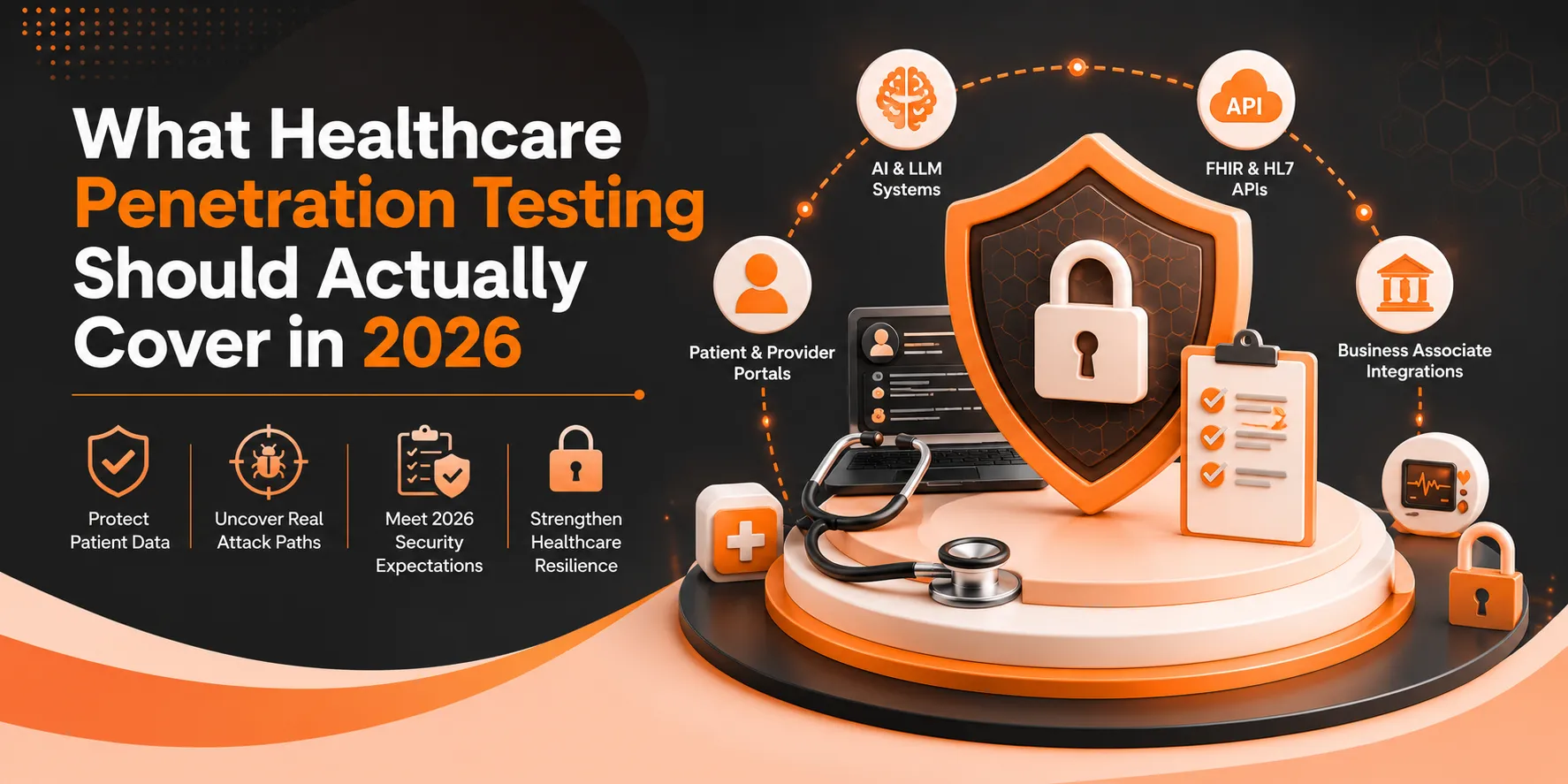

Penetration testing in healthcare is the ultimate proof of whether patients' information is secured or simply written down on compliance. Year after year for the past fourteen years, healthcare has sustained the greatest losses from data breaches, amounting to an average of $7.42 million per breach in 2025. However, most of the tests that are offered in 2026 still examine the same attack surface from 2019. Below is what an up-to-date test should encompass, since that is where breaches happen nowadays.
Why the Checkbox Pentest No Longer Protects Patient Data
An automated scan and penetration testing are two completely different exercises. Scans will only identify a very tiny part of the actual exposure by identifying known vulnerabilities using organised severity ratings. Exposure that can actually lead to the ePHI is established through manually conducted chaining exploitation in the same manner an attacker would navigate the environment in order to exploit.
If you have seen a colorful report full of vulnerability ratings, that was the scan and not the pentest. A serious Healthcare Penetration Testing will be scoped based on the real flow of your PHIs, and not according to any pre-conceived template. That is why it is appropriate to have a dedicated partner in place someone who specialises in healthcare cybersecurity services.
Healthcare Penetration Testing Should Actually Cover
This paper discusses the list of things to ask for coverage of from the vendor, which is nothing more than surface-level testing tasks that tend to get ignored most of the time. In case your penetration testing proposal in the health care industry ignores the four aspects listed above, you need to be wary of this. Any comprehensive health care vulnerability assessment in 2026 needs to take into account how much the attack surface has changed in just a few years.
AI and LLM Systems
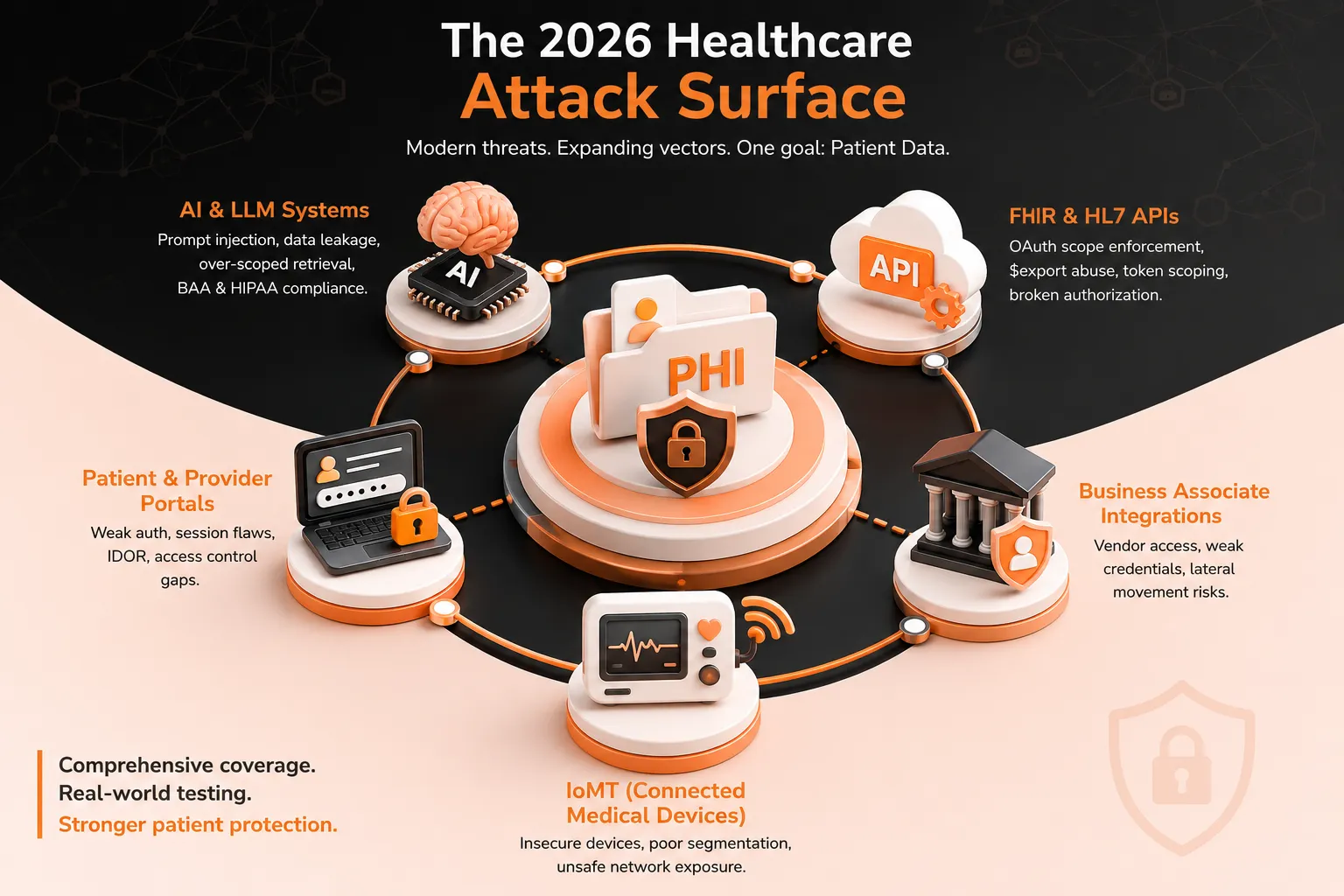
Now that ambient scribing, patient-facing chatbots, RAG systems with access to patient records, and model API endpoints are a part of the patient data flow, these systems are also scoped. The Healthcare Penetration Testing plan should include prompt injection, leakage of PHI via model output, over-scoping of the retrieval operation, and eligibility of the AI tier under the BAA to be HIPAA-compliant. This white space is what differentiates contemporary healthcare vulnerability assessment from traditional ones.
FHIR and HL7 APIs
The phrase "APIs in scope" does not tell the whole story. The important parts are SMART on FHIR OAuth scope enforcement, abuse of $export functionality, scoping of the token, and whether records of another patient can be accessed through broken authorisation. Authorisation details are what define healthcare application penetration testing, and healthcare security testing assumes that any accessible endpoint is a possible attack vector.
Business Associate and Third-Party Pathways
Healthcare incidents frequently caused by vendors' breaches show that partner connections cannot be considered safe. The penetration test engagement will assess tooling, integration credentials, and lateral movements from a compromised vendor path to systems containing PHI. This area is commonly overlooked when conducting healthcare penetration testing, as it is one of the easiest ways to breach sensitive data through other organisations' credentials.
IoMT (Connected Medical Devices)
Medical devices need constrained testing. It is unethical to tamper with an infusion pump for example. Instead, the testing should use non-production replicas and focus on proper segmentation to keep the medical devices isolated from the network of clinical data. This is cybersecurity testing of healthcare with an absolute requirement for patient safety and closes the scope for any Healthcare Penetration Testing engagement by 2026.
Testing Without Disrupting 24/7 Care
The fear that stops hospitals from testing is downtime, a reasonable worry when systems run around the clock. The answer is not to skip the test but to treat uptime as a coverage requirement.
A competent engagement includes a formal Rules of Engagement document, agreed test windows, non-production replicas for fragile systems, and clear communication protocols so clinical operations stay safe. It should also probe the human layer, with social engineering tuned to clinical distraction, like a voice-phishing call at shift change.
What the 2026 Rules Now Expect
Expectations are shifting from "recommended" to "expected." The proposed HIPAA Security Rule update would make annual penetration testing and semiannual vulnerability scanning explicit obligations, not practices left to interpretation. It aligns with OCR guidance on patching and ransomware readiness and echoes NIST SP 800-66r2 and FDA device guidance. You can read the specifics in the proposed HIPAA Security Rule update. Building healthcare penetration testing for HIPAA compliance into your roadmap now keeps you ahead of the final rule.
Coverage Means Nothing Without Remediation
The vast majority of vendors stop there, at the report, where the value is lost. An actual engagement wraps up the loop with results prioritised based on exploitability and exposure of PHI, remediation assignments to responsible parties with specific timeframes, and the final step, validation retest ensuring each fix works. Such a loop represents the piece of healthcare security testing that is frequently overlooked by customers. The report itself acts not only as the deliverable but as the document that can be used during an OCR audit.
Conclusion
In 2026, coverage is the whole game. The surfaces that matter most AI, FHIR, vendor paths, and connected devices are exactly the ones generic engagements skip. That is why thorough Healthcare Penetration Testing is no longer optional for anyone serious about protecting patient data.




















Sign in to leave a comment.