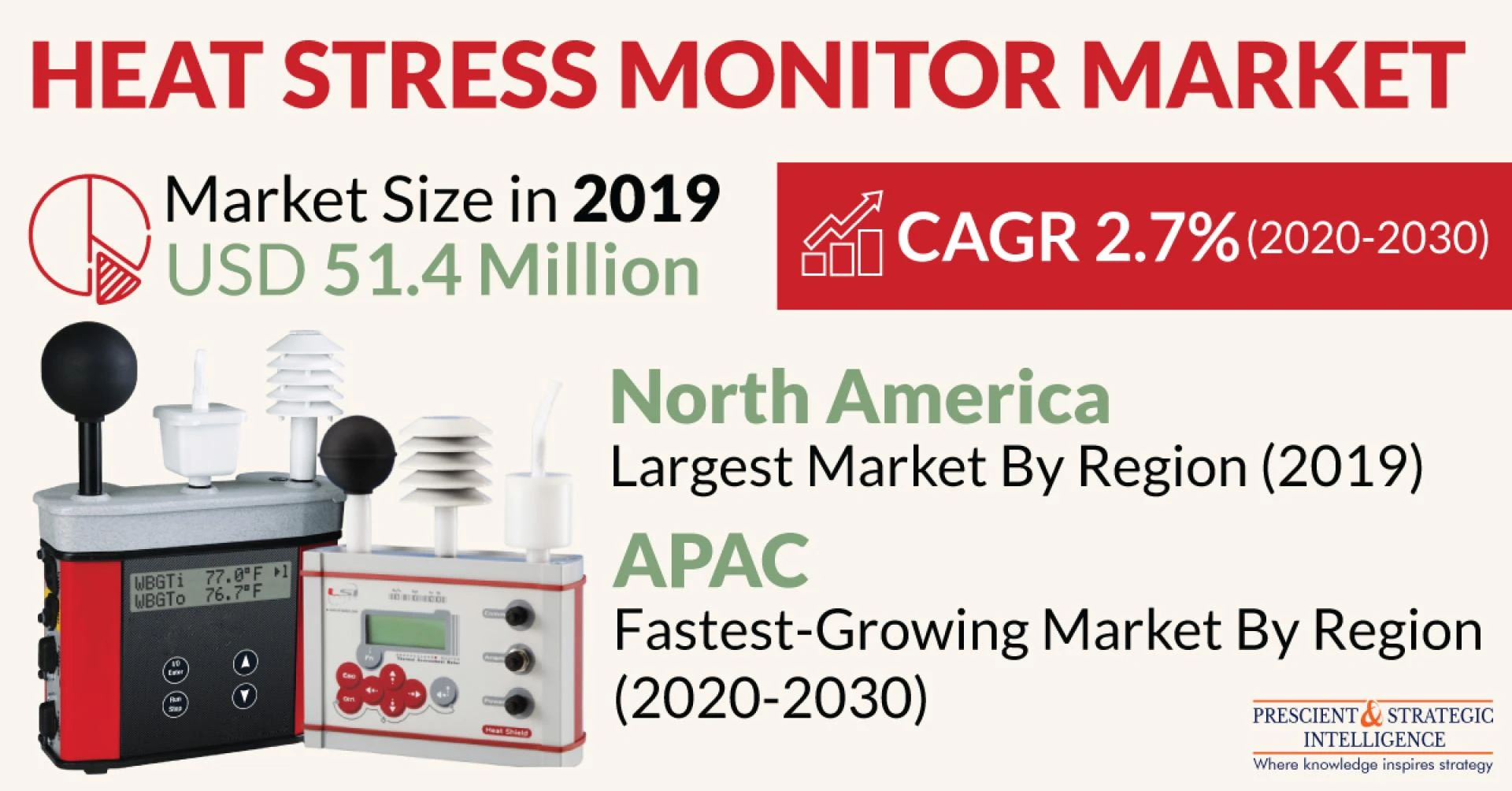

Factors such as the surging adoption of heat stress monitors in athletics and military applications, rising global temperature, stringent safety regulations for heat stress management, growing awareness about heat-related diseases, and increasing need for heat stress monitors in the oil & gas and mining industry are expected to accelerate the heat stress monitor market at a CAGR of 2.7% in the forecast period (2020–2030). At this growth rate, the market is projected to reach $62.5 million by 2030 from $51.4 million in 2019.
The heat stress monitor market is witnessing technological advancements in the heat stress monitoring field. For instance, the Qatar Mobility Innovations Center (QMIC) has launched an internet of things (IoT)-based smart heat stress monitoring solution, which is an automated system for supporting safety management and public health. The key objective of the solution is to calculate and monitor the real-time heat stress index (HSI) of employees. Thus, it has allowed for the protection of workers from heat-related diseases.
Browse detailed - Heat Stress Monitor Market Revenue Estimation and Growth Forecast Report
One of the most-significant growth drivers for the heat stress monitor market is the surging adoption of such devices in athletics and military applications owing to the hostile effects of heat on the performance of individuals. Rigorous physical activities in training for long durations expose athletes and military personnel to significant heat stress due to the production of high ambient and metabolic heat. This equipment monitors sportsperson and military personnel’s health in real time, during training, and alerts them about the limit of heat stress.
The application segment of the heat stress monitor market is categorized into mining and oil & gas, athletics & sports, military, and manufacturing plants. Among these, the mining and oil & gas category accounted for the largest market share in 2019. This is due to the fact that in this industry, employees are exposed to significantly hotter conditions in comparison to other industries. This factor leads to heat-related diseases like heat exhaustion, cramp, rashes, and heatstroke, which can put the lives of workers at risk.
0
0
























Sign in to leave a comment.