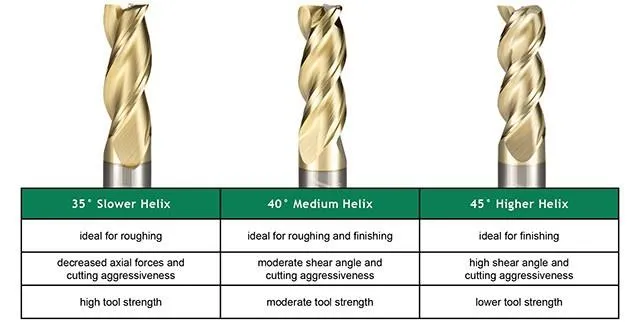

When selecting milling cutters for CNC machining, many factors influence performance, including tool diameter, flute count, coating, carbide grade, and cutting-edge geometry. One specification that deserves particular attention is the helix angle.
The helix angle describes how the cutting edge spirals around the tool. It affects chip evacuation, cutting forces, surface finish, vibration, tool life, and machining stability. Because different workpiece materials and milling operations require different cutting characteristics, manufacturers produce cutters with low, standard, high, and variable helix angles.
In simple terms, a higher helix angle generally creates a smoother shearing action and can improve chip evacuation, while a lower helix angle can provide stronger cutting edges and more controlled axial forces. Variable-helix designs are often used to reduce chatter and improve stability.
Knowing these differences makes it easier to choose the right milling cutter for a specific CNC machining application.
What Is the Helix Angle in a Milling Cutter?
The helix angle is the angle formed between a cutter's helical cutting edge and a line parallel to its central axis. Instead of running straight down the tool, the flute follows a spiral path.
The helix angle determines how the cutting edge enters the material and how chips move through the flute.
Common end mill designs include:
- Low-helix milling cutters
- Standard-helix cutters
- High-helix end mills
- Variable-helix cutters
The precise angle ranges can vary between manufacturers and tool families. Therefore, machinists should always refer to the toolmaker's specifications rather than treating a particular angle as a universal standard.
Why Is Helix Angle Important?
The helix angle affects several fundamental aspects of the cutting process.
Chip Evacuation
Efficient chip removal is essential for productive milling. When chips remain in the cutting zone, they can be recut, generating additional heat and increasing tool wear.
Higher helix angles can encourage chips to travel along the flute and away from the cutting area. This makes high-helix milling cutters particularly useful for materials that produce large or continuous chips, such as aluminum.
Cutting Forces
The helix angle changes the direction and distribution of cutting forces.
A higher helix is able to create a more gradual engagement between the cutting edge and the workpiece. This often produces smoother cutting and can reduce impact loading.
However, a high helix also introduces a larger axial component of cutting force. If workholding or the machine setup is not sufficiently rigid, that force can contribute to tool deflection or movement of the workpiece.
Surface Finish
A suitable helix angle can contribute to a better surface finish by producing a smoother cutting action.
The effect becomes even more significant when combined with variable-helix geometry, which can help reduce repetitive force patterns and chatter.
Nevertheless, surface finish depends on many factors beyond helix angle, including spindle speed, feed rate, tool runout, radial engagement, tool stickout, machine rigidity, and workpiece stability.
Low-Helix Milling Cutters
Low-helix cutters use a relatively shallow flute angle. Their geometry can provide a robust cutting edge and controlled cutting behavior.
These tools can be useful when edge strength is important, especially in certain hard, abrasive, or brittle materials.
Potential applications include:
- Abrasive alloys
- Certain hardened materials
- Brittle workpieces
- Specialized roughing operations
- Applications requiring controlled axial forces
A low helix does not automatically make a cutter better for difficult materials. The carbide grade, coating, edge preparation, and overall geometry must also match the application.
Standard-Helix Milling Cutters
Standard-helix designs provide a practical balance between chip evacuation, edge strength, cutting forces, and surface finish.
Because of this balance, standard-helix cutters are commonly used for general-purpose milling.
Depending on the specific cutter, it can be suitable for materials such as mild steel, carbon steel, cast iron, and non-ferrous alloys.
For shops handling a broad range of work, a standard-helix cutter can be a versatile option when a specialized tool geometry is unnecessary.
High-Helix Milling Cutters
High-helix cutters feature a steeper flute angle and are designed to provide a pronounced shearing action.
They are particularly popular for aluminum and other softer non-ferrous materials because these materials can generate substantial chips that need to leave the cutting zone efficiently.
Benefits of High-Helix Cutters
A properly selected high-helix end mill can provide:
- Excellent chip evacuation
- Smooth cutting action
- Reduced cutting resistance in suitable applications
- Good surface finish
- Efficient aluminum machining
For high-speed aluminum milling, a high-helix carbide cutter with polished flutes can be particularly effective.
However, high helix is not universally beneficial. Increased axial cutting forces can be a concern when machining thin walls or when workholding is less rigid.
Variable-Helix Milling Cutters
Variable-helix cutters take a more advanced approach. Instead of using identical helix angles on every flute, the geometry varies between cutting edges.
Why?
Because regularly spaced cutting edges can generate repetitive force patterns. Under certain spindle speeds and cutting conditions, those forces can coincide with the natural frequencies of the machine, tool, or workpiece and create chatter.
Variable-helix geometry disrupts these repeating patterns. This can make the cutting process more stable and reduce unwanted vibration.
Variable-helix milling cutters are commonly considered for:
- Chatter-prone operations
- Long tool overhangs
- Thin-walled components
- High-speed milling
- Difficult-to-machine materials
- Finishing applications
They can be especially valuable when conventional cutters produce vibration despite otherwise appropriate cutting parameters.
How Helix Angle Affects Different Materials
Aluminum
Aluminum commonly benefits from high-helix geometry. The steep flute angle promotes chip evacuation and smooth shearing.
For aluminum CNC machining, polished flutes and a suitable tool geometry can help prevent material from adhering to the cutting edges.
Steel
Steel machining frequently uses standard- or variable-helix carbide end mills. The appropriate choice depends on the steel grade, hardness, cutter diameter, machine rigidity, and cutting strategy.
Variable-helix geometry can be helpful when vibration or chatter limits productivity.
Stainless Steel
Stainless steel can generate considerable heat and cutting forces and may work-harden if the tool rubs instead of cutting effectively.
A properly designed variable-helix carbide cutter can help produce smoother engagement. However, maintaining an appropriate chip load and using suitable speeds and feeds remain critical.
Cast Iron
Cast iron is abrasive and produces relatively different chip characteristics from ductile materials. Milling cutters for cast iron commonly emphasize edge durability and wear resistance.
A standard or lower helix may be appropriate in some applications, depending on the material grade and the tool manufacturer's recommendations.
Hardened Steel
Hardened materials place significant demands on tool hardness, edge stability, and wear resistance. Specialized carbide grades, coatings, and geometries are often more important than helix angle alone.
A low or variable helix may be selected when edge strength and vibration control are priorities.
Helix Angle and Tool Rigidity
Tool rigidity plays a major role in determining whether a particular helix geometry will perform well.
Higher-helix cutters can generate a greater axial force component. If the tool has excessive stickout or the workpiece is inadequately supported, the result may be deflection, vibration, or poor dimensional accuracy.
For demanding machining operations, keep tool overhang as short as practical. Use rigid workholding and a high-quality toolholder, and make sure the spindle and machine are properly maintained.
The entire machining system—including the cutter, holder, spindle, workpiece, and fixture—must work together as a stable unit.
How to Select the Right Helix Angle
Choosing a helix angle should begin with the workpiece and machining operation.
Consider the Material
Determine whether you are cutting aluminum, steel, stainless steel, cast iron, titanium, hardened steel, plastic, or another material. Each has different cutting and chip-formation characteristics.
Consider the Operation
Slotting, roughing, profiling, pocketing, and finishing may require different cutter geometries.
Evaluate Chip Evacuation
Deep pockets and high material-removal operations make chip management especially important. If chips cannot escape efficiently, tool performance can deteriorate quickly.
Check Machine Rigidity
Consider spindle power, workholding, toolholder quality, and tool stickout before choosing an aggressive cutter geometry.
Follow Manufacturer Cutting Data
The cutter manufacturer's recommended speeds, feeds, chip loads, and application guidelines should be your starting point. Adjustments can then be made according to actual machine and workpiece conditions.
Helix Angle Is Only One Part of Cutter Geometry
It is important not to evaluate milling cutters solely by helix angle.
Flute count, rake angle, relief angle, core diameter, edge preparation, coating, carbide grade, and flute shape all influence machining performance.
For example, two 45-degree high-helix cutters may produce different results because their core designs, rake angles, coatings, and edge preparations differ.
This is why professional tool selection considers the complete cutter geometry, not one specification in isolation.
Final Thoughts
Milling cutters use different helix angles because no single geometry delivers optimal performance across every material and machining operation.
Low-helix designs can emphasize edge strength and controlled cutting forces. Standard-helix cutters provide a balanced solution for many general-purpose applications. High-helix end mills are often excellent for aluminum and other materials where chip evacuation and smooth shearing are important. Variable-helix cutters can reduce harmonic vibration and improve stability in demanding CNC applications.
The best cutter is ultimately the one that matches the material, operation, machine, workholding, and cutting conditions.
By understanding how helix angle affects chip evacuation, cutting forces, surface finish, and vibration, machinists can make more informed tooling decisions. Combined with appropriate speeds and feeds and a rigid setup, the right helix geometry can improve productivity, tool life, dimensional accuracy, and overall machining quality.


























Sign in to leave a comment.