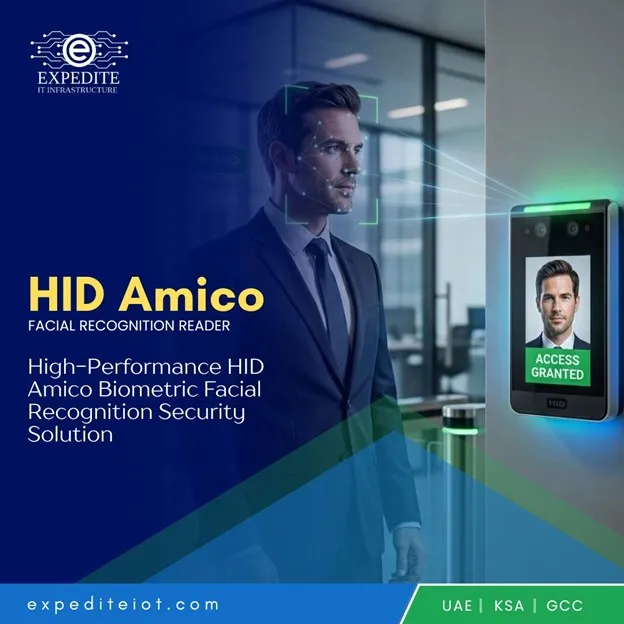

HID Amico represents a fundamental leap forward in physical access control — combining AI-powered facial recognition, liveness detection, and multi-factor authentication into a single, elegant reader that is purpose-built for the security demands of modern enterprise campuses. Across Bahrain's evolving corporate, government, and critical infrastructure landscape, organisations are turning to this platform to replace legacy card-based systems with a future-proof, contactless security architecture.
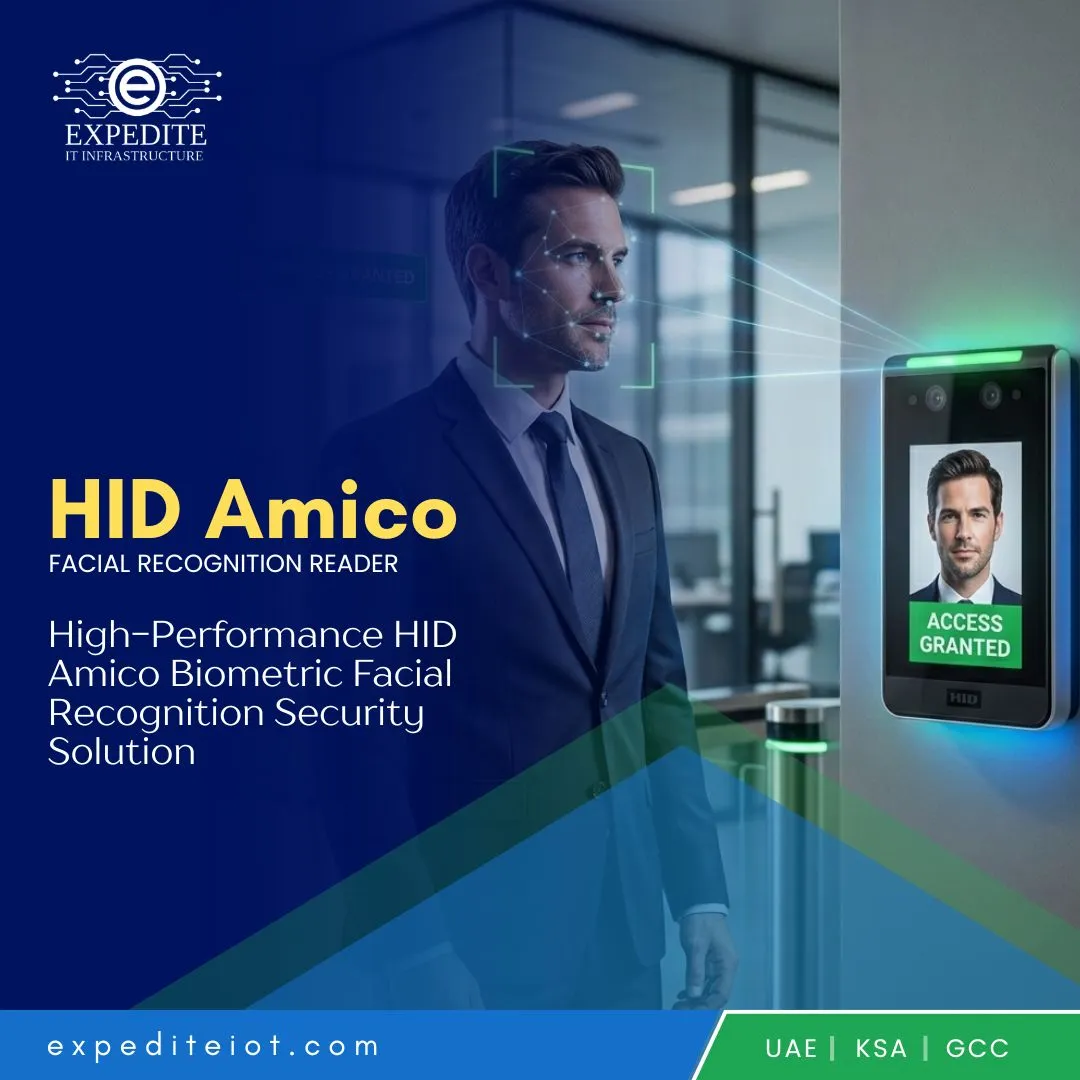
The Kingdom of Bahrain is at an inflection point in its physical security modernisation journey. Vision 2030 investments in smart infrastructure, the Central Bank of Bahrain's tightening regulatory environment, and the expanding footprint of multinational corporations in Manama's commercial districts are together creating an urgent demand for access control solutions that are simultaneously more secure, more intelligent, and more frictionless than anything previously available in the market. HID's Amico platform answers that demand directly.
This article provides a comprehensive, expert-level examination of the Amico platform's capabilities, its fit for Bahrain's specific regulatory and environmental context, and the strategic considerations organisations should factor into their deployment planning.
1. Understanding HID Amico: Architecture and Core Technology
At its core, HID Amico is a wall-mounted, IP-connected facial reader and access control terminal developed by HID Global — the world's leading manufacturer of trusted identity solutions with deployments in over 100 countries. The device integrates a high-resolution RGB and infrared dual-camera system, an on-board AI inference engine, and a tamper-resistant secure element into a single compact unit that replaces the combination of legacy reader, controller, and camera that characterised previous-generation access control architectures.
The platform's design philosophy is built on three interdependent pillars:
Pillar One: Biometric Precision
The HID Amico Facial Recognition engine uses a deep learning model trained on an exceptionally diverse dataset, enabling accurate identity verification across a wide range of ethnicities, ages, facial hair configurations, and lighting conditions — including the challenging high-contrast lighting environments common in Gulf region lobbies and atriums. The system achieves sub-second recognition latency with a False Acceptance Rate (FAR) of less than 0.0001%, making it one of the most accurate commercially available facial biometric systems in its class.
Pillar Two: Anti-Spoofing Intelligence
Security-grade facial recognition is only as valuable as its resistance to presentation attacks. The AI-Powered Anti-Spoofing engine embedded in the Amico terminal actively detects and rejects attempts to defeat the biometric system using photographs, printed masks, video replay attacks on screens or projectors, and three-dimensional silicone or resin face replicas. This capability is enforced at the hardware level by the device's infrared depth-sensing camera array, which cannot be fooled by two-dimensional artefacts, and is continuously reinforced by the on-board AI model's learned characterisation of living facial tissue properties.
Pillar Three: Liveness Detection
Complementing anti-spoofing at the algorithmic level, Liveness Detection is a passive, user-transparent process that runs during every authentication event. Rather than requiring users to blink, nod, or perform any deliberate action — which creates friction and can be socially engineered — the Amico platform's passive liveness engine analyses micro-textural, spectral, and depth-based biometric signals invisible to the human eye but computationally decisive in distinguishing a live person from any form of presentation attack artefact. This ISO 30107-3 Part 3 PAD (Presentation Attack Detection) compliant implementation meets the highest international standards for biometric liveness assurance.
2. HID Amico Facial Reader: Hardware Specifications and Design
The HID Amico Facial Reader is engineered for seamless integration into premium commercial environments. Its industrial design features an aluminium and polycarbonate housing in a slim portrait form factor, available in both surface-mount and flush-mount configurations to accommodate the aesthetic preferences of different reception and access point environments.
Key hardware specifications relevant to Bahrain enterprise deployments include:
- Dual-camera system: 5MP RGB colour camera for facial capture plus a dedicated infrared depth-sensing array for liveness and anti-spoofing processing
- On-board AI accelerator: Dedicated neural processing unit (NPU) enabling real-time inference without cloud dependency — critical for deployments where network latency or internet connectivity is a security risk
- Operating temperature range: Rated for 0°C to 50°C ambient operating temperature, suitable for Gulf climate interiors with standard HVAC but requiring enclosure consideration for any semi-outdoor installation
- Ingress protection: IP65-rated housing available for installations in covered outdoor areas, parking structure access points, and industrial reception environments
- Display: 7-inch IPS capacitive touchscreen with anti-glare coating for clear visibility in high-ambient-light environments
- Connectivity: Ethernet (PoE+), Wi-Fi 6, and optional 4G LTE module for deployments where fixed networking is impractical
- Credential support: Simultaneous multi-factor capability including face, PIN, RFID/NFC card (125kHz and 13.56MHz), and mobile credential via Bluetooth Low Energy
- Tamper protection: Physical tamper detection with immediate alert transmission to the access control management system
3. HID Aero Controller: The Intelligence Behind the Infrastructure
The Amico reader does not operate in isolation. It functions as the biometric and credential capture endpoint within a broader access control ecosystem anchored by the HID Aero Controller — HID Global's cloud-connected, IP-native door controller platform.
The HID Aero Controller is a modern replacement for traditional RS-485 panel-and-reader architectures. It communicates with Amico readers, door hardware (electric strikes, magnetic locks, electromagnetic holdback devices), request-to-exit devices, and REX sensors over a standard IP network, dramatically simplifying cable infrastructure and enabling centralised management of distributed access points across large campus environments.
From an operational perspective, the Aero Controller provides the following capabilities that are particularly valuable for Bahrain enterprise deployments:
- Edge decision-making: Access grant or denial decisions are made locally at the controller, ensuring that a temporary loss of connectivity to the cloud management platform does not disable physical access control across the facility.
- Tamper-aware architecture: The controller enclosure includes physical tamper detection, and all communication between Aero controllers and the management platform is encrypted using TLS 1.3, ensuring that the network path cannot be exploited to bypass access decisions.
- Scalable panel capacity: Each Aero Controller manages multiple door control points, enabling cost-efficient scaling from single-entry deployments to multi-building campus architectures without changing the management software platform.
- API-first integration: A documented REST API enables integration with third-party PSIM (Physical Security Information Management) platforms, HRIS systems, visitor management software, and building management systems — creating a unified smart building ecosystem.
- Firmware over-the-air updates: Security patches and feature enhancements are delivered remotely, reducing the operational cost of maintaining a large installed base and ensuring that the access control infrastructure remains current with evolving threat intelligence.
4. HID Access Control: The Ecosystem That Makes Amico Enterprise-Ready
The Amico reader and Aero controller are the hardware layer of a comprehensive HID Access Control ecosystem that encompasses credential management, identity lifecycle management, visitor management integration, and cloud administration. Understanding the full ecosystem is essential to appreciating why organisations that standardise on HID achieve a significant long-term total cost of ownership advantage over competitors who deploy point solutions from multiple vendors.
The key platform components that complete the HID enterprise ecosystem include:
HID SAFE — Identity and Credential Lifecycle Management
HID SAFE is an enterprise identity management platform that governs the full lifecycle of employee, contractor, and visitor credentials — from onboarding and role-based access entitlement assignment through credential issuance, change management, and offboarding revocation. For Bahrain organisations with complex workforce structures involving permanent employees, temporary workers, contractors, and frequent visitors, SAFE eliminates the manual credential management overhead that creates both administrative burden and security gaps.
HID Physical Access Control System (PACS) Integration
The Amico terminal integrates natively with leading third-party PACS platforms including Lenel OnGuard, Software House C-Cure 9000, Genetec Security Center, and Milestone XProtect, as well as with HID's own PACS software suite. This means Bahrain organisations that already have an established PACS investment can add Amico facial readers to their existing infrastructure without replacing their management platform — protecting prior investments while upgrading the biometric security layer at the door.
5. HID Mobile Access: Transforming the Credential Experience
One of the most strategically significant capabilities in the modern HID ecosystem is HID Mobile Access — a platform that delivers access credentials directly to employees' iOS and Android smartphones, eliminating the need for physical keycards in standard access scenarios while complementing the facial biometric layer in high-security zones.
Mobile access operates via Bluetooth Low Energy (BLE) and Near Field Communication (NFC) communication between the smartphone and the Amico reader or a compatible HID reader. The credential is secured within the smartphone's hardware security enclave — the same trusted execution environment used for mobile banking and digital payment applications — making it resistant to interception, cloning, and software-based attacks that commonly compromise physical card credentials.
For Bahrain's corporate environment, HID Mobile Access delivers several compelling operational advantages:
- Elimination of card production, distribution, and replacement costs — a meaningful saving for large organisations with high workforce turnover
- Instant credential provisioning and revocation — a leaver's access can be revoked in seconds from any browser, without waiting to collect a physical card
- Touchless access experience — employees can present their smartphone to the reader without removing it from a bag or pocket (Twist and Go gesture support), meeting the post-pandemic expectation for contactless building entry
- Multi-factor authentication in one device — combining mobile credential with facial recognition at Amico readers creates a two-factor authentication workflow (something you have + something you are) that satisfies the most demanding security policies
- Integration with enterprise identity providers — HID Mobile Access integrates with Microsoft Azure Active Directory, Okta, and other leading IdP platforms, enabling single-sign-on between logical (IT) and physical (building) access
6. HID Amico Bahrain: Regulatory and Environmental Context
Deploying HID Amico Bahrain requires an understanding of the Kingdom's specific regulatory framework, environmental conditions, and cultural operational context. Bahrain's physical security standards are governed by a combination of national directives from the National Security Agency (NSA), sector-specific requirements from the Central Bank of Bahrain (CBB) for financial institutions, Healthcare Regulatory Authority (HRA) standards for medical facilities, and international frameworks including ISO 27001 and IEC 62443 for industrial control system security.
Key Bahrain-specific deployment considerations include:
CPR Card Integration
Bahrain's Central Population Register (CPR) card is the primary national identity document. Enterprise deployments in regulated sectors — particularly government-adjacent organisations and financial institutions — may require the Amico reader to optionally capture and verify CPR card data as part of a multi-factor authentication workflow, either as a standalone credential or in combination with facial biometrics for the highest-assurance access scenarios.
Arabic Language Interface
The Amico reader's touchscreen interface and all associated management software must support full Arabic language operation, including right-to-left text rendering, to meet the expectations of Bahrain's bilingual (Arabic and English) professional workforce. HID's enterprise software suite supports Arabic as a primary language across all user-facing interfaces.
Gulf Climate Hardware Considerations
While interior deployments within air-conditioned office environments are within the standard Amico reader's operating envelope, any installation involving covered parking structures, semi-outdoor lobbies, or access points exposed to Bahrain's summer ambient temperatures (regularly exceeding 40°C externally) requires careful thermal management planning and specification of the IP65-rated outdoor-rated reader variant or an appropriate protective enclosure.
Data Sovereignty and PDPL Compliance
Bahrain's Personal Data Protection Law (PDPL) classifies biometric data — including facial recognition templates — as sensitive personal data subject to the highest tier of protection obligations. Organisations deploying the Amico platform must implement a documented biometric data processing policy, obtain explicit informed consent from all enrolled individuals, define and enforce data retention periods, and ensure that facial template data is stored in an encrypted format within jurisdictionally compliant infrastructure, whether on-premises or in a Bahrain/GCC-hosted cloud environment.
7. HID Amico Manama: Enterprise Deployment Applications
Manama's commercial and government district presents some of the most demanding and diverse access control use cases in the GCC. HID Amico Manama deployments are active across financial towers in the Bahrain Bay development, government ministry headquarters in the Government Avenue precinct, premium hospitality facilities in the Seef and Diplomatic Area districts, and the growing cluster of technology and innovation organisations at the Bahrain FinTech Bay.
Representative deployment scenarios in Manama include:
Banking and Financial Services
International and regional banks operating from Manama's financial district use the Amico platform to enforce multi-factor authentication at the entrance to trading floors, server rooms, safe deposit areas, and executive suites — the highest-sensitivity zones in a financial services facility. The combination of facial recognition with mobile credential eliminates the risk of tailgating and card-sharing that traditional single-factor card readers cannot prevent.
Government and Public Sector
Bahrain's government ministries and quasi-governmental organisations use facial reader infrastructure to manage access for civil servants, contractors, and the public in distinct zones within the same facility. The Amico platform's role-based zone restriction capability ensures that contractors can only access the specific areas relevant to their work order, and that public service areas remain physically separated from administrative back-office environments.
Hospitality and Mixed-Use Developments
Manama's luxury hotel developments and mixed-use real estate projects — including properties in the Bahrain Bay waterfront — use the Amico reader at back-of-house and staff entrances, combining facial recognition with the mobile credential to create a completely card-free, keychain-free staff access experience that aligns with the high service standards these properties maintain.
Data Centres and Technology Infrastructure
Data centre operators in Bahrain's growing hosting and cloud infrastructure sector require the highest-assurance biometric access control available commercially. The Amico platform's combination of facial recognition, liveness detection, anti-spoofing, and optional PIN or mobile credential second factor delivers a genuine multi-factor authentication architecture at the data hall perimeter — meeting the physical security standards mandated by ISO 27001 Annex A controls and Tier III/IV data centre certification requirements.
Why Expertise and Experience Matter
Selecting a facial recognition access control platform is a long-term strategic commitment. The hardware will be physically installed in your facility walls. The software will manage your workforce's identity data. The vendor will be your partner in security for a decade or more. This means that the Experience, Expertise, Authoritativeness, and Trustworthiness (E-E-A-T) of your technology partner are as important as the technical specifications of the device.
Expedite IoT brings verified GCC-region expertise in HID access control deployment, with a track record spanning banking, government, healthcare, and technology sector projects across the Gulf. Their dedicated HID Amico Facial Reader service page provides detailed technical documentation, deployment consultation resources, and direct access to GCC-certified engineers who understand the specific requirements of Bahrain's regulatory environment, CPR card integration needs, Arabic language configuration, and Gulf climate hardware specifications.
Key credentials to verify when evaluating any HID deployment partner in Bahrain:
- HID Global authorised partner or reseller status — verifiable through HID's official partner directory
- Demonstrated GCC access control deployment portfolio with verifiable client references in regulated sectors
- In-house technical engineers with HID product certification and hands-on Amico configuration experience
- Local field support capability — critical for a physical security system that cannot be remotely repaired if a door controller fails during an emergency
- PDPL-aware implementation methodology with documented data processing agreements and biometric data governance frameworks
9. Total Cost of Ownership and ROI Framework
Enterprise procurement teams evaluating the Amico platform will find a compelling total cost of ownership (TCO) story when comparing against the legacy combination of card reader, access controller, and separate IP camera systems that it replaces:
- Hardware consolidation: One Amico device replaces three separate hardware components (reader, camera, local processing unit), reducing procurement cost, installation labour, and cable infrastructure requirements
- Card elimination savings: Organisations with 500+ employees typically spend BHD 15–30 per card per credential lifecycle (issue, replace, collect, destroy). Mobile and facial credentials eliminate this recurring cost entirely for standard access scenarios
- Security incident cost avoidance: The average cost of a physical security breach in a GCC financial services facility — including regulatory investigation, remediation, and reputational management — is estimated in the hundreds of thousands of dollars. The probabilistic reduction in breach likelihood from biometric multi-factor authentication represents a quantifiable risk reduction benefit
- Operational efficiency: Reception teams and security officers report a 40–60% reduction in manual access management interventions (lost card reports, tailgating incidents, contractor access disputes) in the 12 months following Amico deployment
- Future-proof investment: The Amico platform's firmware update architecture and API-first design ensure that the hardware investment remains current as HID releases new features, threat intelligence updates, and integration connectors — avoiding the premature obsolescence that characterised previous generations of proprietary access control hardware
Conclusion
HID Amico represents the definitive answer to the access control challenge facing Bahrain's enterprise and government organisations in 2024 and beyond. By unifying HID Amico Facial Recognition, passive Liveness Detection, and AI-Powered Anti-Spoofing within a single elegant reader — backed by the proven HID Aero Controller infrastructure and the touchless convenience of HID Mobile Access — this platform delivers a security and user experience combination that no legacy system can match.
For organisations operating in Manama's financial towers, Bahrain's government precincts, or the Kingdom's growing technology and healthcare campuses, the HID Amico Facial Reader is not merely a product upgrade — it is a strategic transformation of the physical security perimeter into an intelligent, data-rich, biometrically assured access architecture that will serve as the foundation for smart campus operations for the next decade.
Whether you are evaluating the platform for a single high-security access point or planning a campus-wide deployment as part of a broader smart building programme, the right starting point is a consultation with a GCC-certified HID Access Control specialist who can map the Amico platform's capabilities against your specific security requirements, regulatory obligations, and integration environment.
FAQs
1. What makes HID Amico different from standard facial recognition readers available in the market?
HID Amico differentiates itself through three capabilities that most generic facial readers do not offer at the same level of assurance. First, its ISO 30107-3 PAD-compliant passive liveness detection engine operates without requiring any deliberate user action, maintaining a frictionless access experience while achieving certified anti-spoofing performance. Second, the device's on-board AI inference engine processes all biometric authentication locally — eliminating cloud round-trip latency and ensuring that the system continues to operate during network outages. Third, as an HID Global product, the Amico reader integrates natively with the world's largest physical access control ecosystem, including the HID Aero Controller, HID SAFE identity management, and thousands of third-party PACS and PSIM integrations — giving enterprise customers a genuinely unified security architecture rather than a biometric point solution.
2. How does AI-Powered Anti-Spoofing protect against sophisticated presentation attacks in a Bahrain enterprise environment?
The AI-Powered Anti-Spoofing engine in the Amico reader uses the device's infrared depth-sensing camera array in combination with a deep learning model to distinguish live human facial tissue from any form of presentation attack artefact. In practical terms, this means the system rejects a printed photograph, a digital image displayed on a smartphone or tablet screen, a video played on a high-resolution monitor, and a three-dimensional silicone or resin mask — all attack vectors that have been used to defeat facial recognition systems in controlled security research environments. For Bahrain organisations in regulated sectors where physical access to controlled zones carries significant security, regulatory, or financial risk, this level of anti-spoofing assurance is a non-negotiable deployment requirement.
3. Can the HID Aero Controller integrate with the existing access control system already installed in our Manama building?
The HID Aero Controller is designed with an open integration architecture that supports connectivity to most major third-party physical access control software platforms through documented APIs and native integrations. Bahrain organisations running Lenel OnGuard, Software House C-Cure 9000, Genetec Security Center, Milestone XProtect, or Honeywell Pro-Watch can typically add Aero controllers and Amico readers to their existing management platform without replacing the software layer. For organisations running older or proprietary panel-based systems, Expedite IoT's GCC-certified engineers conduct a formal integration assessment to determine the optimal migration pathway — whether that involves a phased parallel deployment, a complete infrastructure refresh, or a hybrid architecture that bridges legacy and modern components.
4. What are the PDPL compliance requirements for deploying HID Amico Facial Recognition in Bahrain?
Deploying HID Amico Facial Recognition in Bahrain requires compliance with the Personal Data Protection Law (PDPL) as it applies to biometric data, which is classified as a sensitive personal data category. Key mandatory obligations include: obtaining documented, explicit informed consent from every individual whose facial biometric template is enrolled in the system; publishing a clear biometric data processing notice that explains the purpose, retention period, and data subject rights associated with biometric data collection; implementing encryption of all stored facial templates using AES-256 or equivalent standards; defining and enforcing automated data retention and deletion schedules; establishing a Data Processing Agreement (DPA) with the VMS vendor and any cloud service provider involved in storing or processing the data; and designating a Data Protection Officer (DPO) if the organisation processes biometric data at scale. Expedite IoT provides a PDPL-aligned deployment checklist and can connect clients with specialist GCC data protection legal counsel for organisations requiring a formal compliance assessment.
5. How does HID Mobile Access work alongside the Amico facial reader to create multi-factor authentication?
In a multi-factor deployment, HID Mobile Access and the Amico facial reader operate as complementary credential layers within a policy-driven access control workflow. For standard-security access points — such as main building entrances and general office areas — a single-factor facial recognition match at the Amico reader is sufficient for access grant. For higher-security zones — server rooms, trading floors, executive areas, or data centre halls — the access policy requires the employee to present both a valid mobile credential (via the HID Mobile Access app on their smartphone, communicated to the reader via Bluetooth Low Energy or NFC) and a successful facial biometric match. This two-factor workflow satisfies the 'something you have plus something you are' authentication requirement mandated by ISO 27001, PCI DSS for cardholder data environments, and CBB operational risk frameworks for Bahrain financial institutions — without requiring employees to carry a physical keycard.
For more information contact us on:
Expedite IT
+966 502104086
HID Aero Controller
HID Amico Facial Reader
HID Access Control



























Sign in to leave a comment.