

Three Non-Financial Risks Every Company Should Audit
When organizations evaluate risk, financial exposure often dominates the conversation revenue volatility, cash flow constraints, or rising costs. While these are important, many of the most damaging threats to long-term success are non-financial. These risks tend to remain invisible until they disrupt operations, trigger regulatory action, or damage brand credibility. Identifying and managing non-financial risks is no longer optional; it is essential for sustainable growth.
Below are three critical non-financial risks every business should regularly audit.
Operational Risk: When Process Gaps Undermine Performance
Operational risk arises from weaknesses in internal processes, systems, and workflows. These risks often develop gradually, making them easy to overlook. Inefficient approvals, outdated technology, undocumented procedures, or over-reliance on key individuals can all limit a company’s ability to scale.
Over time, small inefficiencies compound. Teams spend more time fixing errors, customer experience suffers, and leadership lacks reliable data for decision-making. As companies grow, informal processes that once worked can quickly become bottlenecks. Conducting operational audits helps uncover hidden gaps, improve efficiency, and ensure that processes align with business objectives. Strong operations are the foundation of consistent performance and controlled growth.
Compliance Risk: The Danger of Regulatory Blind Spots
Regulatory environments are constantly changing. Tax laws, data protection rules, labor regulations, and industry-specific requirements evolve in response to economic, technological, and social shifts. Compliance risk occurs when organizations fail to monitor and adapt to these changes.
The impact of non-compliance extends far beyond financial penalties. Regulatory violations can result in legal disputes, operational delays, and reputational harm that erodes stakeholder trust. Many compliance failures stem not from intentional misconduct but from outdated policies or lack of internal oversight. Regular compliance audits allow businesses to identify blind spots early, strengthen internal controls, and demonstrate accountability to regulators, partners, and customers alike.
Strategic and Reputational Risk: Governance Shapes Perception
Strategic and reputational risk is closely tied to governance quality and leadership decision-making. Weak governance structures, unclear accountability, or inconsistent ethical standards can expose organizations to public scrutiny and long-term brand damage.
In an era of social media and instant communication, reputational harm can spread rapidly and be difficult to reverse. Customers, investors, and employees increasingly evaluate companies not just on financial performance, but on transparency, ethics, and leadership integrity. Auditing governance frameworks, decision-making processes, and risk oversight mechanisms helps organizations protect brand value and align strategy with stakeholder expectations.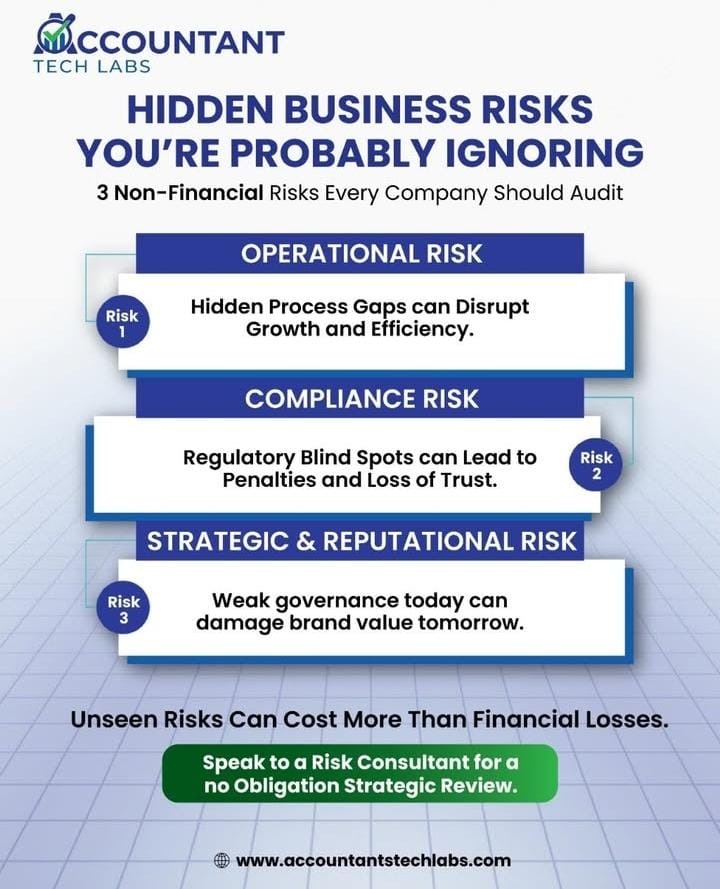
Why Proactive Risk Audits Matter
Unseen risks often cost more than direct financial losses. They erode efficiency, trust, and resilience three elements every successful organization depends on. By auditing operational, compliance, and strategic risks, businesses gain clarity, reduce uncertainty, and build stronger foundations for growth. In a complex business environment, proactive risk management is not a defensive move it is a strategic advantage.






























Sign in to leave a comment.