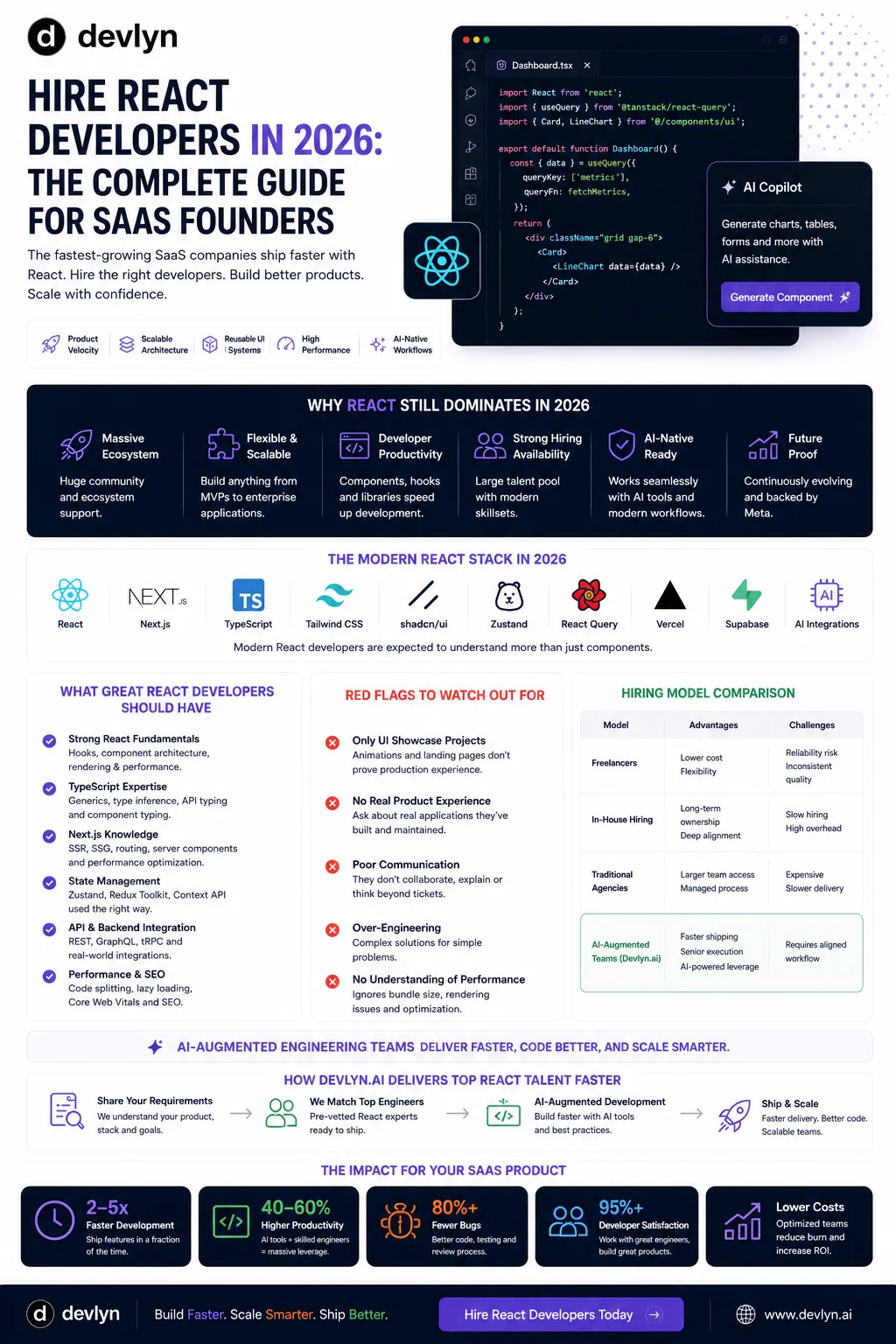

The fastest-growing SaaS companies are no longer competing on ideas.
They’re competing on product velocity.
And React has become the foundation of powering that velocity.
From AI startups to enterprise dashboards, React continues to dominate modern frontend development because it enables:
- faster UI iteration
- scalable architecture
- reusable component systems
- real-time user experiences
- high-performance web applications
But there’s a problem most founders discover too late:
Hiring experienced React developers in 2026 is harder than ever.
The best engineers are already overloaded with offers.
Traditional hiring pipelines move too slowly.
Freelance marketplaces are crowded with unverified talent.
And most agencies still operate with outdated workflows.
Meanwhile, your roadmap keeps slipping.
This guide explains:
- how to hire React developers effectively
- what skills matter
- how much React developers cost
- what red flags to avoid
- why AI-augmented engineering teams are changing software hiring completely
Why React Still Dominates Frontend Development
Despite the rise of dozens of frontend frameworks, React remains the default choice for modern product teams.
Why?
Because React gives engineering teams:
- flexibility
- scalability
- massive ecosystem support
- reusable UI systems
- strong hiring availability
- compatibility with AI-native workflows
Modern companies use React for:
- SaaS dashboards
- AI applications
- admin panels
- fintech products
- marketplaces
- real-time collaboration tools
- analytics platforms
- enterprise software
The ecosystem surrounding React has also matured significantly.
Today’s React stack commonly includes:
- TypeScript
- Next.js
- Tailwind CSS
- shadcn/ui
- Zustand
- React Query
- Vercel
- Supabase
- AI SDK integrations
The result?
React developers are now expected to understand much more than frontend components.
The Real Challenge with Hiring React Developers
Most companies don’t actually need “someone who knows React.”
They need developers who understand:
- frontend architecture
- product scalability
- performance optimization
- API integrations
- authentication systems
- state management
- AI integrations
- production deployment
- developer experience
That level of expertise is rare.
And expensive.
Many founders learn this after hiring developers who:
- can build interfaces
- but struggle with production systems
- create technical debt
- slow feature delivery
- over-engineer simple workflows
The difference between a junior React developer and a senior product focused React engineer is massive.
What Skills Great React Developers Should Have
1. Strong React Fundamentals
A senior React developer should deeply understand:
- hooks
- component architecture
- rendering behavior
- state management
- memoization
- performance optimization
Not just copy-pasting components from templates.
2. TypeScript Experience
Modern React teams increasingly require TypeScript.
Why?
Because large-scale applications become impossible to maintain without type of safety.
Strong developers should understand:
- generics
- type inference
- API typing
- reusable component typing
3. Next.js Knowledge
Reacting alone is rarely enough in 2026.
Most production applications now use Next.js for:
- server-side rendering
- SEO optimization
- edge rendering
- routing
- server components
That’s why companies increasingly search for:
- hire React developers
- hire Next.js developers
- hire frontend engineers
…almost interchangeably.
Red Flags When Hiring React Developers
Red Flag #1: Only UI Showcase Projects
Beautiful portfolios can be misleading.
Many developers showcase:
- animations
- landing pages
- visual effects
But lack experience with:
- SaaS systems
- authentication
- API architecture
- scalable frontend patterns
Production engineering matters more than visual polish.
Red Flag #2: No Real Product Experience
Ask:
“What production applications have you maintained?”
Building demos is easy.
Maintaining large-scale products under real users, deadlines, and performance constraints is completely different.
Red Flag #3: Weak Communication
The best React developers are not just coders.
They:
- communicate clearly
- collaborate with product teams
- explain technical tradeoffs
- think beyond tickets
This matters more than most founders realize.
Freelancers' vs Agencies vs Dedicated React Teams
| Hiring Model | Advantages | Challenges |
| Freelancers | Lower cost | Reliability risk |
| In-House Hiring | Long-term ownership | Slow recruitment |
| Traditional Agencies | Larger team access | Expensive and slower |
| AI-Augmented Pods | Faster shipping, senior execution | Requires aligned workflow |
The industry is rapidly moving toward AI-native engineering pods because they:
- reduce delivery time
- improve developer leverage
- eliminate hiring bottlenecks
- accelerate roadmap execution
Why AI-Augmented Engineering Teams Are Winning
Modern engineering teams are no longer scaling through headcounts alone.
They’re scaling through leverages.
AI-assisted workflows now accelerate:
- frontend scaffolding
- testing
- documentation
- debugging
- refactoring
- code reviews
- component generation
That allows senior developers to:
- ship faster
- maintain cleaner architecture
- reduce repetitive work
- focus on product decisions
The result?
Smaller engineering teams can now outperform larger traditional teams.
How Devlyn.ai Helps Companies Hire React Developers Faster
Devlyn.ai helps startups and SaaS companies scale engineering using AI-augmented development teams.
Instead of spending months recruiting internally, companies can:
- onboard senior React developers quickly
- launch products faster
- reduce technical bottlenecks
- scale frontend delivery efficiently
Devlyn.ai engineering pods are designed for:
- SaaS startups
- AI companies
- MVP launches
- product redesigns
- scaling frontend applications
- dedicated engineering capacity
The process focuses on:
- fast onboarding
- production-ready engineering
- senior developer quality
- AI-assisted execution
Similar hiring models increasingly prioritize deployment speed over traditional recruitment timelines.
Questions to Ask Before Hiring a React Developer
Technical Questions
- How do you optimize React performance?
- How do you structure scalable component systems?
- When would you use Context vs Zustand vs Redux?
- How do you reduce unnecessary re-renders?
Product Questions
- Have you built a subscription for SaaS products?
- What front-end scaling problems have you solved?
- How do you manage technical debt?
Workflow Questions
- How do you collaborate with designers?
- What AI tools improve your workflow?
- How do you handle code reviews?
How Much Does It Cost to Hire React Developers in 2026?
Pricing varies significantly based on:
- seniority
- geography
- product complexity
- hiring model
Freelance React Developers
- $20–$120/hour
Mid-Level React Developers
- $4,000–$7,000/month
Senior React Engineers
- $8,000–$18,000/month
Dedicated AI-Augmented Teams
- Often more efficient than hiring multiple in-house engineers
- Faster delivery cycles
- Reduced operational overhead
The real cost isn’t salary.
It’s slow execution.
Community Hiring Trends in 2026
Many founders now prioritize:
- React + TypeScript experience
- Next.js knowledge
- production SaaS experience
- async communication skills
- AI-assisted workflows
Developers with strong React architecture experience are increasingly preferred over “generalist” frontend developers.
Final Thoughts
Hiring React developers in 2026 is no longer just about frontend coding.
The real competitive advantage comes from:
- senior engineering quality
- execution speed
- AI-native workflows
- scalable product thinking
The startups growing fastest today are not necessarily hiring the biggest teams.
They’re building the fastest.
And that changes everything.
Frequently Asked Questions
Is React still relevant in 2026?
Yes. React remains the dominant frontend ecosystem powering SaaS platforms, AI products, and enterprise applications.
Should startups hire React freelancers or dedicated teams?
Freelancers work well for smaller tasks. Dedicated engineering teams are better for long-term product velocity and scalability.
Why do most SaaS startups use React?
Because React enables:
- faster UI development
- reusable components
- scalable frontend architecture
- strong ecosystem support
What should I look for when hiring React developers?
Focus on:
- production experience
- TypeScript knowledge
- frontend architecture
- communication skills
- performance optimization expertise




























Sign in to leave a comment.