
Managing an HOA is not only about maintaining common areas, enforcing community rules, or planning improvements. Every major board decision eventually connects to the association’s finances.
Accurate HOA financial statements give board members a clear view of assessment income, operating expenses, available cash, unpaid owner balances, outstanding obligations, and reserve funds. Without reliable reporting, an association can appear financially stable while cash shortages, growing delinquencies, budget overruns, or reserve funding gaps develop in the background.
Effective HOA financial reporting therefore goes beyond producing accounting reports. The goal is to turn financial activity into information the board can use to protect the association’s financial position.
For associations with growing transaction volumes or limited accounting capacity, professional HOA accounting services can also provide the accounting workflows, reconciliations, controls, and reporting discipline required to keep financial information accurate and current.
What financial statements should an HOA board review?
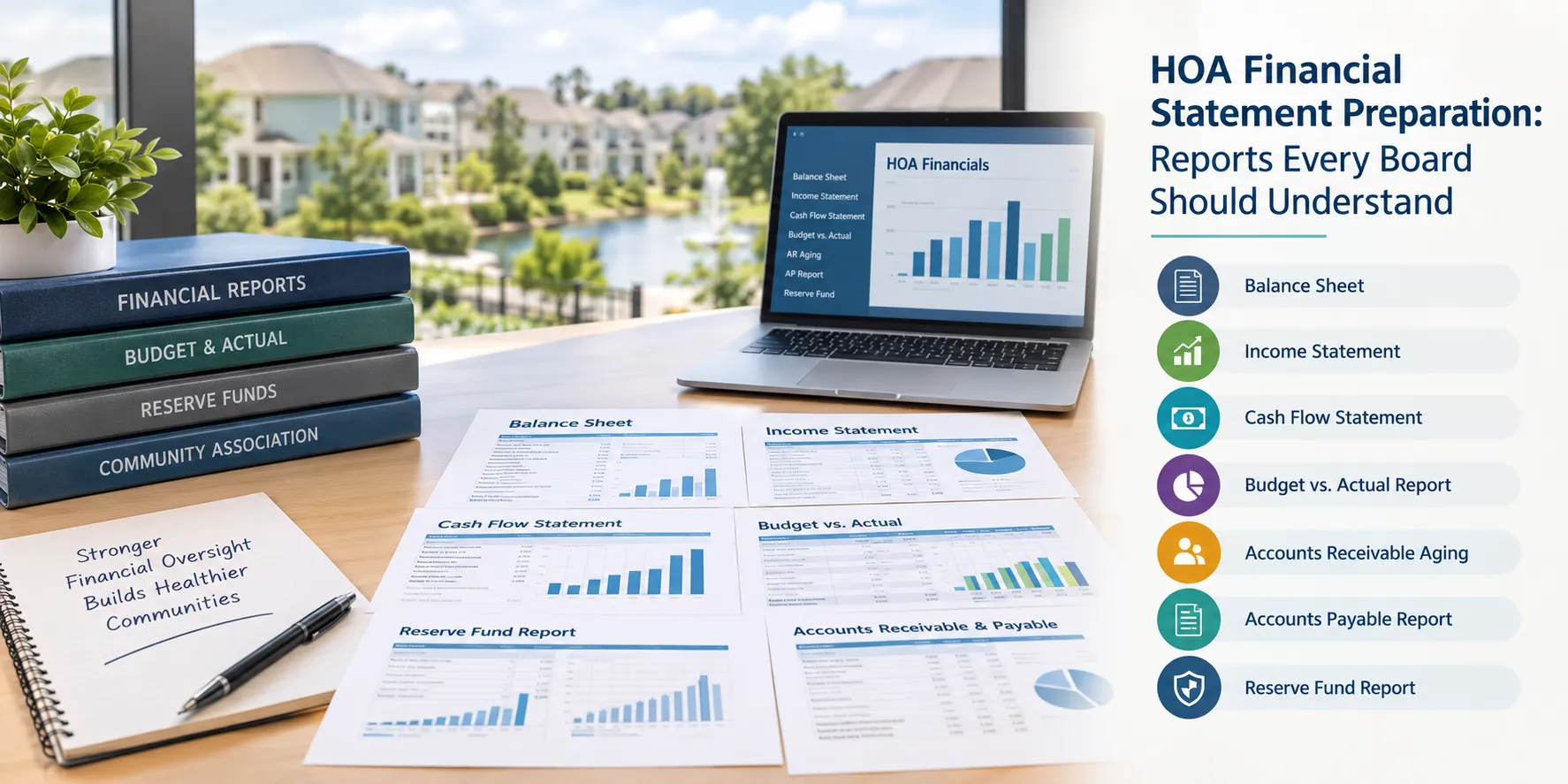
An HOA board should regularly review the balance sheet, income statement, cash flow statement, budget vs. actual report, accounts receivable aging, accounts payable report, and reserve fund report. Boards should also review completed bank reconciliations to confirm that reported cash balances agree with the association’s bank activity.
What Is HOA Financial Statement Preparation?
HOA financial statement preparation is the process of recording, reconciling, reviewing, and organizing an association’s financial activity into reports that show its financial position and operating performance.
A typical monthly HOA accounting workflow may include:
- Recording owner assessments and other revenue
- Processing vendor invoices and payments
- Recording operating expenses
- Reconciling bank and credit card accounts
- Updating accounts receivable and delinquency balances
- Recording accruals and adjusting entries
- Tracking reserve contributions and expenditures
- Comparing actual results against the approved budget
- Reviewing general ledger activity
- Preparing the monthly financial package
Depending on the association’s structure, these activities may be handled by an internal accountant, community association management company, property management team, external accounting provider, or a combination of these resources.
Preparation and approval should remain distinct responsibilities where practical. The accounting team prepares and reconciles the financial information, while management and the board review results, investigate material exceptions, and exercise financial oversight.
Why Financial Statements Matter to HOA Boards
HOA boards have to make decisions about spending, assessments, contracts, repairs, reserves, collections, and long-term projects. Financial statements provide the evidence needed to make those decisions responsibly.
Strong HOA financial management helps boards maintain:
Financial transparency: Board members can see where association funds came from and how they were used.
Budget control: Actual revenue and expenses can be compared with the approved annual budget.
Cash management: Boards can determine whether sufficient operating cash is available for upcoming obligations.
Reserve planning: Reserve balances and expenditures can be monitored separately from routine operating activity.
Risk identification: Delinquencies, unusual expenses, unreconciled balances, cash pressure, or unexpected liabilities can be identified earlier.
Better decision-making: Financial data gives boards a factual basis for evaluating contracts, projects, assessment levels, and spending priorities.
The value of financial reporting is therefore not simply having reports available. It is having reports that are timely, reconciled, understandable, and actionable.
7 HOA Financial Reports Every Board Should Understand
1. HOA Balance Sheet
The HOA balance sheet shows the association’s financial position at a specific date.
It typically includes:
- Cash and bank balances
- Assessments receivable
- Prepaid expenses and other assets
- Accounts payable
- Accrued expenses and other liabilities
- Fund balances or members’ equity
Why the board should care: The balance sheet helps answer a fundamental question: what does the association currently own, owe, and have available?
Key numbers to review: Cash, receivables, current liabilities, operating fund balance, and reserve balances.
Warning signs: Declining operating cash, rapidly increasing receivables, old liabilities, negative fund balances, or balances that do not reconcile with supporting schedules.
2. HOA Income Statement
The HOA income statement, sometimes called the statement of revenues and expenses, shows financial activity over a period such as a month or year to date.
It includes assessment revenue and other income against expenses such as landscaping, utilities, insurance, repairs, management fees, and administrative costs.
Why the board should care: It shows whether operations are tracking according to financial expectations.
Key numbers to review: Assessment income, major expense categories, total operating expenses, and net operating results.
Warning signs: Recurring operating deficits, unexplained expense increases, inconsistent revenue, or unusually large month-to-month fluctuations.
3. HOA Cash Flow Statement
The HOA cash flow statement explains how cash moved into and out of the association during a reporting period.
Accounting income does not always equal cash available. For example, assessments may be recorded as revenue before all homeowners have paid them.
Why the board should care: An association can report positive accounting results and still experience cash pressure.
Key numbers to review: Operating cash flow, major cash outflows, reserve activity, and ending cash.
Warning signs: Consistently negative operating cash flow, declining available cash, or routine operating expenses being supported by funds intended for other purposes.
4. HOA Budget vs. Actual Report
The HOA budget vs. actual report compares approved budget amounts with actual financial results.
A useful report normally presents:
| Measure | What It Tells the Board |
|---|---|
| Budget | What the association expected |
| Actual | What occurred |
| Variance | Difference between budget and actual |
| YTD variance | Cumulative difference for the year |
Why the board should care: Variance analysis shows where financial performance is moving away from the annual plan.
Key numbers to review: Material dollar and percentage variances in revenue and major expense categories.
Warning signs: Repeated overspending, assessment revenue below expectations, significant year-to-date variances without explanations, or expenses consistently posted to incorrect accounts.
A variance is not automatically a problem. Timing differences and unexpected repairs happen. What matters is whether significant variances are understood and properly documented.
5. HOA Accounts Receivable Aging Report
HOA accounts receivable represents money owed to the association, primarily unpaid assessments, fees, or other owner charges.
An aging report typically separates balances according to how long they have remained outstanding.
Why the board should care: Increasing delinquencies can directly affect operating cash and the association’s ability to meet obligations.
Key numbers to review: Total outstanding assessments, aging categories, delinquency trends, and material owner balances.
Warning signs: Growing older balances, sharp increases in total receivables, unexplained credits, or differences between the aging report and general ledger.
6. Accounts Payable Report
The accounts payable report shows invoices and other amounts the HOA owes vendors or service providers.
Why the board should care: It helps the board understand upcoming cash requirements and whether obligations are being processed on time.
Key numbers to review: Total unpaid invoices, due dates, aging, major vendor balances, and overdue obligations.
Warning signs: Old unpaid invoices, duplicate bills, unexpected vendor balances, late-payment charges, or liabilities appearing in the general ledger without supporting detail.
7. HOA Reserve Fund Report
HOA reserve funds are generally intended to support major repair and replacement requirements rather than ordinary recurring operations.
Reserve reporting should clearly identify contributions, expenditures, transfers, and balances.
Why the board should care: Reserve funding affects the association’s ability to address major future expenditures without creating unnecessary financial pressure.
Key numbers to review: Beginning balance, contributions, investment income where applicable, approved expenditures, transfers, and ending balance.
Warning signs: Unexplained withdrawals, reserve activity mixed with operating transactions, missing supporting documentation, or reserve balances that do not agree with bank and general ledger records.
How HOA Boards Should Review Financial Statements
A board does not need to reperform the accounting department’s work. It should focus on financial condition, material changes, exceptions, and supporting controls.
During each monthly review, board members should examine:
- Revenue: Is assessment income consistent with expectations?
- Operating expenses: Which categories are materially over or under budget?
- Cash balances: Is sufficient operating cash available for upcoming expenses?
- Delinquent assessments: Are receivables increasing or becoming older?
- Outstanding bills: Are material vendor invoices unpaid or overdue?
- Reserve balances: Do contributions and expenditures agree with approved activity?
- Budget variances: Are significant differences explained?
- Bank reconciliations: Have all material bank accounts been reconciled through the reporting date?
The board should also compare reports rather than reviewing each statement in isolation. For example, the cash balance on the balance sheet should connect with reconciled bank records, while accounts receivable should agree with the owner aging schedule.
These cross-checks make inconsistencies easier to identify.
Common HOA Financial Reporting Mistakes
Even when monthly statements are being produced, weaknesses in the underlying accounting process can reduce their reliability.
Unreconciled Bank Accounts
A HOA bank reconciliation compares accounting records with bank activity. Unreconciled accounts can leave duplicate transactions, missing entries, outstanding checks, incorrect deposits, or posting errors unresolved.
Incorrect Expense Classifications
Expenses recorded in the wrong general ledger accounts distort both the income statement and budget variance analysis.
Delayed Financial Statements
Reports received weeks or months after the reporting period lose much of their decision-making value.
Poor Assessment Tracking
If owner charges, receipts, credits, and adjustments are not recorded correctly, receivable balances and collection reporting become unreliable.
Mixing Operating and Reserve Funds
Operating and reserve activity should be appropriately identified and tracked. Poor fund accounting can make it difficult for boards to determine how restricted or designated resources have been used.
Unexplained Budget Variances
A report showing a $20,000 variance is less useful if the board cannot determine why it occurred. Material variances should have supporting explanations.
Inaccurate Accruals
Expenses may relate to a reporting period even when the invoice has not yet been paid or received. Missing or incorrect accruals can cause expenses to appear in the wrong period and distort monthly comparisons.
When Should an HOA Consider Professional HOA Accounting Services?
An HOA should consider professional HOA accounting services when its financial workload or reporting complexity begins exceeding the capacity of its existing processes or team.
Common situations include:
- The community or portfolio is growing
- Multiple operating and reserve bank accounts require reconciliation
- Reserve activity has become more complex
- Monthly transaction volumes have increased
- Assessment delinquencies require stronger tracking
- Financial reports are consistently delayed
- Month-end close depends heavily on one internal employee
- Board members regularly find unexplained differences between reports
- Internal accounting resources are limited
- Management needs more consistent financial packages across multiple associations
The objective is not simply to move bookkeeping elsewhere. A well-structured community association accounting model should improve month-end discipline, reconciliations, supporting schedules, financial controls, and reporting consistency.
For associations evaluating this approach, an internal link to a dedicated HOA accounting services page can provide additional information about the accounting functions that can be supported.
How Outsourcing Property Management Can Improve HOA Financial Reporting
When organizations consider outsourcing property management or specific back-office functions, financial reporting is often one of the areas where standardized workflows can create meaningful operational improvements.
Depending on the engagement model, outsourced support can help with:
- Monthly financial statement preparation
- Bank and credit card reconciliations
- Accounts payable processing
- Assessment and accounts receivable tracking
- General ledger maintenance
- Accruals and adjusting entries
- Reserve fund accounting
- Budget vs. actual reporting
- Supporting schedules and documentation
- Month-end close processes
The important distinction is that outsourcing should not weaken financial oversight. The board, management company, and accounting provider need clearly defined responsibilities, approval limits, documentation requirements, and review procedures.
For example, invoice processing and payment approval should not automatically become the responsibility of the same individual without appropriate authorization controls.
Organizations exploring broader back-office support can naturally link readers to an outsourcing property management resource explaining which accounting and administrative workflows can be delegated while management retains oversight.
HOA Financial Statement Review Checklist
Board members can use this checklist during each monthly financial review:
- Review operating and reserve cash balances
- Confirm bank reconciliations have been completed
- Compare assessment revenue with budget
- Review accounts receivable and delinquency aging
- Investigate material operating expense variances
- Review unpaid and overdue vendor invoices
- Confirm reserve contributions were recorded correctly
- Review reserve expenditures and supporting approvals
- Investigate unusual general ledger activity
- Review significant accruals or adjusting entries
- Compare current results with prior months where useful
- Obtain explanations for material budget variances
- Confirm supporting schedules agree with the financial statements
- Document questions requiring management or accounting follow-up
The checklist should be adapted to the association’s governing documents, accounting basis, reporting requirements, and internal control structure.




























Sign in to leave a comment.