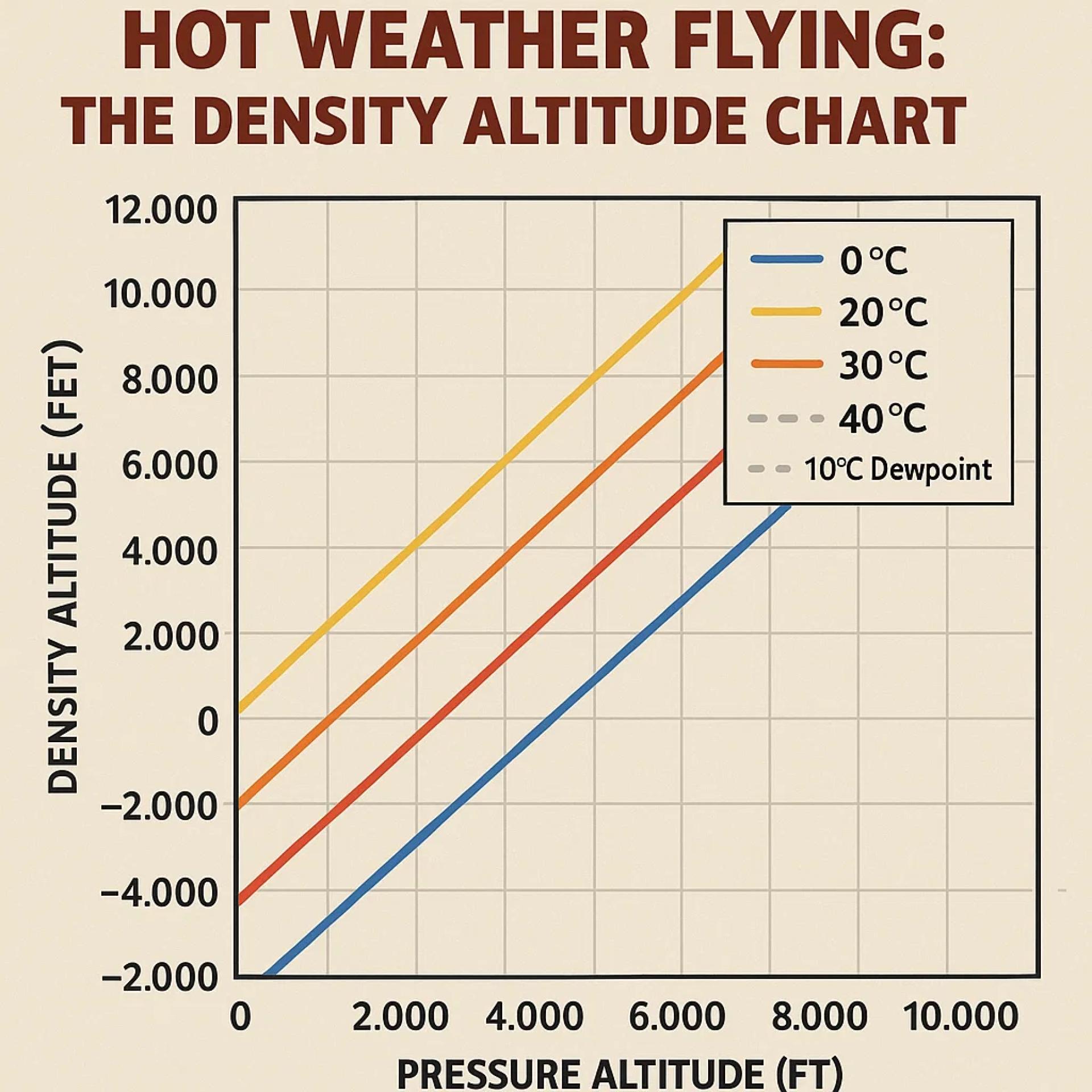

Flying in high temperatures can be a great challenge for everyone pilot-in-training and professional aviators. As heat comes into the picture, the performance of your aircraft gradually tends to deteriorate due to the myriad factors that contribute. This then translates into an increased takeoff distance, increased ground roll, lower climb rates, reduced engine power, and a lot more.
Density altitude is a very popular phenomenon seen in summer or at high-altitude airfields.
Student pilots and experienced pilots should know about density altitude in order to plan and fly a safe flight. If you’re training for your private pilot licence in Australia or you’re an instructor, a sound knowledge of the density altitude chart and density altitude is very important. Planning for density altitude and understanding an aircraft’s performance limitations in high-density altitude conditions are a must for everyone.
The density altitude chart can be a lifesaver when it comes to troubleshooting in adverse weather conditions. Density altitude can vary from time to time depending on the conditions present. You should be aware of a few things with respect to density altitude and a density altitude chart. We’ve put together this handy guide to help you read and understand a density altitude chart.
What is density altitude?
Density altitude is used in aviation to estimate performance in high-elevation airports. Density altitude refers to pressure altitude corrected for non-standard temperature. If the temperature at a place is greater than the standard temperature, the density altitude will be higher than the pressure altitude.
Density altitude is defined as the air density altitude at which the performance of an aircraft corresponds to the conditions in the atmosphere at that place and time. Density altitude is calculated in feet. Density altitude is the altitude at which the density of the International
Standard Atmosphere equals the actual air density.
In simple terms, Density altitude (DA) is an altitude in the International Standard Atmosphere at which air density would be equal to the indicated air density at the place of observation.
Why does hot weather affect aircraft performance?
Aircraft are designed and certified for a huge range of environments, but high temperatures impact aircraft performance greatly. Here’s why:
● Engines produce less power, especially if it’s non-turbocharged.
● Propellers are less efficient as the air is thin.
● Wings don’t have enough lift that creates longer ground rolls and lower rate of climb.
The high density altitude leads to:
● Longer takeoff roll.
● Slow rate of climb.
● Higher TAS (true airspeeds) but less responsive.
● Reduced ability to clear high terrain or short runways.
Density altitude and summer flying
Students who have enrolled for a diploma of aviation Melbourne in Essendon and nearby suburbs need to know about the density altitude and the density altitude chart. A large part of the flying takes place in a warm to hot temperature for most of the year. Here, a pilot needs to take a few things into consideration before flying in hot weather.
Key density altitude considerations in flying
Plan for density altitude in pre-flight
Pre-flight planning is the key to safe flying. In pre-flight planning, pilots must look at density altitude in advance for the airports they are flying from and to. The density altitude information is available on many aviation weather platforms, including ForeFlight. This data gets automatically calculated or you may also have to calculate manually by using a flight computer or rule-of-thumb charts in the aircraft’s POH.
Aircraft’s performance charts are another key in knowing about density altitude. The pilots may need to calculate the takeoff and landing performance and also calculate the actual climb performance. Manufacturers take care of this and provide takeoff and landing performance charts on the basis of temperature, elevation, and weight of the aircraft.
Weight and balance of the aircraft
Density altitude conditions may require the reduction in aircraft weight as well. The pilot should always ensure that the aircraft doesn’t weigh too much at high-density altitudes. There’s a possibility to offload the fuel or baggage. Flight can be delayed to a cooler part of the day in case of a multi-passenger flight.
Time of day
Flying early in the morning or later in the evening when temperatures are cooler and the air is denser. This time period should be a few hours before sunrise and a few hours post-sunset, which may not be entirely possible for a commercial pilot but totally possible for a recreational pilot and flight training students.
Flying during these times reduces density altitude and thus increases aircraft performance and response. In a hot climate, it’s common for training organizations to book solo flights for students for the first light, where density altitude is the lowest.
Runway length and terrain
Runway length is also a factor. It is always better to ensure that the runway length is more than enough for the aircraft’s takeoff roll in current conditions.
It’s important to look at factors such as short and sloped runways where the pilot should be extra cautious. The terrain is a major key that is to be considered here. It is often that in reduced climb performance, the aircraft is unable to clear the terrain or rising ground after departure.
Density altitude and emergencies
In high-density altitude, aircraft performance may be a little tricky or difficult when it comes to a go-around or missed approach. This is a scenario where the pilot must be mentally equipped to face the difficulties in high-density altitudes. Pilots should always have a mental plan to abort takeoff or in a situation where loss of climb performance is seen after rotation.
Simulating a high-density altitude scenario and go-around in a training session is a great idea to build confidence and help pilots develop a conservative habit for the future.
Wrap up
Flying in hot weather conditions doesn’t need to be scary or difficult. It just needs a proper awareness of how density altitude affects aircraft performance. From pre-flight calculations to in-flight changes, the pilot needs to be vigilant about a few key things in hot weather. Takeaways from this post are:
l Calculate the density altitude before the flight
l Performance charts should be used cautiously
l Reduce weight if necessary
l Fly during the cooler times of the day.
l Keep an eye on the climb gradient and obstacle clearance.
Density altitude is something that student pilots and instructors should be aware of while training or applying for a private pilot licence in Australia. Diploma of aviation Melbourne is one of the courses in Essendon that has many such points to consider before and while flying in summer. The students get a hands-on experience of density altitude in simulators and while in the air with instructor pilots.






























Sign in to leave a comment.