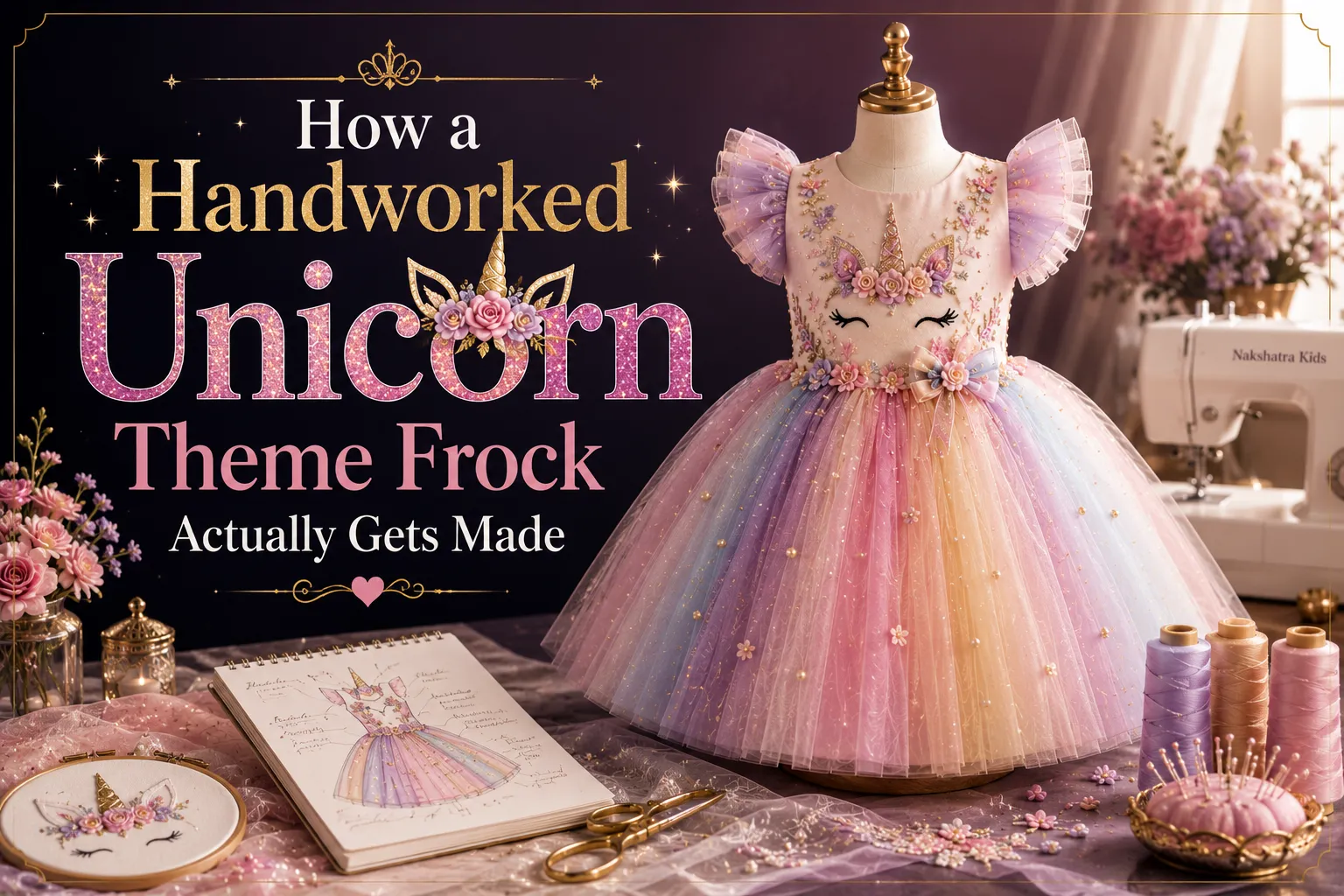

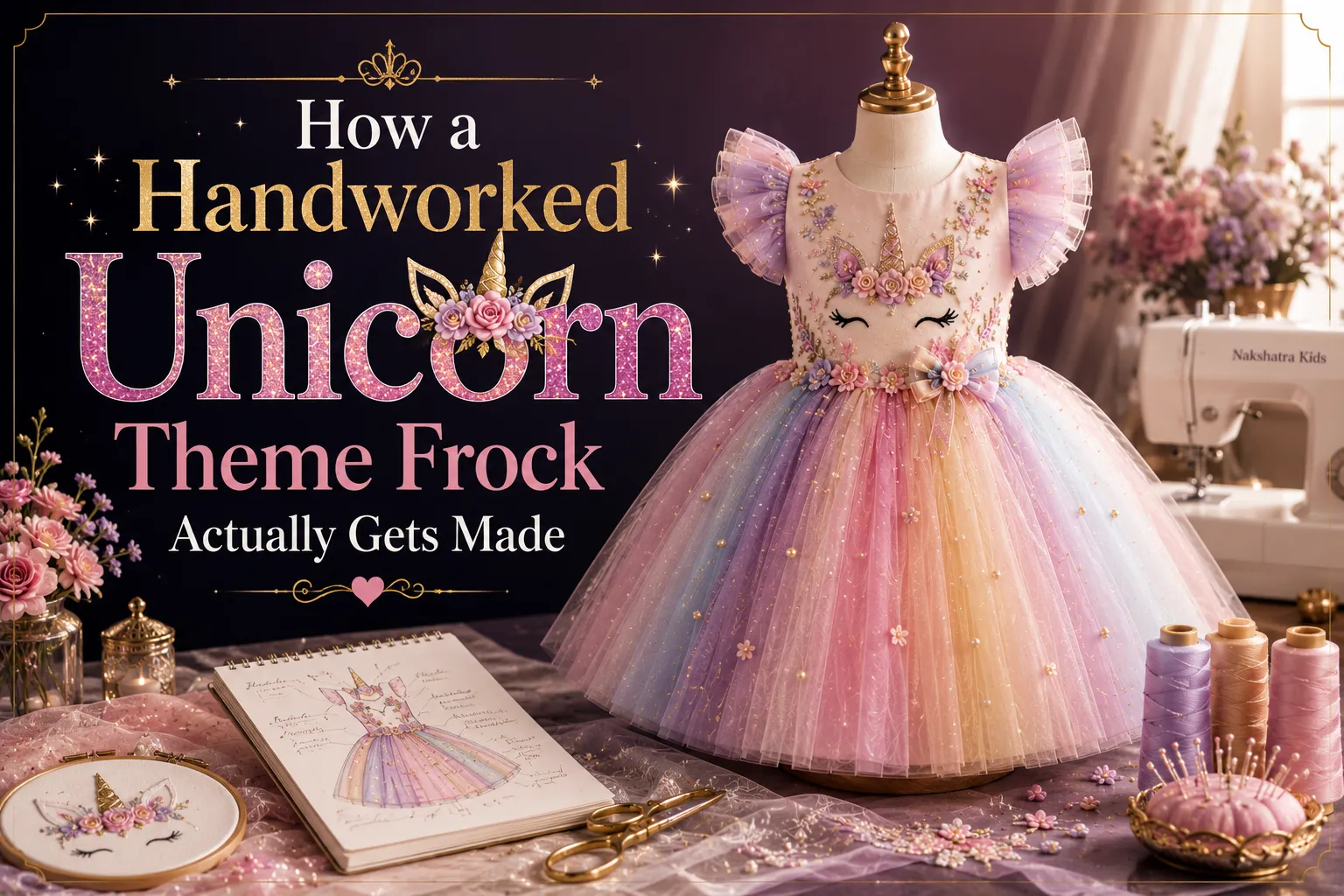
If you've ever wondered why a unicorn theme frock costs more and takes longer than something off a store rack, the answer comes down to one thing: almost none of it is machine-made. The horn detailing, the mane, the pastel rainbow touches — most of that is placed and stitched by hand, one piece at a time.
Most hand-worked unicorn theme frocks take anywhere from 1 to 4 weeks to make, depending on how much embroidery, appliqué, or 3D detailing is involved. A dress with a simple embroidered unicorn on the bodice comes together much faster than one with a full 3D horn, mane, and rainbow appliqué across the skirt. Here's what actually goes into making one, from order to delivery.
Quick Answer: Typical Timeline
| Type of Handwork | Estimated Time |
|---|---|
| Simple embroidered unicorn motif on bodice | 5–7 days |
| Moderate appliqué with mane or horn detailing | 10–15 days |
| Dense embroidery with beadwork or sequins | 2–3 weeks |
| Full 3D horn, mane, and rainbow appliqué detailing | 3–4 weeks |
These timelines hold fairly steady across most premium hand-worked kidswear the more layered and dimensional the detailing, the more hours of hand-stitching it needs.
Why the Detailing Takes So Long
A unicorn theme isn't just a print the pieces that make it feel magical are usually the ones built up by hand. A raised, padded horn. A mane made from layered ribbon or thread work. Rainbow-colored appliqué that's been individually placed and secured. None of that can be rushed through a machine without it looking flat or falling apart with wear.
Each element usually has to be finished in a certain order too — the base embroidery before the appliqué goes on, the appliqué before any beadwork gets layered over it. That sequencing is part of why a heavily detailed unicorn dress takes real time, not just busy hours.
What Happens Behind the Scenes, Step by Step
It starts with design and sizing. Before any fabric gets touched, the color palette, unicorn design, and your child's measurements get confirmed usually through a quick form or a short call with the design team.
Then the fabric gets cut. Most unicorn theme frocks use tulle net or organza for the base, both of which need careful, precise cutting since they fray or shift easily if handled roughly.
The embroidery and appliqué stage takes the longest by far. This is where the horn, mane, and any rainbow or star detailing actually take shape hand embroidery, individually placed appliqué pieces, and sometimes 3D elements like a padded horn or ribbon mane. A detailed unicorn motif alone can take several hours; a full design across the skirt can take days.
Once the handwork is done, the dress gets assembled. Seams, lining, and structural layers like a petticoat are all stitched together into the finished shape.
Fitting and finishing follow. The dress is checked against the original measurements, and finishing details hems, closures, any final trims get completed.
A final quality check happens before it ships. Loose threads, motif placement, overall fit and finish all get reviewed one more time.
What Can Push the Timeline Longer or Shorter
- How much dimensional detailing is involved — a flat embroidered motif is quicker than a padded 3D horn or layered mane
- The fabric itself — tulle net and organza need slower, more careful handling than cotton
- Whether it's a custom size — standard age-based sizing moves faster than a fully custom fit
- The season — festival and peak party months can stretch timelines since artisans are often working several orders simultaneously
- Mid-production changes — a request to swap colors after handwork has already started usually adds days back onto the clock
If You're Working With a Deadline
- Order 3 to 4 weeks ahead if you can, especially for anything with heavy detailing
- Get measurements confirmed accurately the first time to avoid rework
- If time is tight, a simpler embroidered design will move faster than full 3D detailing
- Ask directly about rush options rather than assuming they're available
- Avoid requesting design changes once the handwork has already begun
A Few Questions Parents Often Ask
Can a unicorn theme frock be rushed if I need it urgently? Sometimes, for simpler embroidered designs. Anything with 3D horn or mane detailing is much harder to speed up without affecting quality, so it's worth checking directly before ordering.
Why does a 3D horn or mane cost more than a printed unicorn design? Because it's built by hand in layers padding, stitching, securing rather than printed in seconds. It also tends to hold its shape and look far better over repeated wear.
Does the fabric affect the timeline much? Yes. Tulle net and organza are more delicate to cut and stitch than cotton, so they add a bit more time throughout the process.
How early should I order for a birthday? For a handworked design, 3 to 4 weeks gives enough room for production, fitting, and shipping without cutting it close.
Can I request changes after placing the order? Usually yes, early on. Once the embroidery or appliqué work has started, changes can add time and aren't always possible depending on how far along the piece is.
Final Thoughts
A hand-worked unicorn theme frock takes the time it does because every horn, mane detail, and rainbow motif is built by hand for one child, not mass-produced. Once you understand what actually happens during that production window, the wait makes a lot more sense — and it's easier to plan your order around it. You can see the full range of hand-worked unicorn designs in the Unicorn Theme Dress Collection.





















Sign in to leave a comment.