

A dashboard can look polished, a machine learning model can return a prediction, and a regulatory report can be delivered on time—while the underlying data is incomplete, duplicated, stale, or structurally changed. These “silent” failures are among the most expensive data problems because teams often discover them only after a decision has been made.
That is why enterprises are moving beyond occasional data checks toward continuous, AI-assisted validation. The right data quality software helps teams find issues early, understand what changes, and protect the data products that business users rely on.
Why traditional data checks struggle at scale
Data environments are rarely static. New source systems are added, schemas evolve, volumes fluctuate, and transformation of logic changes. In this environment, teams relying on manually maintained SQL checks face a familiar set of challenges:
- Rules take time to create and update
- Unknown anomalies are difficult to anticipate
- Alerts may arrive after downstream reports are affected
- Engineers spend too much time investigating recurring issues
- Data quality coverage becomes inconsistent across pipelines
A modern data quality tool should reduce this manual burden while giving data teams visibility into the health of their most important datasets.
What AI-powered data quality software should monitor
Effective validation is not limited to checking whether a table exists. It should assess the signals that reveal whether data is still fit for use. Key areas include:
1. Completeness
Are expected records, fields, and values present? Missing data can distort reports, customer views, and model inputs.
2. Uniqueness
Are duplicate records appearing in customer, transaction, product, or vendor data? Duplicate data can lead to inaccurate counts and reconciliation problems.
3. Schema stability
Have columns been added, removed, renamed, or changed in format? Schema changes can break downstream transformations without obvious warning.
4. Freshness and volume
Did the data arrive when expected, and is the volume within a normal range? Late or unexpectedly small loads can indicate an upstream pipeline failure.
5. Distribution and drift
Has the pattern of values changed significantly? Distribution shifts may signal source-system changes, data corruption, or risk to analytics and AI models.
Together, these checks make data quality monitoring a continuous practice rather than a reactive cleanup exercise.
How FirstEigen DataBuck supports proactive validation
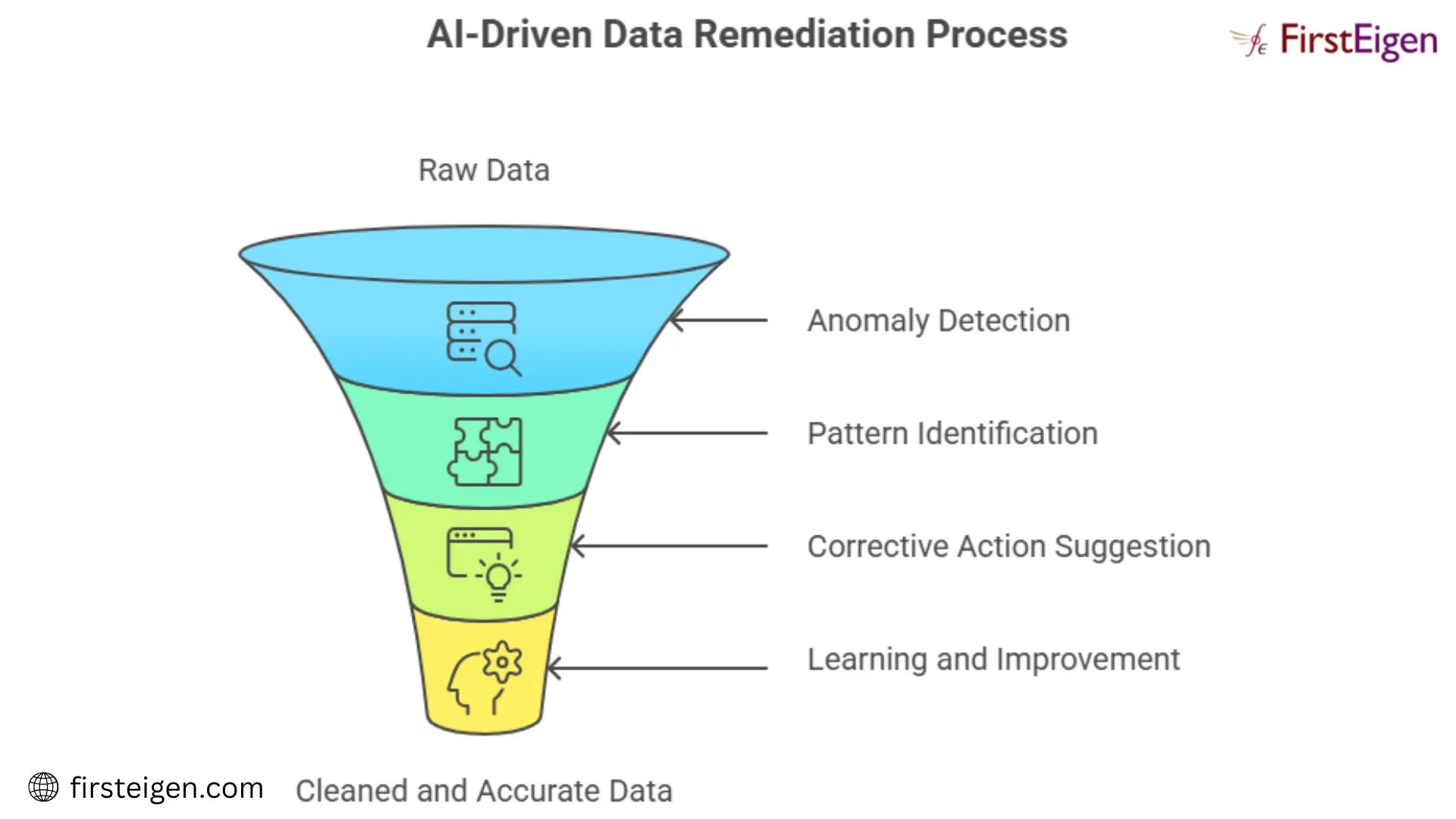
FirstEigen DataBuck is an AI-driven platform built to help enterprises validate and monitor data at scale. Rather than requiring teams to define every possible rule in advance, it learns expected data behavior and identifies unusual patterns that deserve attention.
DataBuck can help teams monitor data across complex pipelines and datasets through automated checks for anomalies, schema changes, missing values, duplicates, volume changes, and distribution shifts. This allows data engineers, analytics teams, and governance leaders to focus on the issues with the greatest business impact.
For organizations supporting large analytics programs, AI initiatives, or regulatory reporting, this approach helps reduce manual rule maintenance and improve confidence in the data delivered to downstream users.
The business value of continuous data quality monitoring
When teams can identify data issues before they reach dashboards or models, they gain more than cleaner tables. They can:
- Improve confidence in reporting and analytics
- Reduce time spent on manual troubleshooting
- Protect AI and machine learning workflows from unreliable inputs
- Support stronger governance and compliance processes
- Give business users faster access to dependable information
The goal is not simply to generate more alerts. It is to create a dependable system for identifying meaningful changes and resolving them before they become business problems.
Choosing a data quality tool for enterprise data
When evaluating a data quality tool, look for capabilities that fit both current workloads and future scale:
- Automated profiling and anomaly detection
- Coverage for schema, volume, completeness, uniqueness, and distribution
- Ability to support high-volume, complex data environments
- Clear alerts and investigation workflows
- Reduced dependence on manual rule writing
- Integration with existing cloud data platforms and pipelines
A platform that combines automation with actionable visibility can help teams establish a more reliable data foundation without creating another manual process to manage.
Build trust before data reaches the business
Data reliability is a prerequisite for trustworthy analytics, AI, and decision-making. AI-powered data quality software gives enterprises a practical way to detect silent failures, monitor changing data patterns, and maintain confidence in critical data assets.
Explore how FirstEigen DataBuck supports autonomous validation and data quality monitoring for enterprise data environments:





















Sign in to leave a comment.