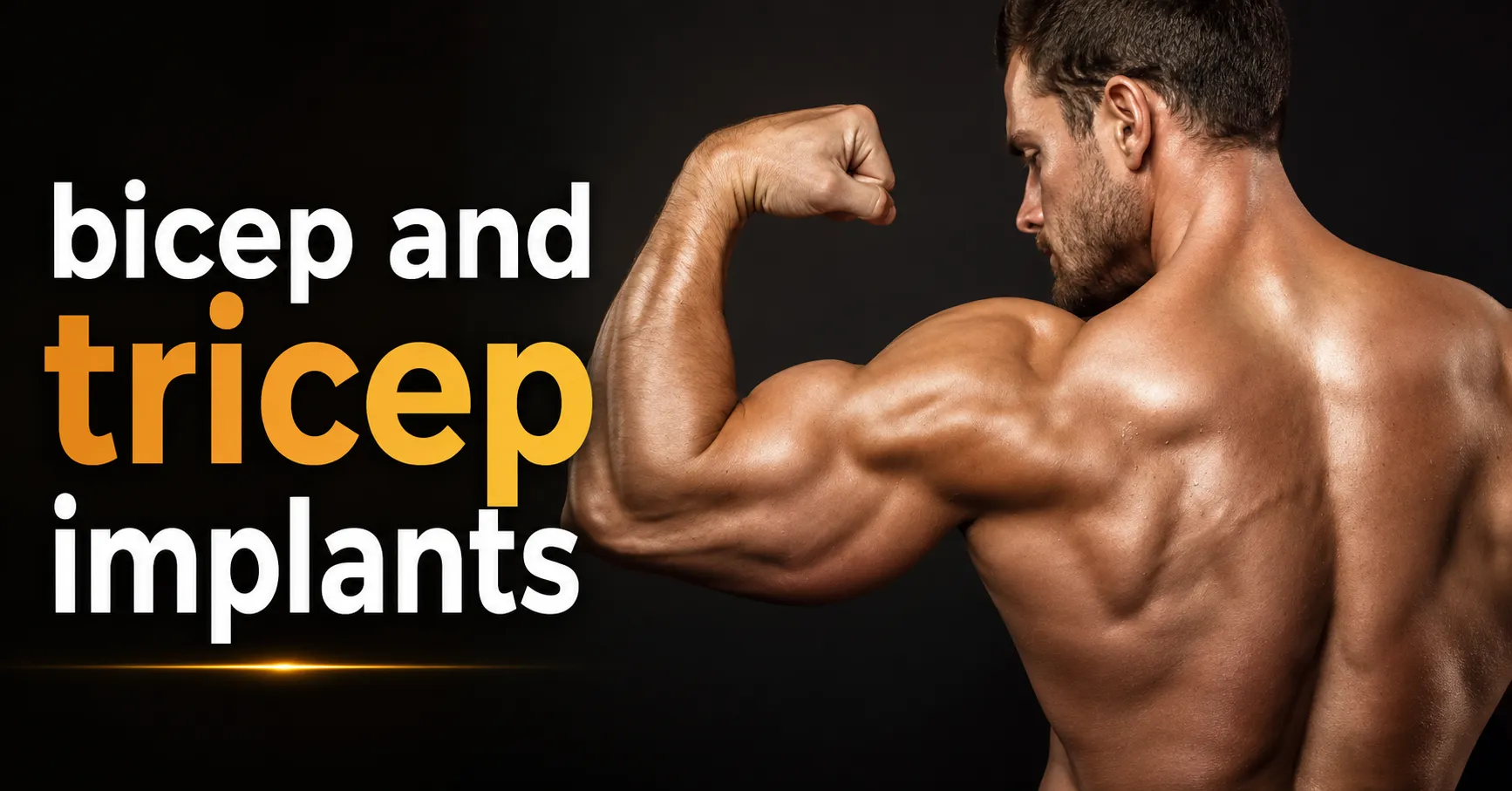

Hitting a hard wall on upper body growth is brutal; you churn through endless heavy sets, dial in the nutrition, and still watch your arm development plateau because of bad insertion genetics. When exercises do not yield results anymore, arm augmentation offers a direct physical shortcut to adding permanent mass.
Surgeons use semi-solid silicone implants shaped specifically to mimic dense muscle tissue, giving that full, athletic flex without getting in the way of how arms actually move. So, before pulling the trigger on surgery, knowing how these pieces get positioned, secured, and healed helps figure out if bicep and tricep implants are the right play for the physique.
At A Glance
- Subfascial Placement: Why does locking implants under the muscle sheath prevent sliding and preserve range of motion?
- Hidden Incisions: How do surgeons hide cuts right inside armpit folds and inner elbow creases?
- Recovery Timeline: The essential weeks needed before you can safely hit heavy weights again.
What to Expect During Bicep & Tricep Implant Surgery?
Pre-Op Customization & Anesthesia
To get balanced arms, it’s not as easy as going to the store and buying some silicone off the shelf. You have to get the sizing right to match the existing frame. Surgeons choose custom-molded solid silicone blocks that feel like firm muscle under tension, not soft liquid bags. Because these implants are solid, they can't leak, rupture, or flatten out under physical pressure.
The whole operation happens under general anesthesia in an accredited surgical facility, keeping you completely knocked out while the doctor works. Spending time dialing in the sizing for your bicep and tricep implants beforehand ensures the final shape looks like natural muscle built in the gym rather than something that sticks out like a sore thumb.
Hiding Incisions & Prepping the Pocket
Nobody wants obvious surgical scars running down their arms, so incisions are tucked directly into deep body folds. For bicep work, a shortcut goes right into the axillary crease of the armpit. For triceps, it sits inside the inner elbow crease or along the rear armpit fold.
The surgeon carefully carves out a pocket right underneath the deep fascia, the tough layer of connective tissue wrapping the muscle belly. Dropping bicep and tricep implants underneath this fascial sheath keeps them firmly anchored over the muscle so they won't shift around or press against major nerve pathways.
Implant Sliding & Locking
When the pocket has been created, the surgeon will place the soft silicone implant directly over the muscle to be augmented. They compare both arms side-by-side, making sure the thickness matches and blends with the existing muscle lines.
- Muscle Alignment: The implant is centered along the long head to create natural bicep peaks or to fill out the triceps horseshoe.
- Internal Stitch: The deep fascial pocket is closed with dissolvable stitches to completely lock the implant in place.
- Skin closure: The outer skin is sutured with fine surgical thread, and waterproof dressings are applied over the incisions.
Securing bicep and tricep implants under the muscle sheath lets the silicone move directly alongside the real muscle fibers whenever contracting the arms.
Post-Op Healing & Workout Restrictions
Healing up from arm augmentation surgery takes some discipline while the tissues stretch to accommodate the new volume. You'll wear snug compression sleeves for the first couple of weeks to control swelling and force fluids out of the area.
- First 48 Hours: Keep arms propped up, take pain meds, and stick to complete rest.
- Weeks 1 to 3: You can handle basic daily stuff and light walking, but leave heavy lifting, pushing, or pulling completely alone.
- Weeks 4 to 6: Gradually work your way back into upper body training once your surgeon clears the surgical pockets as fully healed.
Conclusion
Building proportional, sleeve-filling arms comes down to working with a seasoned surgeon who knows body contouring inside and out. So, if you've been searching online for bicep implants near me, try to dig deep and look for a local specialist, such as the likes of Dr. Shahin Javaheri, SF Plastic Surgeon.
Teaming up with a top Bay Area specialist gives you a smooth surgical process, sharp muscle definition, and results you can show off with total confidence.

























Sign in to leave a comment.