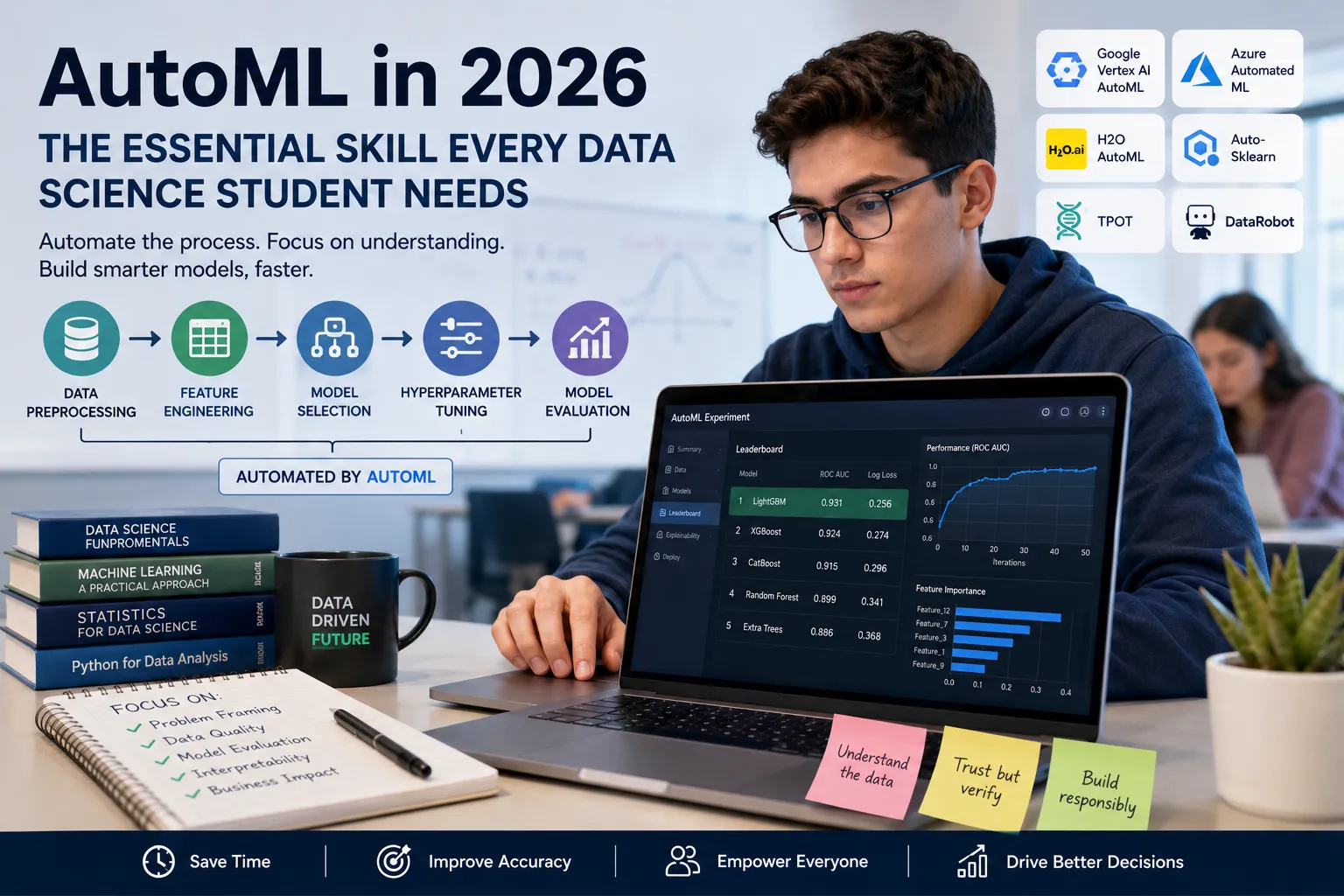

Artificial intelligence continues to evolve at an incredible pace, and AutoML has become one of the biggest drivers of change. What started as a tool for automating repetitive machine learning tasks has matured into an essential component of modern data science workflows. Companies no longer expect every data scientist to spend days tuning models manually. Instead, they expect professionals to understand business problems, evaluate automated models, and deploy AI systems responsibly.
For students preparing for careers in data science, analytics, or artificial intelligence, understanding AutoML has become just as important as learning Python or statistics. Universities are updating their curricula, employers are changing hiring expectations, and cloud platforms are making machine learning accessible to a much wider audience.
Why Businesses Are Adopting AutoML Faster Than Ever
Every organization wants to make better decisions using data, but building machine learning models traditionally required experienced specialists and significant development time.
AutoML changes that equation.
Instead of manually testing dozens of algorithms and parameter combinations, modern AutoML platforms automatically generate, compare, and optimize hundreds of candidate models. Tasks that previously occupied data science teams for several weeks can now be completed in a single afternoon.
This speed allows companies to experiment more frequently, reduce development costs, and deploy predictive analytics across departments such as finance, healthcare, marketing, retail, and manufacturing.
Rather than replacing professionals, AutoML allows them to focus on higher-value work that directly impacts business decisions.
The New Responsibilities of Data Scientists
AutoML has shifted the role of the data scientist from technical execution to strategic decision-making.
Instead of asking, "Which algorithm should I try next?" professionals are asking questions like:
- Is this the right business problem?
- Is the data reliable?
- Are the predictions fair?
- Can stakeholders trust these results?
These questions cannot be answered by automation alone.
Organizations increasingly rely on human expertise to validate datasets, identify bias, interpret model explanations, and ensure compliance with industry regulations. As AutoML becomes more capable, these responsibilities become even more valuable.
This shift explains why employers continue to hire data scientists despite rapid advances in AI automation.
Skills Employers Value in 2026
Coding remains important, but it is no longer the only competitive advantage.
Employers are actively searching for graduates who understand the complete machine learning lifecycle.
Strong candidates know how to prepare datasets, evaluate performance metrics, interpret feature importance, explain predictions, and communicate technical findings to business leaders.
Knowledge of model governance, responsible AI, and deployment pipelines has become equally valuable.
Students who combine technical ability with business thinking are far more attractive to employers than those who simply know how to build predictive models.
According to current educational trends, foundational knowledge in statistics and machine learning principles remains essential because AutoML depends entirely on the quality of the data and the decisions made by its users.
AutoML Tools Worth Learning
Several AutoML platforms dominate both education and industry.
Open-source frameworks such as Auto-Sklearn, TPOT, H2O AutoML, and AutoGluon allow students to build sophisticated machine learning pipelines with relatively little code.
Cloud providers have also simplified machine learning through services like Google Vertex AI AutoML and Azure Automated ML. These platforms provide graphical interfaces where users can upload datasets, configure experiments, and evaluate results without extensive programming.
Learning multiple platforms helps students understand how automated machine learning operates across different environments while strengthening their technical portfolio.
AutoML Does Not Eliminate Learning
Some beginners assume AutoML means they no longer need to understand machine learning concepts.
The opposite is true.
Imagine using an advanced calculator during an engineering exam. The calculator produces answers quickly, but without understanding the formulas, mistakes become impossible to detect.
AutoML works exactly the same way.
Students still need to understand classification, regression, cross-validation, feature engineering, overfitting, evaluation metrics, and explainability. These concepts help determine whether an automated model is actually solving the intended problem.
The strongest professionals know both the theory and the automation.
Classroom Learning Is Becoming More Practical
Universities are adapting to these industry changes by redesigning machine learning courses.
Instead of spending an entire semester building algorithms from scratch, many instructors now include practical AutoML projects that mirror real business workflows.
Students learn how to prepare datasets, compare automated and manual models, analyze performance reports, and present recommendations.
This project-based approach develops critical thinking while exposing students to the same tools used by modern organizations.
When working through challenging AutoML coursework or capstone projects, many students also seek guidance from Expertsmind's Machine Learning Assignment Help. The platform connects learners with experienced tutors who can explain AutoML concepts, evaluation techniques, model interpretation, and project documentation, helping students strengthen both academic performance and practical understanding.
Building an AutoML Learning Roadmap
Students who want to stay competitive should approach AutoML in stages.
Begin with Python programming, Pandas, NumPy, and Scikit-learn fundamentals.
Next, practice with open-source AutoML frameworks to understand how automated model selection works.
After mastering the basics, explore cloud platforms that introduce enterprise workflows, deployment concepts, and model monitoring.
Finally, build portfolio projects using real-world datasets. Employers consistently prefer candidates who can demonstrate practical experience over those who only possess theoretical knowledge.
The Future Belongs to Problem Solvers
AutoML is changing how machine learning is built, but it is not replacing the need for skilled professionals.
As automation handles repetitive technical work, organizations increasingly depend on people who can understand business objectives, evaluate AI systems critically, and communicate meaningful insights.
Students who embrace AutoML while continuing to strengthen their analytical thinking, statistical knowledge, and communication skills will be well prepared for the next generation of data science careers.
The future of machine learning belongs not to those who write the most code, but to those who ask the right questions and know how to turn automated predictions into informed decisions.




























Sign in to leave a comment.