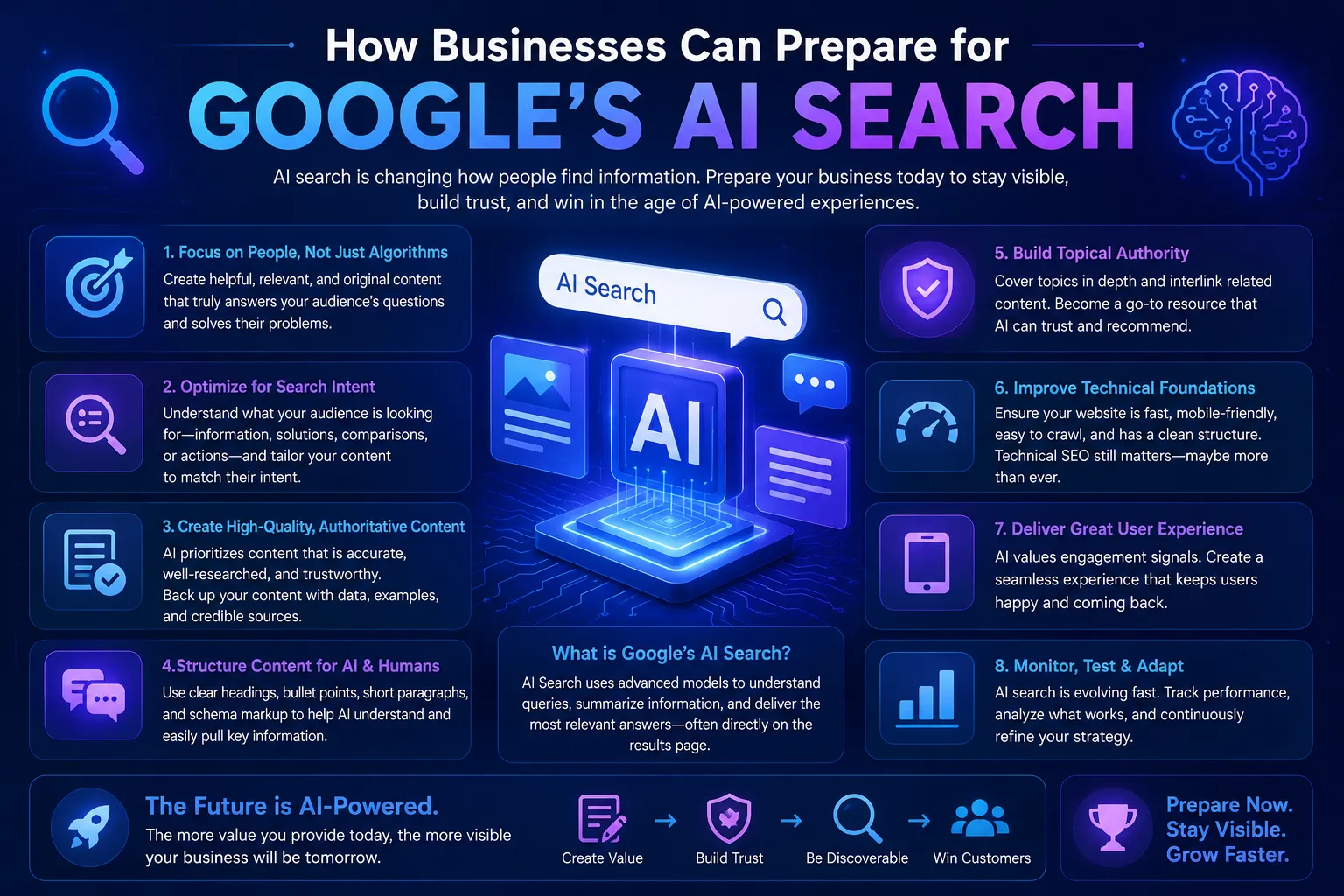

How Businesses Can Prepare for Google’s AI Search
A few years ago, getting found on Google was mostly about ranking on page one. Today, the game is changing fast. With Google’s AI Search, customers may get answers directly in search results before they even click a website. This is where modern SEO becomes important. It is no longer only about keywords and backlinks. It is about becoming the most useful, trusted, and clear answer for your audience.
Imagine a customer searching, “Which service is best for my small business website?” Earlier, they would open five links, compare pages, and then decide. Now, Google’s AI may summarise the best points from different websites and show a quick answer. If your business content is weak, unclear, or too sales-heavy, you may not even enter that conversation.
That is the brutal truth. Businesses that still write blogs only for keywords will lose visibility. Businesses that answer real customer questions will win.
What Google’s AI Search Means for Businesses
Google’s AI Search is designed to help users get faster and more useful answers. Instead of showing only a list of links, it can explain, compare, summarise, and guide users.
For businesses, this means your website must do more than “exist.” It must prove that your brand understands the customer’s problem better than others.
If your content says, “We are the best digital marketing company,” that is weak. Every business says that. But if your content explains pricing, process, results, timelines, mistakes, comparisons, and FAQs, Google has more useful information to understand and show.
Think From the Customer’s Point of View
Customers are not searching like robots. They are searching with doubts, fear, urgency, and confusion.
A customer may think the following:
“Will this service actually solve my problem?”
“How much will it cost?”
“Can I trust this company?”
“What if I choose the wrong provider?”
“Is this better than another option?”
Your website must answer these questions clearly. Do not hide important information behind fancy words. Do not write only for search engines. Write for the person who is trying to make a decision.
Good AI-ready content should feel like a helpful conversation. It should guide the customer from confusion to clarity.
Why Old SEO Is Not Enough Anymore
Old SEO focused heavily on placing keywords in titles, headings, and paragraphs. That still matters, but it is not enough.
Weak SEO looks like this:
A blog stuffed with keywords.
Generic service pages.
No real examples.
No customer problems explained.
No pricing guidance.
No proof.
No fresh updates.
Modern SEO is different. It focuses on helpfulness, trust, structure, and real value. Google’s AI needs clear information to understand your business. Customers need clear information to trust you.
If your website content is thin, copied, outdated, or confusing, AI Search will not save you. It will expose you.
What Businesses Need to Implement
To prepare for Google’s AI Search, businesses should focus on practical improvements rather than fake SEO hacks.
- Create helpful service pages: Explain what you offer, who it is for, how it works, pricing factors, benefits, timelines, and common mistakes.
- Answer real customer questions: Add FAQs based on what customers actually ask before buying.
- Use clear headings: Make every page easy to scan and understand.
- Add comparison content: Create pages like “Service A vs Service B” or “Best option for small businesses.”
- Build trust signals by adding testimonials, case studies, reviews, certifications, company details, and real project examples.
- Improve local SEO: Keep Google Business Profile updated with services, photos, reviews, location, and contact details.
- Use structured data: Add schema for FAQs, products, services, reviews, local businesses, and articles where relevant.
- Refresh old content: Update outdated blogs, pricing details, service descriptions, and statistics.
- Improve website speed and mobile experience: A slow, messy website kills trust and conversions.
- Create content for every buying stage: Write for people who are researching, comparing, and ready to buy.
Build Topic Authority, Not Random Blogs
One big mistake businesses make is publishing random blogs. One week they write about SEO, the next week about Instagram, then about logo design, then about something unrelated.
That is not a strategy. That is noise.
If your business offers website development, create a full content cluster around website planning, cost, design, maintenance, SEO, hosting, security, and conversion. This helps Google understand your expertise.
AI Search rewards depth. A single shallow blog will not make you an authority. A connected library of useful content can.
Make Your Content Easy for AI and Humans
Your content should be simple, direct, and well-organised. Avoid long, boring paragraphs. Avoid vague claims. Avoid saying “best quality service” ten times.
Instead, explain things clearly:
What is the problem?
Why does it happen?
What should the customer do?
What mistakes should they avoid?
How can your business help?
This type of content works because it helps both humans and AI understand your value.
Deep Thought
Google’s AI Search is not the end of SEO. It is the end of lazy SEO.
Businesses that depend only on keyword stuffing, copied blogs, and basic service pages will struggle. AI-powered results will favour businesses that explain themselves clearly, answer customer doubts, show proof, and build trust.
Modern SEO is about becoming the best answer, not just another result. If your website teaches, guides, and builds confidence, customers will trust you faster. And when customers trust you faster, leads become easier to convert.
FAQs
1. What is Google’s AI Search?
Google’s AI Search uses artificial intelligence to give users faster, more detailed answers directly inside search results.
2. Is SEO still important with AI search?
Yes. SEO is still important, but it must focus more on helpful content, trust, structure, and customer intent.
3. How can businesses appear in AI search results?
Businesses should create clear, useful, well-structured content that answers real customer questions and builds authority.
4. Does keyword research still matter?
Yes, but keywords should support helpful content. Stuffing keywords without value will not work.
5. What type of content works best for AI search?
FAQs, guides, comparison pages, service explanations, pricing guides, case studies, and problem-solving blogs work well.
6. Should small businesses care about AI search?
Yes. Small businesses can compete better if they create specific, local, and helpful content for their target customers.
7. Is technical SEO still needed?
Yes. Your website must be crawlable, fast, mobile-friendly, secure, and properly indexed.
8. How often should businesses update content?
Important pages should be reviewed every few months, especially service pages, pricing pages, and high-traffic blogs.
9. Can AI-written content rank on Google?
Content can perform if it is useful, accurate, original, and edited for real users. Low-quality mass content is risky.
10. What is the first step to prepare for AI search?
Start by improving your main service pages. Make them clear, detailed, helpful, and focused on customer questions.





























Sign in to leave a comment.